Wildlife Tracking Safari 10 Expert Ways to Find Animals in Dubai
Dubai is famous for its vertical architecture and man-made islands.
However, the true heartbeat of the region is found in the ancient sands.
A Wildlife Tracking Safari is not your typical high-speed dune bashing trip.
It is a slow, methodical, and deeply rewarding exploration of the desert ecosystem.
Many tourists assume the desert is a dead space, devoid of life.
This is a massive misconception that experts work hard to correct.
The Arabian desert is teeming with life, but much of it is hidden.
It is hidden beneath the sand, behind the Ghaf trees, or under the cover of night.
To see these creatures, you need more than just eyes; you need a strategy.
You need to understand the language of the dunes and the habits of the hunters.
In this massive guide, we will dive into the world of professional wildlife tracking.
We will discuss how to read tracks, identify species, and respect the fragile environment.
We recommend booking with https://htdesertsafari.com/ because their guides are naturalists.
Let us learn the secrets of the sands and the animals that call them home.
1. The Mindset of the Expert Tracker
The first rule of a Wildlife Tracking Safari is patience.
Animals in the desert have evolved to be elusive to survive the heat and predators.
An expert guide does not drive fast; they crawl through the dunes.
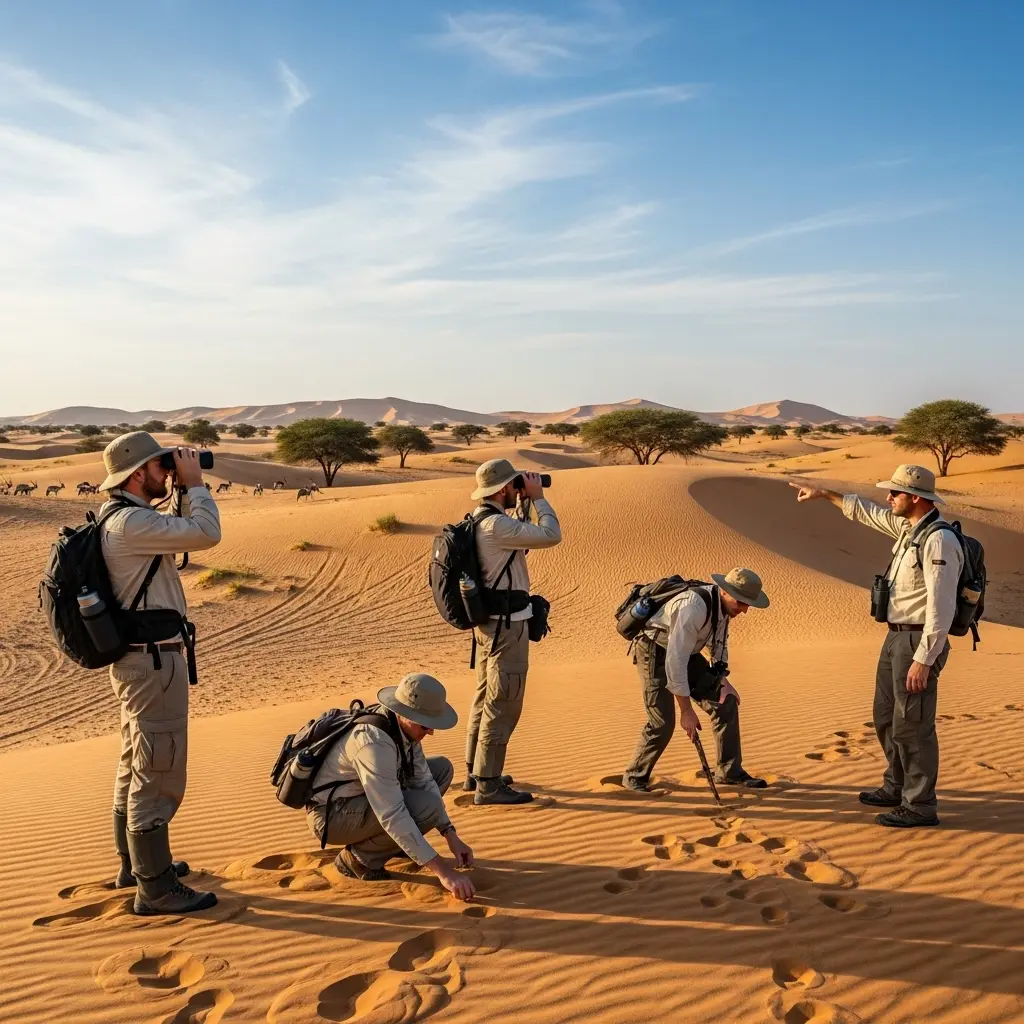
They look for “Sign”—this includes tracks, droppings, and disturbed vegetation.
Tracking is like being a detective at a crime scene.
You are looking for clues about where an animal was and where it is going.
Experts also understand the “Circadian Rhythm” of the desert.
They know that the best sightings happen at the edge of the day.
This is why sunrise and sunset are the peak hours for tracking.
By adopting a quiet and observant mindset, you increase your chances of a sighting.
You stop being a tourist and start being a participant in the wilderness.
2. Tracking the Iconic Arabian Oryx
The Arabian Oryx is the undisputed star of any Wildlife Tracking Safari.
This majestic white antelope was once extinct in the wild.
Thanks to the visionary efforts of the UAE government, they have been reintroduced.
Finding them requires looking for their distinctive hoof prints.
Their tracks are large and heart-shaped, usually found near water holes.
Experts from https://royaldesertadventures.ae/ know their grazing patterns.
The Oryx prefers the succulent grasses found in the Dubai Desert Conservation Reserve.
They often huddle under Ghaf trees during the heat of the day.
Seeing a white Oryx against the orange sand is a masterpiece of natural contrast.
It is a symbol of conservation success and national pride.
Respecting their space is vital, as they can be defensive if they feel cornered.
3. The Elusive Arabian Red Fox
One of the most difficult animals to spot on a Wildlife Tracking Safari is the fox.
The Arabian Red Fox is smaller and more slender than its European cousins.
They are master hiders and primarily nocturnal.
Tracking them involves looking for dainty, cat-like paw prints.
Their tracks are often found in a straight line, signifying a purposeful walk.
Guides often look for “dens” dug into the side of stable dunes.
If you see a hole with small bones or feathers outside, you have found a home.
Foxes are curious but shy; they will watch you from a distance.
If you are quiet enough, you might see their glowing eyes in the flashlight.
Finding a fox is a sign that your tracking skills are reaching an expert level.
The experts at https://htdesertsafari.com/ use non-intrusive red lights to spot them.
4. Reading the Sand: The Art of Spoor
In the world of the Wildlife Tracking Safari, the sand is a daily newspaper.
Every morning, the wind “resets” the dunes, leaving a clean slate.
The tracks you see at 6:00 AM are the record of the previous night.
Experts can tell the age of a track by the sharpness of its edges.
If the edges are crumbling, the track is old and the animal is far away.
If the edges are crisp and deep, the animal is likely nearby.
You will see the “Sidewinder” patterns of vipers and the straight lines of beetles.
You will see the erratic jumps of the desert hare.
Learning to differentiate between these prints is a core skill.
It turns a simple drive into an intellectual challenge.
You start to visualize the hidden world that exists beneath your tires.
5. The Role of the Ghaf Tree in Wildlife
The Ghaf tree is the “Apartment Complex” of the desert.
On an expert Wildlife Tracking Safari, the guide will always stop at these trees.
The canopy provides shade, which attracts larger mammals like the Sand Gazelle.
The branches are home to birds like the Desert Wheatear and the Hoopoe.
The roots provide stability for reptiles to dig their burrows.
If you want to find life, you must find a Ghaf tree.
Look for “Browsing Lines”—this is where the leaves are eaten up to a certain height.
This tells you that Oryx or camels have been feeding there recently.
The Ghaf tree is a biological anchor for the entire ecosystem.
Respecting these trees is essential for the survival of the wildlife.
Operators like https://dubaidesertsafarie.com/ emphasize the protection of these ancient plants.
6. Spotting the Sand Gazelle
Sand Gazelles are the embodiment of desert grace and speed.
They are smaller than the Oryx and much more skittish.
During a Wildlife Tracking Safari, you will often see them darting over ridges.
They move in small herds, usually led by a dominant male.
Their tracks are small, pointed, and often grouped together.
They have an incredible ability to go without liquid water for months.
They get all their moisture from the plants they eat.
To see them, you must approach downwind so they don’t smell you.
They are most active in the very early morning before the sun is high.
Capturing a photo of a gazelle in mid-leap is the goal of many nature photographers.
Their presence signifies a healthy and balanced desert environment.
7. The Nocturnal World: Night Tracking
The desert truly comes alive when the sun goes down.
A night-time Wildlife Tracking Safari uses technology to assist the eyes.
Guides use thermal imaging or high-powered spotlights to find movement.
This is the only time you might see the Gordon’s Wildcat.
It is a rare feline that looks like a domestic cat but is purely wild.
You will also see the jerboa, a tiny rodent that hops like a kangaroo.
The night air is cooler, allowing animals to hunt and socialise.
Tracking at night requires extreme caution to avoid disturbing the animals.
We keep the vehicle lights low and the noise to a minimum.
It is a spooky, thrilling, and beautiful way to see the dunes.
Check the specialized night tours at https://htdesertsafari.com/.
8. Identifying Reptiles and Insects
Not all wildlife is large. Much of it is small and fascinating.
On a Wildlife Tracking Safari, don’t forget to look at your feet.
The “Wonder Gecko” has large eyes and translucent skin.
The “Blue-headed Agama” lizard is a common sight on rocky outcrops.
Then there are the insects, the “Janitors” of the desert.
The Dung Beetle is a tireless worker, rolling waste into balls.
The “Pitted Tenebrionid” beetle leaves beautiful geometric tracks.
These creatures are the foundation of the food chain.
Without the insects, the lizards would starve, and the foxes would follow.
Learning about the small stuff makes the big stuff more meaningful.
It shows the complexity of the desert’s biological web.
9. Bird Watching in the Dunes
The desert sky is just as busy as the sand.
A Wildlife Tracking Safari often includes a birding component.
Dubai is on a major migratory path between Europe and Africa.
You might see the Cream-colored Courser running across the sand.
Or the majestic Lappet-faced Vulture circling high above.
The “Desert Eagle Owl” is the apex predator of the night sky.
Finding their nesting sites in the rocky ridges is a rare treat.
Bring a good pair of binoculars to see the details of their plumage.
Birds are excellent indicators of nearby water or food sources.
A guide who knows their calls can find animals that are invisible to others.
https://royaldesertadventures.ae/ provides high-quality optics for bird enthusiasts.
10. The Ethics of Wildlife Tracking
Seeing animals is a privilege, not a right.
The golden rule of a Wildlife Tracking Safari is “Do No Harm.”
Never chase an animal with a vehicle. This causes them extreme stress.
Stress leads to dehydration, which can be fatal in the desert.
Keep a respectful distance. Use a zoom lens for your photos.
Never feed the wildlife. This disrupts their natural hunting habits.
Stay on the designated tracks as much as possible to avoid crushing burrows.
If you find a nest or a den, do not linger too long.
We are visitors in their home; we must behave like polite guests.
Responsible operators like https://htdesertsafari.com/ follow strict eco-guidelines.
Ethical tracking ensures that the animals will be there for the next generation.
11. Equipment for the Amateur Tracker
If you want to get serious about your Wildlife Tracking Safari, you need gear.
Checklist:
-
Binoculars: 8×42 is the ideal size for desert light.
-
Field Guide: A book or app to identify tracks and species.
-
Camera: A long zoom (at least 300mm) is necessary for animals.
-
Water: Tracking involves walking; stay hydrated.
-
Polarized Sunglasses: These help you see into the shadows under trees.
Having the right tools makes the experience much more immersive.
It allows you to verify what you are seeing and learn as you go.
Don’t forget a small notebook to record your sightings.
Citizen science starts with curious travelers in the dunes.
12. Flora: The Silent Partners
You cannot understand the animals without understanding the plants.
Wildlife Tracking Safari guides spend a lot of time talking about botany.
The “Fire Bush” or Leptadenia pyrotechnica is a favorite of the camels.
The Sodom’s Apple has large leaves that provide shade for small lizards.
The Desert Squash provides moisture for the gazelles.
Every plant has a defense mechanism: thorns, bitter sap, or deep roots.
Learning about these plants explains why the animals live where they do.
It completes the picture of the desert as a living organism.
The greenery is the energy source that fuels the entire tracking experience.
13. Safety Protocols for Wildlife Encounters
While most desert animals are shy, some can be dangerous if provoked.
Wildlife Tracking Safari safety rules:
-
Never touch a snake or scorpion.
-
Do not approach a male Oryx during the breeding season.
-
Be careful when walking in high grass or near burrows.
-
Follow your guide’s instructions immediately.
The Arabian Cobra and the Saw-scaled Viper are present in the UAE.
They are masters of camouflage and will only strike if stepped on.
Your guide wears protective boots and knows where to walk safely.
Respect the power of nature and you will have a safe, wonderful trip.
Safety is the top priority at https://royaldesertadventures.ae/.
14. The Seasonal Shift in Wildlife Activity
The time of year changes everything on a Wildlife Tracking Safari.
Winter (November to March):
Animals are most active during the day.
The cooler weather allows them to graze for longer hours.
This is the best time for photography and long nature walks.
Summer (June to September):
Animals go into “Survival Mode.”
They are only active at night or in the very early dawn.
Tracking is mostly focused on the nocturnal life.
Choose your travel dates based on the type of animals you want to see.
Spring is the best time for baby animals and flowering plants.
The desert transition is a beautiful thing to witness.
15. The Impact of Human Noise
Animals have much better hearing than humans.
A loud conversation can ruin a Wildlife Tracking Safari from a kilometer away.
Experts communicate in whispers or hand signals.
Turning off the car engine is the first thing a good guide does.
The silence allows the animals to feel safe enough to emerge.
It also allows you to hear them.
You might hear the rustle of a tail or the snap of a twig.
Embracing the silence is a key part of the tracking experience.
It connects you to the frequency of the natural world.
Visit https://htdesertsafari.com/ to experience their “Silent Tracking” sessions.
16. Comparing Tracking Locations
| Location | Primary Wildlife | Tracking Difficulty |
| Dubai Desert Conservation Reserve | Oryx, Gazelles, Wildcat | Low (Protected) |
| Al Marmoom Reserve | Birds, Gazelles, Lizards | Medium |
| Al Lahbab (Red Dunes) | Foxes, Hares, Insects | High (Busy area) |
| Hatta Mountains | Arabian Tahr, Eagles | Very High |
Choose your location based on your patience and fitness level.
The DDCR is the most reliable spot for big mammal sightings.
Hatta is for the serious mountaineers and birders.
17. Why Local Guides are Essential
You cannot find these animals by driving a rental car into the dunes.
A local guide for a Wildlife Tracking Safari has years of “Bush Eyes.”
They can spot a gazelle’s ear sticking out of the grass from 500 meters.
They know the history of the land and the secret water holes.
They have relationships with the conservation rangers.
Their knowledge is the most valuable part of the ticket.
They turn a “sand drive” into a meaningful educational journey.
Support local expertise and the conservation economy.
Check the credentials of the guides at https://dubaidesertsafarie.com/.
18. Photography Tips for Wildlife
Capturing animals in the desert is a challenge for any photographer.
Pro Tips:
-
Use a fast shutter speed: Animals move quickly and unpredictably.
-
Focus on the eye: This creates a connection with the viewer.
-
Stay low: Getting on the animal’s level makes for a more dramatic shot.
-
Be patient: Wait for the animal to look at the camera.
The golden hour light makes the Oryx’s coat glow like silk.
Do not use a flash, as it will startle the animal and ruin the natural light.
19. Summary of Tracking Steps
-
Find the Sign: Look for tracks and droppings.
-
Determine Direction: Which way is the animal heading?
-
Check Age: How fresh are the prints?
-
Follow Quietly: Move slowly and stay downwind.
-
Observe from Afar: Use binoculars to avoid spooking the subject.
-
Record and Report: Note your sightings for conservation records.
20. Conclusion
A Wildlife Tracking Safari is a journey of discovery.
It teaches you that the desert is not a void, but a masterpiece of survival.
By following the tracks, you connect with the ancient rhythm of the UAE.
You learn to respect the Oryx, the fox, and even the smallest beetle.
Don’t just go for the adrenaline; go for the life.
The dunes have many stories to tell if you are quiet enough to hear them.
Book your expert-led tracking adventure today.
Visit https://htdesertsafari.com/.
Find the wild side of Dubai.
FAQs: Desert Safari Wildlife Tracking with Experts
1. What is the best time of day for wildlife tracking?
The “Golden Hours” of sunrise and sunset are the absolute best times for a Wildlife Tracking Safari. Most desert animals are “crepuscular,” meaning they are most active during twilight when the temperatures are cooler but there is still enough light to see. In the early morning, you can also see the freshest tracks from the night before before they are erased by the wind or daytime traffic.
2. Are we guaranteed to see an Arabian Oryx?
While nature is never 100% guaranteed, booking a safari in the Dubai Desert Conservation Reserve (DDCR) gives you a very high probability (over 90%) of seeing the Oryx. Because the area is protected and the population is managed, the guides know the specific grazing areas. However, seeing them “in the wild” requires patience and a good guide from https://htdesertsafari.com/.
3. Is it safe to be near the animals?
Yes, as long as you stay in the vehicle or at a distance recommended by your expert guide. The animals in Dubai are generally shy and will move away if they feel threatened. The Arabian Oryx can be powerful, so you should never attempt to approach one on foot. Following the safety protocols of your marshal ensures a safe and respectful experience for both you and the wildlife.
4. Can children participate in wildlife tracking?
Absolutely! In fact, kids often make the best trackers because they are closer to the ground and have great eyesight. It is a fantastic educational experience that teaches them about biology, conservation, and the environment. Most Wildlife Tracking Safari packages are family-friendly and much more educational than a standard dune bashing tour.
5. What should I wear for a tracking safari?
Wear neutral, earthy colors like beige, khaki, or olive green to blend into the landscape. Bright colors can startle animals from a distance. Wear closed-toe shoes or hiking boots, as you may step out of the vehicle to examine tracks in the sand. A hat and high-SPF sunscreen are also essential for protection during the day.
6. Do I need to bring my own binoculars?
It is highly recommended. While many premium operators like https://royaldesertadventures.ae/ provide binoculars, having your own pair allows you to scan the horizon constantly. A pair with 8x or 10x magnification is perfect for the open desert landscape.
7. How many species of animals live in the Dubai desert?
You might be surprised to learn that there are over 50 species of mammals, reptiles, and birds that call the Dubai dunes home. This includes the Arabian Oryx, three types of gazelles, the desert fox, the Gordon’s wildcat, and various eagles and falcons. A Wildlife Tracking Safari aims to show you the diversity of this often-overlooked ecosystem.
8. Is the desert fox dangerous?
No. The Arabian Red Fox and the Ruppell’s Fox are very small (about the size of a domestic cat) and extremely shy. They are not a threat to humans. They are scavengers and hunters of small rodents and insects. Seeing one is considered a highlight of any tracking trip because they are so elusive.
9. Why do we stay on the tracks?
Staying on designated tracks is a core rule of Ethical Wildlife Tracking. The “Crust” of the desert is home to many ground-nesting birds and burrowing insects. Driving off-road indiscriminately can destroy these homes and compact the soil, preventing plants from growing. We use 4×4 power to reach the area, but we use our eyes and feet to do the tracking.
10. Can I take photos of the animals?
Yes, and we encourage it! However, do not use a flash, as it can temporarily blind or scare the animals. A camera with a good “Optical Zoom” is much better than a smartphone for wildlife, as it allows you to get close-up shots without physically moving closer to the animal.
11. What is the “Sand Fish”?
The Sand Fish is actually a type of skink (lizard) that has the amazing ability to “swim” through the sand as if it were water. On a Wildlife Tracking Safari, your guide might show you the unique wavy tracks they leave behind. They are a perfect example of the specialized evolution required to survive in the dunes.
12. Are there snakes in the safari areas?
Yes, there are several species of snakes, including the Saw-scaled Viper. However, they are nocturnal and extremely shy. They spend their days buried deep in the sand or under bushes. It is very rare for a tourist to see a snake, and bites are virtually unheard of in the tourism industry because the guides know which areas to avoid.
13. Do the animals move differently in winter vs summer?
Yes. In the winter, you can see animals throughout the day. In the summer, they remain almost entirely stationary in the shade from 9:00 AM to 5:00 PM. If you visit in the summer, we highly recommend a Night Tracking Safari to see the nocturnal activity.
14. What do the animals drink if there is no rain?
Many desert animals, like the Sand Gazelle, get 100% of their water intake from the plants they eat. They are “Metabolic Water” specialists. Others visit man-made “Guzzlers” or natural oases that the conservation reserves maintain to support the population during the dry months.
15. Is wildlife tracking included in a standard safari?
Usually, no. A standard “Budget” safari focuses on the car ride and the dinner show. To see the animals, you need to book a “Nature Safari” or “Conservation Drive” specifically. These tours have higher-trained guides and go to restricted areas where wildlife is abundant. Check the options at https://htdesertsafari.com/.
16. How long does a tracking safari last?
A dedicated tracking safari usually lasts about 4 to 5 hours. This includes the drive to the reserve, the slow-speed tracking session, and stops for photography and education. It is a more leisurely pace than a standard tour.
17. What is the most common animal seen?
The Sand Gazelle is the most common mammal you will see. They are quite curious and can often be seen in small groups near the Ghaf trees. The Arabian Toad-headed Lizard is the most common reptile you will see on the dunes during the day.
18. Can I see camels in the wild?
Most camels in the UAE are owned by local farmers, even if they appear to be wandering freely. However, seeing a camel caravan moving across the dunes is a beautiful sight that reminds us of the Nomadic Desert Life. They are an essential part of the landscape’s story.
19. Does noise affect the tracking?
Yes, immensely. Animals have a “Flight Distance”—the distance at which they feel they must run away. Noise from loud music or shouting significantly increases this distance. A Wildlife Tracking Safari is a quiet experience designed to minimize our footprint on the animal’s stress levels.
20. Why book with Royal Desert Adventures for wildlife?
https://royaldesertadventures.ae/ has a long-standing partnership with local conservationists. Their guides undergo regular training in animal behavior and desert ecology. They provide a high-end, respectful, and deeply informative experience that is widely considered the best in the region for nature lovers.
Table: Wildlife Sighting Probability by Season
| Animal | Winter (Nov-Mar) | Summer (Jun-Aug) | Best Spot |
| Arabian Oryx | 95% | 70% (Dawn/Dusk) | DDCR |
| Sand Gazelle | 90% | 60% | Al Marmoom |
| Desert Fox | 30% (Night) | 40% (Night) | Deep Dunes |
| Eagle Owl | 20% (Night) | 10% (Night) | Rocky Ridges |
| Wonder Gecko | 10% | 80% (Night) | Sand Flats |
Table: Tracking “Sign” Cheat Sheet
| Sign Type | What it tells the Expert |
| Heart-shaped Hoof | Arabian Oryx is nearby. |
| Crumbling Sand Edge | The track is old (2+ hours). |
| Dainty 4-toe Print | A desert fox passed by. |
| Wavy “S” Pattern | A viper or Sand Fish is under the surface. |
| Browsed Tree Line | Gazelles are feeding in this area. |
This guide is your field manual to the dunes.
The desert is alive, and its inhabitants are waiting to be found.
Don’t just watch the sand move; watch the life within it.
Book your Wildlife Tracking Safari today with https://htdesertsafari.com/.
Become a master of the Arabian wild.