Traditional Desert Food Experience 19 Delicious Secrets of Bedouin Cuisine
Food is the universal language of travel.
It tells the story of a people.
It explains their history and their struggle.
In Dubai, the food tells a story of survival.
The desert is a harsh environment.
Yet, the Bedouin people created a rich culinary tradition.
A Traditional Desert Food Experience is more than just a meal.
It is a journey back in time.
It connects you with the traders of the Silk Road.
It connects you with the pearl divers of the coast.
Most tourists expect a generic buffet.
They expect hummus and grilled chicken.
While these are good, they are not the whole story.
Real desert food is deep and flavorful.
It uses spices like saffron, cardamom, and turmeric.
It uses techniques like slow cooking underground.
It is food meant to give energy.
It is food meant to be shared.
This guide will take you beyond the standard buffet.
We will explore the ancient dishes of the UAE.
We will learn about the etiquette of dining in a tent.
We will discover the secrets of Arabic coffee.
Get your appetite ready.
We are going on a culinary adventure.
The Roots of Bedouin Cuisine
To understand the food, you must understand the life.
Bedouins were nomads.
They moved constantly to find water.
They could not carry heavy ovens.
They could not carry perishable ingredients.
Their diet was simple but nutritious.
It relied on three main pillars.
Dates, milk, and grain.
Dates provided sugar and energy.
Camel milk provided protein and vitamins.
Grain provided carbohydrates.
Meat was a luxury.
A camel or goat was only killed for a special guest.
Or for a wedding.
This scarcity made food sacred.
Wasting food was a sin.
Sharing food was a duty.
When you book a safari with https://htdesertsafari.com/, you step into this history.
You experience the hospitality that saved lives.
You taste the flavors of resilience.
Modern safaris have expanded the menu.
But the core remains the same.
It is about generosity.
It is about community.
The Welcome: Dates and Tahini
Your Traditional Desert Food Experience starts instantly.
As you enter the camp, you are greeted.
You are offered a platter of dates.
These are not just any dates.
They are often Medjool or Khudri.
They are soft, sweet, and sticky.
Sometimes they are served with Tahini.
Tahini is sesame paste.
It is savory and nutty.
You dip the sweet date into the savory paste.
The combination is explosive.
It balances the sugar.
It adds a layer of richness.
This is the traditional energy bar of the desert.
It gives you an instant boost.
It prepares your stomach for the meal ahead.
It is a simple gesture.
But it carries deep meaning.
It says, “You are welcome here.”
It says, “We will take care of you.”
The Ritual of Arabic Coffee
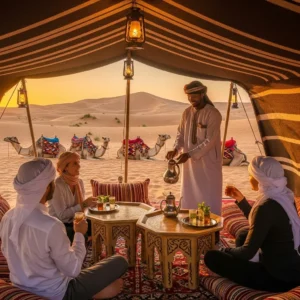
Next comes the coffee.
In the UAE, coffee is not a drink.
It is a ceremony.
It is called “Gahwa.”
It is brewed in a golden pot called a “Dallah.”
The coffee beans are lightly roasted.
They are greenish-brown, not black.
They are boiled with cardamom.
Finally, saffron is added.
This gives it a golden color.
It smells spicy and floral.
It is served in small cups called “Finjan.”
The cup has no handle.
The server holds the pot in his left hand.
He holds the cups in his right hand.
He pours a small amount.
Just a sip or two.
This keeps the coffee hot.
It also encourages interaction.
The server must refill your cup constantly.
This shows his attention to you.
You receive the cup with your right hand.
You drink it.
It is bitter and aromatic.
It pairs perfectly with the sweet dates.
If you want more, you hand the cup back.
If you are finished, you shake the cup gently.
This silent language is part of the Traditional Desert Food Experience.
It is a code of respect.
Learning it makes you an insider.
Fresh Bread: The Art of Ragag
Bread is the spoon of the desert.
You will see women baking it fresh.
They sit by a hot metal dome.
It is called a “Tawa.”
They have a bowl of wet dough.
They grab a handful.
They slap it onto the hot metal.
They spread it thin with their hand.
It cooks in seconds.
It becomes crispy and lace-like.
This is “Ragag” bread.
It is paper-thin.
You can eat it plain.
Or you can add toppings.
Cheese and honey is a favorite.
Za’atar and olive oil is another.
Or sometimes egg and cheese.
Watching the bread being made is hypnotic.
The skill required is immense.
The metal is scorching hot.
Yet the women move with grace.
They do not burn their fingers.
The smell of baking bread fills the air.
It makes you hungry.
It is the ultimate comfort food.
Eating it hot off the grill is a joy.
It connects you to the domestic life of the camp.
Harees: The Dish of Strength
If you see a pot of white porridge, do not walk away.
This is “Harees.”
It is one of the oldest dishes in the region.
It is made of wheat berries and meat.
Usually lamb or chicken.
The wheat and meat are boiled for hours.
They are boiled until they melt together.
Then, the mixture is beaten.
It is beaten with a wooden spoon called a “Midrab.”
It becomes a smooth, elastic texture.
It is topped with local ghee (clarified butter).
It looks very simple.
But the taste is complex.
It is savory, rich, and comforting.
It was the food of warriors.
It gave them slow-burning energy.
It is served at weddings.
It is served during Ramadan.
It is a dish of celebration.
In a Traditional Desert Food Experience, Harees is a star.
It represents patience.
You cannot rush Harees.
It takes time and effort.
When you eat it, appreciate the labor involved.
It is the soul food of the UAE.
Machboos: The King of Rice
Rice is the staple of the modern Bedouin diet.
“Machboos” is the national dish.
It is similar to Biryani, but distinct.
The meat (chicken, lamb, or fish) is cooked in water first.
This creates a rich broth.
Spices are added to the broth.
Dried lime (Loomi) is essential.
It adds a smoky, sour flavor.
Cinnamon, cloves, and turmeric are added.
Then, the rice is cooked in this broth.
The rice absorbs all the flavor.
The meat is then grilled or returned to the pot.
It is served on a massive platter.
It is often garnished with fried onions.
And raisins and nuts.
Machboos is aromatic and colorful.
The yellow rice smells of saffron.
The meat is tender and falls off the bone.
It is a communal dish.
Traditionally, everyone eats from one big plate.
They use their right hand to form a ball of rice.
This sharing creates a bond.
You are “breaking bread” together.
It is the centerpiece of the safari dinner.
Thareed: The Bedouin Lasagna
Another classic is “Thareed.”
Some call it the Bedouin Lasagna.
It is a stew.
It is made with big chunks of vegetables.
Potatoes, carrots, marrow, and pumpkin.
And large pieces of meat.
The magic happens at the bottom.
Layers of thin Ragag bread are placed in the bowl.
The stew is poured over the bread.
The bread soaks up the sauce.
It becomes soft and flavorful.
It is incredibly filling.
It was the Prophet Muhammad’s favorite dish.
Therefore, it holds a special place in the culture.
It is healthy and hearty.
It uses whatever vegetables are available.
It is a zero-waste dish.
The dry bread is given new life by the stew.
In a Traditional Desert Food Experience, Thareed is comfort.
It tastes like home cooking.
It is warm and satisfying on a cool desert night.
The Magic of the Underground Oven: Ouzi
If you are lucky, you will see “Ouzi.”
This is a feast dish.
It involves a whole lamb or goat.
The meat is marinated in spices.
Yogurt, saffron, and special spice mixes.
It can be cooked in an underground oven.
This oven is called a “Zarb” or “Tanoor.”
A hole is dug in the sand.
Firewood is burned until it becomes charcoal.
The meat is lowered into the hole.
It is covered with sand.
It cooks slowly for many hours.
The result is spectacular.
The meat is smoky and tender.
It falls apart at the touch.
It is served over a bed of rice.
The rice is mixed with nuts and spices.
When the Ouzi is brought out, it is an event.
It is the highlight of the buffet.
It shows the generosity of the host.
Providing a whole animal is a sign of wealth and respect.
Operators like https://royaldesertadventures.ae/ often feature Ouzi.
It is the mark of a premium safari.
Luqaimat: The Golden Dumplings
No meal is complete without dessert.
“Luqaimat” is the most famous sweet.
The name means “small bites.”
They are deep-fried dough balls.
Crunchy on the outside.
Soft and airy on the inside.
They are similar to donuts.
But the topping makes them unique.
They are drizzled with “Dibs.”
Dibs is date syrup.
It is thick and sweet like molasses.
Then they are sprinkled with sesame seeds.
The contrast is amazing.
Hot dough and sticky syrup.
Crunchy shell and soft center.
They are usually made fresh in front of you.
You can watch the cook drop the batter into the oil.
She moves with incredible speed.
Eating them fresh is a requirement.
They lose their crunch if they sit too long.
Luqaimat is addictive.
You cannot eat just one.
They are the perfect ending to a Traditional Desert Food Experience.
They pair beautifully with more Arabic coffee.
The bitter coffee cuts through the sugar.
Camel Milk and Its Products
We cannot talk about the desert without the camel.
Camel milk was the primary drink for centuries.
It is a superfood.
It is high in Vitamin C.
It is lower in fat than cow’s milk.
It is slightly salty.
Some safaris offer a tasting.
You can drink fresh camel milk.
Or you can try camel milk chocolate.
Or camel milk ice cream.
The ice cream is rich and creamy.
Saffron or pistachio flavors are popular.
Some brave foodies might try camel meat.
It is lean and red.
It tastes like a cross between beef and lamb.
It is usually served as a burger or stew.
It is not always on the standard buffet.
You might have to request it.
Or book a specific heritage safari.
Trying camel products connects you to the animal.
The animal that made life in the desert possible.
The Importance of Spices
Bedouin food is not spicy hot.
It is spiced aromatically.
The spice trade influenced the UAE heavily.
Ships brought spices from India and Persia.
You will taste cinnamon.
You will taste cloves.
You will taste black lime.
Black lime adds a unique sourness.
It is a lime that has been boiled and dried in the sun.
It turns black and hard.
It is crushed into stews.
Turmeric gives the rice its yellow color.
Rose water is used in desserts.
Saffron is the most expensive spice.
It is used lavishly in coffee and sweets.
These spices preserve the food.
They also help digestion in the heat.
A Traditional Desert Food Experience is a smell sensation.
The air smells of roasting meat and spices.
It triggers your appetite instantly.
Salads and Sides
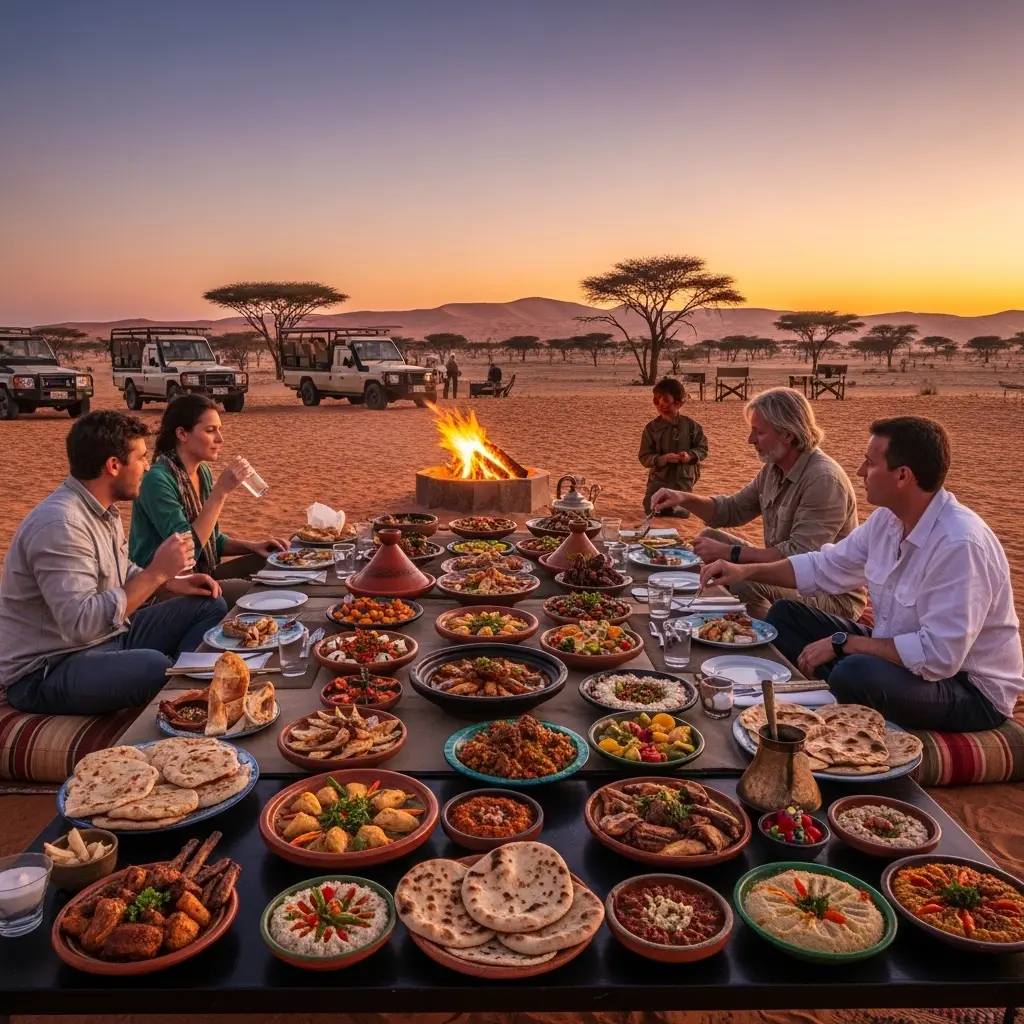
The meal is balanced with fresh items.
“Fattoush” is a popular salad.
It has lettuce, cucumber, and tomato.
It is topped with fried bread pieces.
It has a tart dressing made of sumac and pomegranate molasses.
“Tabbouleh” is a parsley salad.
It has mint, tomatoes, and bulgur wheat.
It is very refreshing.
“Hummus” is a chickpea dip.
It is creamy and rich in olive oil.
“Moutabal” is an eggplant dip.
It is smoky and savory.
These dishes are technically Levantine (from Lebanon/Syria).
But they have been adopted by the UAE.
They provide a cool contrast to the hot meat.
They are healthy and light.
They are eaten with the fresh bread.
You scoop up the dip with the bread.
No fork is needed.
This style of eating is communal and relaxed.
Beverages: Jallab and Vimto
Besides coffee, there are cold drinks.
“Jallab” is a traditional drink.
It is made from grape molasses, dates, and rose water.
It is served with ice and pine nuts.
It is sweet and cooling.
“Laban” is a yogurt drink.
It is salty and cold.
It aids digestion and hydration.
Surprisingly, “Vimto” is also traditional.
It is a British fruit cordial.
But it became a favorite in the Gulf.
Especially during Ramadan.
It is sugary and berry-flavored.
You will often find these on the safari menu.
They are refreshing after a day in the sun.
They rehydrate you quickly.
Water is always available.
But try the local drinks.
They are part of the flavor profile of the region.
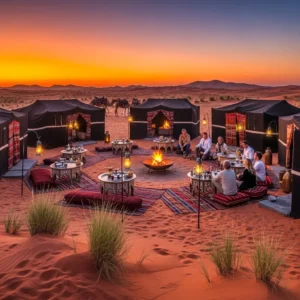
The Setting: Dining Under the Stars
The food is only half the experience.
The setting completes it.
You sit on low cushions.
These are called “Majlis” seating.
The carpets are red and patterned.
This is the traditional “Sadu” design.
You are close to the sand.
The tables are low.
You dine under the open sky.
The stars are bright in the desert.
Lanterns provide a soft glow.
This atmosphere is magical.
It relaxes you.
You are not in a rushed restaurant.
You are in nature.
The desert breeze cools the evening.
It encourages you to eat slowly.
It encourages conversation.
Dining in a Majlis is a cultural act.
It removes hierarchy.
Everyone sits at the same level.
It fosters equality and friendship.
https://dubaidesertsafarie.com/ highlights camps with the best ambiance.
Look for camps that use traditional lighting.
Avoid camps with bright neon lights.
Modern Twists on Tradition
Dubai is a modern city.
Chefs are innovating with traditional ingredients.
You might find “Chebab” pancakes with Nutella.
Or camel milk cappuccinos.
Or truffle-infused Harees.
Some luxury safaris offer a fusion menu.
They mix Bedouin recipes with fine dining techniques.
They might serve grilled prawns with saffron sauce.
Or lamb chops with pomegranate glaze.
This shows the evolution of the cuisine.
It respects the past but embraces the future.
However, for your first trip, stick to the classics.
Taste the original recipes.
Understand the baseline flavors.
Then you can appreciate the modern twists.
A Traditional Desert Food Experience should be authentic first.
Dietary Requirements
Bedouin food is very inclusive.
There are many vegetarian options.
The salads, dips, and vegetable stews are plant-based.
The bread is vegan.
The rice is often cooked with vegetable oil.
Gluten-free options are available (rice, meat).
However, Harees and Bread contain gluten.
Halal is standard.
All meat in the UAE is Halal.
It is prepared according to Islamic law.
No pork is served in traditional desert camps.
Alcohol is a separate issue.
Traditional Bedouin culture does not include alcohol.
However, tourist camps often have a bar.
It is usually separate from the dining area.
You can buy beer or wine.
But for a truly authentic experience, stick to the juices and tea.
“Karak Chai” is a strong tea with milk and spices.
It is sweet and delicious.
It is the perfect end to the meal.
Sustainability in Food
The desert teaches us not to waste.
Authentic camps practice this.
They cook what is needed.
They use local ingredients where possible.
Dates from local palms.
Fish from the local sea.
Meat from local farms.
Reducing food miles is a modern concept.
But it is an ancient practice here.
Eating local food supports the local economy.
It supports the farmers and fishermen.
It keeps the traditions alive.
When you eat Harees, you support the heritage.
You prove that these dishes are still relevant.
You vote with your fork.
Choose operators who care about this.
Ask about the food sourcing.
It adds a layer of ethics to your meal.
Booking Your Foodie Safari
How do you find the best food?
Not all safaris are the same.
Budget safaris cut corners on food.
They might serve frozen meat or generic catering.
To get a Traditional Desert Food Experience, you must pay for quality.
Look for “Heritage” or “VIP” safaris.
Look for descriptions that mention “Live Cooking Stations.”
Fresh bread making is a good sign.
Fresh Luqaimat is a good sign.
Read reviews about the food specifically.
“Was the meat tender?”
“Was the bread fresh?”
Use links like https://htdesertsafari.com/ to find trusted operators.
They have reputations to maintain.
They partner with good kitchens.
Sometimes you can book a private dinner.
This allows you to customize the menu.
You can ask for specific Emirati dishes.
It is worth the extra cost.
Bad food can ruin a good trip.
Good food makes it unforgettable.
Final Thoughts
A Traditional Desert Food Experience is a bridge.
It bridges the gap between you and the culture.
You can read about Bedouins.
You can watch videos.
But tasting their food is intimate.
It enters your body.
It becomes a memory.
The taste of cardamom coffee will remind you of the sunset.
The crunch of Luqaimat will remind you of the laughter.
The smoky Ouzi will remind you of the fire.
Don’t just eat to survive.
Eat to understand.
Ask questions about the dishes.
Talk to the chefs.
Engage with the history on your plate.
The desert is not empty.
It is full of flavor.
It is waiting for you to taste it.
So grab a piece of fresh bread.
Dip it in the hummus.
And take a bite of Dubai.
Comparison Table: Standard Buffet vs. Traditional Food Experience
| Feature | Standard Safari Buffet | Traditional Food Experience |
| Welcome | Juice box or water | Arabic Coffee (Gahwa) & Dates |
| Bread | Store-bought pita | Freshly baked Ragag/Khubz |
| Main Dish | Generic BBQ Chicken | Ouzi (Slow-cooked Lamb) |
| Rice | Plain White Rice | Machboos (Spiced Rice) |
| Star | Pasta / Fries | Harees (Wheat & Meat) |
| Dessert | Fruit Salad / Cake | Luqaimat (Fresh Dumplings) |
| Setting | Plastic Tables | Majlis (Carpets & Cushions) |
| Cooking | Catering warmed up | Live cooking stations |
| Authenticity | Low (International mix) | High (Emirati Heritage) |
20 FAQs About Traditional Desert Food Experience
1. Is the food spicy in a Traditional Desert Food Experience?
No, traditional Bedouin food is not “hot” spicy like Indian or Thai food. It is “aromatic” spicy. It uses spices like cardamom, saffron, cinnamon, turmeric, and dried lime. These add flavor and fragrance without burning your mouth. It is generally very mild and suitable for children and those with sensitive stomachs. If you want heat, hot sauce is usually available on the side.
2. Is the food suitable for vegetarians?
Yes, there are plenty of vegetarian options. The buffet typically includes hummus, moutabal (eggplant dip), tabbouleh, fattoush salad, vegetable curry or stew (Salona), plain rice, and fresh bread. While the main centerpieces are often meat, a vegetarian will not go hungry and can enjoy many traditional flavors.
3. Is the meat Halal?
Yes, absolutely. All meat served in the UAE is Halal, in accordance with Islamic dietary laws. This means it is prepared in a specific way and is free from pork. You can eat any meat dish on the safari with the assurance that it meets Halal standards.
4. Can I drink alcohol with my meal?
Traditional Bedouin culture does not include alcohol. However, most tourist desert camps have a designated bar area where alcohol is sold to non-Muslim guests. You can buy beer, wine, or spirits to enjoy with your dinner. It is usually not included in the ticket price and costs extra. Note that during religious holidays, dry days may apply where no alcohol is served.
5. What is the most famous Bedouin dessert?
The most famous dessert is undoubtedly Luqaimat. These are sweet, crunchy dumplings made of flour, sugar, and yeast, deep-fried until golden. They are drizzled with date syrup (Dibs) and sprinkled with sesame seeds. They are best eaten hot and fresh from the fryer. They are a symbol of Emirati hospitality.
6. Do I have to eat with my hands?
Traditionally, Bedouins eat with their right hand. It is a cultural experience to try this, especially with dishes like Machboos or Ouzi. However, in safari camps, cutlery (spoons, forks, knives) is always provided for tourists. You are not forced to eat with your hands, but trying it can be fun and connects you to the tradition.
7. What is Arabic Coffee made of?
Arabic Coffee, or Gahwa, is made from lightly roasted coffee beans. It is boiled with water and cardamom. Saffron is added at the end for color and aroma. Sometimes cloves or rose water are added. It is served unsweetened. It is very different from a latte or espresso; it is more like a spicy tea in consistency.
8. Why are dates served first?
Dates are rich in natural sugars and provide an instant energy boost. Historically, they were the first thing Bedouins ate to break a fast or welcome a guest after a long journey. They prepare the digestion. Serving dates is the primary sign of hospitality in the UAE.
9. Is camel meat served?
Camel meat is not always on the standard buffet, but it can be found. Some camps offer camel burgers or camel stew as a specialty item. It is considered a delicacy and is lean and healthy. If you want to try it, look for a safari package that specifically mentions camel meat or heritage cuisine.
10. What is “Harees”?
Harees is a traditional dish made of wheat berries and meat (chicken or lamb). They are cooked together for hours until the meat dissolves into the wheat. It is beaten into a porridge-like consistency and topped with ghee. It has a subtle, savory, and comforting taste. It is very nutritious.
11. Is the water safe to drink?
The water served in bottles or dispensers at the camp is perfectly safe. It is mineral water. It is recommended to drink plenty of water to stay hydrated in the desert. Avoid drinking tap water from the restroom sinks, but all serving water is safe.
12. Can I watch the food being cooked?
Yes, many high-quality camps feature “Live Cooking Stations.” You can watch women baking fresh bread (Ragag) on a hot plate. You can watch the grill master cooking kebabs. You can watch Luqaimat being fried. This visual element is part of the Traditional Desert Food Experience.
13. What if I have a food allergy?
The buffet labels usually indicate the name of the dish, but not always the allergens. If you have a severe allergy (nuts, gluten, dairy), you must inform the tour operator in advance. They can advise the kitchen. Stick to simple items like grilled meats and salads if you are unsure, and ask the chef on-site.
14. What is “Tanoor” or “Zarb” cooking?
This is an ancient method of cooking meat underground. A pit is dug, a fire is lit, and the meat is lowered in a pot or on a rack. It is covered with sand and left to slow cook for hours. The result is incredibly tender and smoky meat. Witnessing the “unearthing” of the Tanoor is a highlight of the evening.
15. Is breakfast served on morning safaris?
Yes, morning safaris often include a breakfast. It is usually lighter than the dinner. It might include Arabic bread, cheese, honey, dates, eggs, and coffee. It is a lovely way to start the day in the cool morning sand.
16. What is “Laban”?
Laban is a chilled yogurt drink. It is savory, slightly salty, and tart. It is very good for digestion and hydration in the hot climate. It is a staple drink in the region, often consumed with lunch or dinner.
17. Why is the bread so thin?
The traditional bread, Ragag, is thin because it cooks very fast on a hot plate. This conserved fuel (wood/charcoal) in the desert. It also dries quickly, meaning it could be stored for long periods without molding, which was essential for nomadic life.
18. Do I need to tip the serving staff?
Tipping is not mandatory but is highly appreciated. The staff work long hours in the heat to prepare and serve the food. If you enjoyed the service, a small tip to the waiter or the bread-maker is a kind gesture.
19. Can I take food back to my hotel?
Generally, no. For food safety reasons, taking buffet food away is discouraged. The hot climate causes food to spoil quickly. It is better to eat your fill at the camp.
20. Why should I book with a reputable company for food?
Booking with a reputable company like https://royaldesertadventures.ae/ ensures that hygiene standards are met. They use fresh ingredients and proper temperature control. Cheap tours might compromise on food quality. Your health and enjoyment depend on choosing a provider that values the culinary experience.