
School Holiday Desert Safari: The Ultimate Guide to Family Fun in Dubai
School holidays are the highlight of the year for children. They mean freedom from homework and early alarms.
For parents, however, school holidays can be a logistical challenge. You need to keep the kids entertained.
You want to create memories that last longer than a video game session. You want them to experience something new.
A School Holiday Desert Safari in Dubai is the perfect solution. It combines adventure, culture, and relaxation.
It gets the kids off their screens and into nature. The vast open space of the desert is a playground like no other.
However, traveling during school breaks means dealing with peak season crowds. It means higher prices and busier roads.
Planning a School Holiday Desert Safari requires a strategic approach. You cannot leave it to the last minute.
You need to know the best times to go. You need to know which operators handle families best.
This guide is your comprehensive manual. We will cover every detail of planning your trip.
From booking the right vehicle to packing the right snacks, we have you covered.
We will explore how to make the trip educational as well as fun.
We will discuss safety protocols for different age groups.
By the end of this post, you will be ready to book with confidence.
Let’s turn this school break into an epic Arabian adventure.
Why Choose a Desert Safari for School Holidays
The desert offers a unique escape from city life. It is a complete change of scenery.
During the school term, kids are stuck in classrooms. They are surrounded by walls and artificial light.
A School Holiday Desert Safari immerses them in the natural world. They see the horizon.
They feel the texture of the sand. They experience the silence of the dunes.
It is a sensory experience that is vital for development.
It is also an opportunity for family bonding. In the desert, there are fewer distractions.
You are stuck in a car together during the drive. This encourages conversation.
You eat together at the camp. You watch the show together.
Shared adventures create the strongest family bonds.
Screaming together on a dune bash is a memory they will talk about for years.
Furthermore, it is educational. They learn about a different culture.
They see how people lived in the harsh environment before modern technology.
It brings their geography and history lessons to life.
The Best Time of Year for School Breaks
Dubai has two main school holiday windows that are perfect for safaris.
The first is the Winter Break. This usually falls in December and January.
This is the absolute best time for a School Holiday Desert Safari. The weather is perfect.
Daytime temperatures are around 25°C. It is cool enough to play outside all day.
The evenings are chilly, which adds to the camping atmosphere.
The second window is the Spring Break. This is usually late March or early April.
The weather is getting warmer, but it is still pleasant.
The afternoons are hot, but the evenings are delightful.
Summer holidays (July and August) are very challenging. It is too hot for most outdoor activities.
If you visit in summer, you must choose evening or morning tours carefully.
We will discuss summer strategies later.
For now, focus on Winter and Spring for the optimal experience.
These are the peak seasons, so early planning is essential.
Booking Strategies for Peak Season
During school holidays, Dubai is flooded with tourists. Everyone wants to go to the desert.
If you wait until you arrive to book your School Holiday Desert Safari, you might be disappointed.
The best camps sell out weeks in advance. The best drivers are booked early.
We recommend booking at least 3 weeks before your trip.
If you are a large family needing multiple cars, book 4 weeks ahead.
This guarantees you get the slot you want. It guarantees you get a private fleet.
Look for operators who specialize in families.
Check out https://royaldesertadventures.ae/ for their holiday availability.
They often open bookings months in advance for the busy periods.
Don’t rely on finding a last-minute deal on the street.
Those deals often put you in subpar camps with poor safety standards.
Secure your booking online and get a confirmation number.
Private Vehicles vs. Shared Transport
This is the most critical decision you will make.
For a solo traveler, a shared car is fine. For a family on school break, it is a risk.
In a shared car, you are paired with strangers.
You cannot control the schedule. You cannot control the driving style.
If your child needs a bathroom break, you have to ask the whole car to wait.
A private vehicle gives you autonomy. This is vital for a School Holiday Desert Safari.
You can pick the music. You can adjust the air conditioning.
Most importantly, you control the dune bashing intensity.
If you have a timid child, you can ask for a gentle drive.
If you have thrill-seeking teens, you can ask for more excitement.
You cannot do this in a shared car.
It also keeps your family bubble intact.
You don’t have to worry about strangers’ behavior around your kids.
It costs a bit more, but for a family of 4 or 5, the price difference is small.
Morning vs. Evening Safaris for Kids
Which timing is better for your kids? It depends on their ages.
Morning safaris are great for high-energy toddlers.
They wake up early anyway. You can be in the desert by 8:00 AM.
You do the dune bashing, camel riding, and sandboarding.
Then you are back at the hotel by lunchtime for a nap.
This avoids the late-night crankiness.
However, morning safaris miss the camp dinner and shows.
Evening safaris are the full experience.
They include the sunset, the BBQ, and the entertainment.
This is better for children aged 6 and up.
They can handle staying up a bit later.
The evening atmosphere with the fire and stars is magical.
A School Holiday Desert Safari in the evening feels like a real party.
Decide based on your children’s sleep schedule.
Don’t force a late night if it means a meltdown the next day.
Educational Opportunities in the Desert
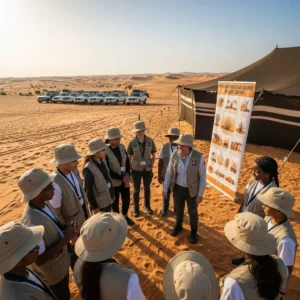
Make the trip a learning experience. Teachers love this.
Encourage your kids to ask the guide questions.
“How do camels survive without water?” “Why is the sand red?“
Learn about the Ghaf tree. It is the national tree of the UAE.
It has deep roots to find water. It is a lesson in resilience.
Visit the heritage area in the camp.
Watch the ladies making bread. Watch them weaving.
This is living history. It is better than a textbook.
Astronomy is another great topic. The desert sky is clearer than the city.
Download a star map app on your phone.
Identify the constellations. Show them the North Star.
A School Holiday Desert Safari can be a science lesson in disguise.
They will learn about ecosystems and conservation.
It adds depth to the fun.
Activities for Teenagers
Teens can be hard to please. They get bored easily.
The desert has plenty to keep them engaged.
Sandboarding is a hit with teens. It is like snowboarding.
They can compete with their siblings. They can take cool videos for social media.
Quad biking is another favorite.
Most camps allow teens to ride their own quad (age depending).
It gives them a sense of independence.
Camel trekking is also good for teens. It is a chance to slow down.
Encourage them to take photos. The lighting is perfect for Instagram.
A School Holiday Desert Safari offers “bragging rights” back at school.
They can tell their friends they rode a camel or conquered a dune.
Ensure you have a power bank. They will drain their batteries taking videos.
Activities for Toddlers and Younger Kids
Toddlers need a different approach.
Dune bashing is too rough for them.
Skip the bashing and go straight to the camp.
Or do a very gentle “Nature Drive”.
At the camp, they will love the sand. It is like a giant beach.
Bring a bucket and spade. Let them dig.
They will be fascinated by the camels.
Let them pet the camel gently.
The henna painting is popular with little girls.
Get a small flower on their hand. It dries fast.
The fire show might be a bit loud or scary.
Sit further back. Cover their ears if needed.
A School Holiday Desert Safari for toddlers is about sensory play.
Keep it simple and relaxed.
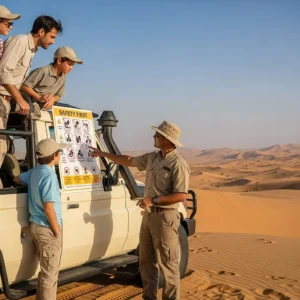
Safety First: Car Seats and Seatbelts
Safety is non-negotiable.
If you have a child under 4, you need a car seat.
Standard seatbelts are not designed for small bodies.
During dune bashing, a child can slip out of a loose belt.
Ask the operator to provide a seat.
Or better yet, bring your own. You know it fits.
For older kids, ensure they keep their seatbelts on.
They might want to move around to see better. Do not let them.
The car can dip suddenly.
A School Holiday Desert Safari must be safe to be fun.
Check the locks on the doors. Engage child locks.
This prevents accidental opening during the ride.
Explain the rules to the kids before you get in the car.
Managing Motion Sickness
Car sickness can ruin the trip instantly.
The dunes are like a boat on rough water.
If your child is prone to sickness, take precautions.
Give them medication 30 minutes before the pickup.
Avoid heavy meals before the drive.
A light snack like crackers is best.
Avoid milk or acidic juices.
Keep the car cool. Fresh air helps.
Tell the driver immediately if someone feels unwell.
They can stop on a stable surface.
Looking at the horizon helps the brain adjust.
Don’t let them play on iPads during the drive.
Reading or looking down triggers sickness.
A School Holiday Desert Safari should be vomit-free.
Be prepared with sick bags just in case.
Hydration and Sun Protection
We cannot stress this enough.
Even in winter, the desert sun is strong.
Kids play hard and forget to drink.
Dehydration leads to headaches and bad moods.
Carry water bottles for everyone.
Remind them to sip every 20 minutes.
Sunscreen is mandatory. Apply it before leaving the hotel.
Reapply it at the camp.
Hats are essential. They protect the face and neck.
Sunglasses protect young eyes from the glare.
The sand reflects the UV rays.
A School Holiday Desert Safari requires sun safety.
Dress them in light, breathable clothes.
Long sleeves are good for protection.
Food for Picky Eaters
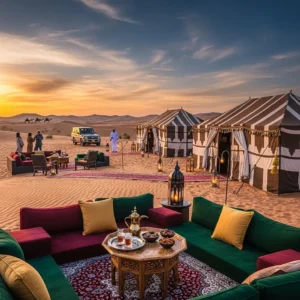
The camp dinner is a buffet. It has Arabic and international food.
There is usually grilled chicken, rice, and pasta.
There are salads and bread.
Most kids will find something they like.
However, if you have a very picky eater, plan ahead.
Bring their favorite snacks.
You are allowed to bring food for kids.
Granola bars, chips, or a sandwich.
It is better to have it and not need it.
Hungry kids are not fun kids.
The dessert station usually has specialized sweets.
The Luqaimat (donuts) are a hit with everyone.
A School Holiday Desert Safari is a chance to try new foods.
Encourage them to taste the hummus.
But have the backup plan ready.
Budgeting for a Family Safari
Family trips are expensive. Multiplied by 4 or 5 people, costs add up.
A private car is an investment, but worth it.
Look for group discounts.
If you are traveling with another family, book together.
Booking two cars is often cheaper per person than booking one.
Avoid the tourist traps at the camp.
The souvenir shops can be pricey.
Set a budget for the kids. “You can buy one item.”
The professional photos are expensive.
Take your own photos. Modern phones are great.
Quad biking is an extra cost. Decide in advance if you will do it.
Don’t promise it if it’s not in the budget.
A School Holiday Desert Safari can be affordable if you plan.
Check https://htdesertsafari.com/ for competitive family packages.
Handling the Crowds
School holidays mean people. Lots of people.
The camps will be busy. The buffet lines will be long.
To manage this, arrive early if possible.
Get a table as soon as you reach the camp.
Designate one parent to hold the table.
The other parent takes the kids to the activities.
Do the camel ride immediately. The line gets longer later.
Get the henna done early.
Eat as soon as the buffet opens.
Don’t wait until 8:00 PM. The food will be picked over.
If you hate crowds, book a VIP table.
It gives you a reserved space and waiter service.
This upgrade is a lifesaver for a School Holiday Desert Safari.
It removes the stress of fighting for seats.
What to Wear for the Safari
Comfort is key.
Kids will be running, jumping, and rolling in sand.
Do not dress them in their best clothes.
Sand gets everywhere. It stains white socks.
Wear sandals or sneakers.
Sandals are easy to empty. Sneakers protect feet better.
Bring a jacket. The desert gets cold at night.
In winter, it can be 10°C.
A shivering child is a miserable child.
Pack a change of clothes for the drive home.
They will be sweaty and sandy.
Changing into fresh pajamas makes the ride back peaceful.
They might even fall asleep.
A School Holiday Desert Safari is a messy adventure.
Dress accordingly.
Photography Tips for Parents
You want to capture these moments.
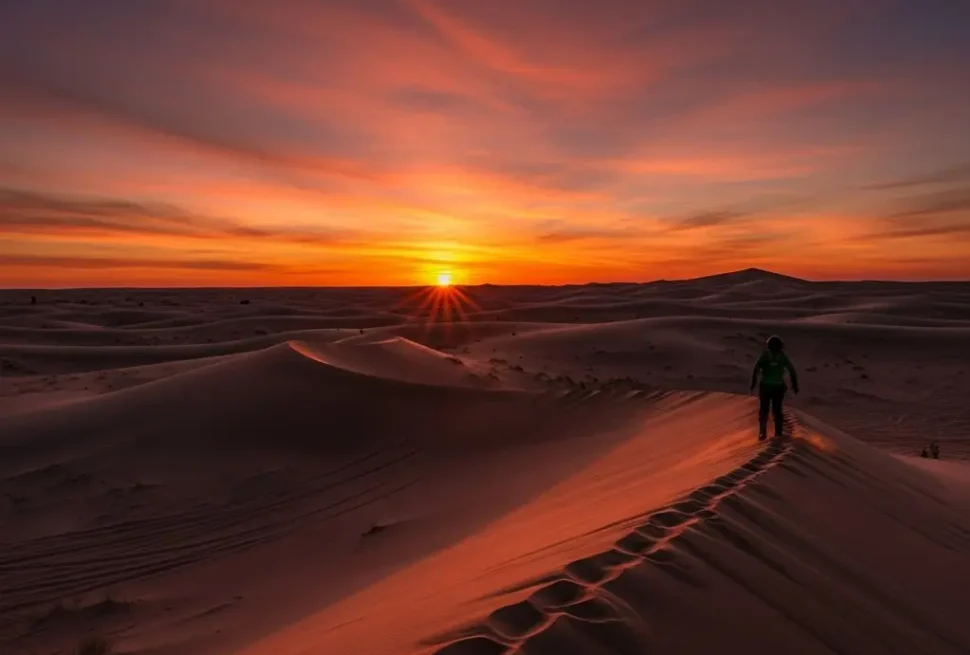
The best light is the “Golden Hour”.
This is the hour before sunset.
The sand turns a deep orange. The shadows are soft.
Take your family portraits then.
Get down low. Shoot from the ground up.
It makes the dunes look huge.
Capture candid moments.
The kids laughing on the sandboard.
The look of awe at the fire show.
Don’t spend the whole time behind the lens.
Be in the photos too. Ask the guide to take a group shot.
A School Holiday Desert Safari provides a stunning backdrop.
Use it to take your holiday card photo.
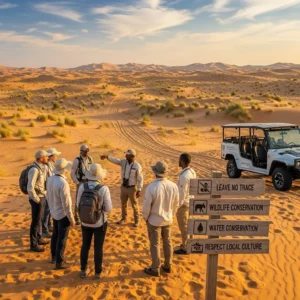
Sustainable Tourism with Kids
Teach your kids to respect the desert.
“Take only memories, leave only footprints.”
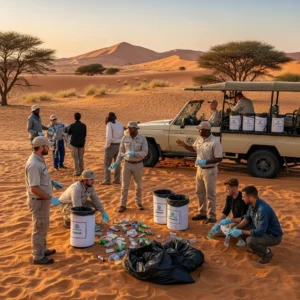
Do not leave plastic bottles on the dunes.
Do not throw trash out of the car window.
Explain that animals live here.
Plastic kills camels and gazelles.
This is an important lesson in responsibility.
Choose operators who care about the environment.
https://dubaidesertsafarie.com/ lists eco-friendly tours.
A School Holiday Desert Safari should be green.
It teaches the next generation to protect nature.
Emergency Preparedness
Hope for the best, plan for the worst.
Bring a small first aid kit.
Plasters for scrapes. Antiseptic wipes.
Painkillers for headaches.
Know the location of the nearest hospital.
Keep digital copies of passports on your phone.
Make sure your travel insurance covers the safari.
Some basic policies exclude “adventure sports”.
Check this before you fly.
Keep your phone charged.
Give the older kids a meeting point in the camp.
“If you get lost, come to this table.”
A School Holiday Desert Safari is safe if you are prepared.
Awareness prevents accidents.
Why Royal Desert Adventures is Family Friendly
We recommend Royal Desert Adventures for families.
They understand the needs of parents.
They have a fleet of clean, safe cars.
Their drivers are patient with children.
They offer flexible pickup times.
They can arrange car seats upon request.
Their camps are clean and well-managed.
They have good food options for kids.
They are reliable. You can trust them with your family.
Visit https://royaldesertadventures.ae/ to see their family reviews.
Choosing the right partner makes the trip stress-free.
Final Thoughts
The school holidays are precious.
They are the time to reconnect.
A trip to the desert offers everything you need.
Adventure, culture, food, and fun.
It breaks the routine. It challenges the kids.
It creates stories you will tell at the dinner table.
With proper planning, it is easy.
Follow these tips. Book early. Pack wisely.
Your School Holiday Desert Safari awaits.
Make this break the best one yet.
20 FAQs About School Holiday Desert Safari (Detailed Answers)
1. How far in advance should I book for school holidays?
For a School Holiday Desert Safari, booking early is crucial. During the peak winter break (December/January) and spring break (March/April), demand is incredibly high. We recommend booking at least 3 to 4 weeks in advance. This ensures you can secure a private vehicle and your preferred time slot. Last-minute bookings often result in shared vehicles with poor seating or suboptimal camp locations. By planning ahead, you also have time to communicate specific dietary or seating needs to the operator.
2. Is it better to book a private car for a family?
Yes, absolutely. A private car is the single best investment for a family safari. It gives you total control over the experience. You can adjust the dune bashing intensity to suit your children’s comfort levels. You can control the air conditioning and music. You can stop for bathroom breaks whenever needed without annoying other passengers. It keeps your family unit together and safe. In a shared car, you are at the mercy of the group’s schedule and dynamics, which can be stressful with kids.
3. What is the minimum age for a desert safari?
There is no strict legal minimum age, but most operators recommend children be at least 3 years old for the dune bashing. For children under 3, the violent motion of the car is dangerous for their neck and spine. If you have an infant or toddler, you can still enjoy a School Holiday Desert Safari, but you should opt for a “Nature Drive” or direct transfer to the camp. This avoids the rough dunes and keeps the baby safe while allowing the rest of the family to enjoy the desert.
4. What clothes should kids wear?
Comfort is the priority. Kids should wear loose, breathable clothing like t-shirts and shorts or leggings. Avoid skirts or dresses as they are not practical for sitting on sand or riding camels. In the winter months, bring a warm jacket or hoodie for everyone. The desert temperature drops significantly after sunset, and it can be quite windy. Closed-toe shoes (sneakers) are better than sandals for walking on hot sand and protecting feet from insects or rough terrain.
5. Is the food at the camp suitable for children?
Yes, the buffet dinner usually includes kid-friendly options. While the main focus is Arabic cuisine, you will typically find plain rice, grilled chicken, pasta or noodles, and french fries. There is also bread and fruit. If your child is a very picky eater, you are allowed to bring your own snacks or a packed meal for them. It is always a good idea to have backup snacks like granola bars or crackers in your bag just in case they refuse the buffet options.
6. Can we skip the dune bashing if my child is scared?
Yes, you can. If you have booked a private vehicle, you can simply tell your driver to skip the bashing or take the “flat route.” They will drive gently through the valleys to the camp. This is a common request for families with sensitive children. If you are in a shared car, you generally have to follow the group’s itinerary, which is another reason why private cars are recommended for a School Holiday Desert Safari. You should never force a terrified child to endure the bashing.
7. Are car seats provided for toddlers?
Car seats are not automatically provided in every car. You must request them at the time of booking. Reputable operators will have a limited supply of seats available. However, for the best fit and safety, it is highly recommended to bring your own car seat. You know how to install it, and you know it fits your child correctly. The drivers are happy to help you install it in the Land Cruiser. Safety regulations require small children to be restrained.
8. What happens if a child gets motion sickness?
Motion sickness is a real risk. If your child feels unwell, alert the driver immediately. They will stop the car on a flat surface to let the child get fresh air. This usually helps quickly. To prevent it, give your child a light meal before the trip (no heavy or greasy food) and consider non-drowsy motion sickness medication if they are prone to it. Sitting in the front seat or by a window can also help. Keep a sick bag handy just in case.
9. Is there a bathroom on the way to the desert?
The drive from the city to the desert takes about 45 minutes to an hour. There are usually no bathrooms on the highway itself. However, drivers typically stop at a meeting point or “deflation point” just before entering the dunes. These areas usually have basic toilet facilities and shops. Make sure every child uses the bathroom at this stop, as there are no toilets inside the dunes until you reach the camp about an hour later.
10. How do we handle the crowds at the camp?
School holidays mean crowded camps. To manage this, arrive as early as possible to claim a good table. Decide on a meeting point in case anyone gets separated. If the buffet lines are long, split up—one parent waits in line while the other stays with the kids at the table. To completely avoid the hassle, consider upgrading to a VIP table. This gives you reserved seating and waiter service, allowing you to bypass the crowds and queues entirely.
11. Can teens ride quad bikes alone?
Most operators allow teenagers to ride quad bikes, but age restrictions vary. usually, kids above 14 or 16 can ride alone, while younger teens might need to ride a smaller bike or be accompanied by an adult. Always check the specific rules of the camp. Safety helmets are mandatory. Ensure your teen wears closed shoes and follows the guide’s instructions. Reckless driving will get them removed from the bike. It is a thrilling addition to a School Holiday Desert Safari.
12. Is the fire show too scary for young kids?
The fire show is visually spectacular but can be intense. The performers often breathe fire and spin flaming objects. The music is loud and dramatic. For some young children, this can be frightening. If you think your child might be scared, sit further back from the stage. You can also explain to them beforehand that it is just a trick and they are safe. Most kids find it fascinating, but you know your child best.
13. What if we want to leave early?
If you are in a shared vehicle, you generally have to wait until the end of the program (around 9:00 PM or 9:30 PM). If you have a private vehicle, you have the flexibility to leave whenever you want. If the kids are tired and cranky by 8:00 PM, you can ask your driver to take you back to the hotel immediately. This exit strategy is invaluable for parents of young children and makes the private car worth the extra cost.
14. Are there medical facilities in the desert?
There are no hospitals in the desert itself. However, safari guides are trained in basic first aid. They carry first aid kits for minor injuries. In case of a serious emergency, they have direct communication with police and ambulance services, which can reach the desert access points. It takes about 45-60 minutes to reach a major hospital in the city. Always carry any specific medication your child needs (like asthma inhalers or EpiPens) with you.
15. Can we bring a stroller?
You can bring a stroller, but it will be of limited use in the deep sand. It is useful for the hard ground at the meeting point or if the camp has paved pathways (which some do). However, once you are on the soft sand, the wheels will get stuck. A baby carrier or sling is a much more practical option for moving around the dunes and the camp. You can store the stroller in the trunk of the car during the drive.
16. Do the camps have high chairs?
Most standard desert camps do not have high chairs. The seating is traditionally on low cushions on the floor or on standard chairs. You will likely have to hold your baby on your lap while eating or let them sit on the cushion. If you have a portable booster seat that straps onto a chair, bring it along. It will make feeding time much easier. VIP areas usually have standard tables and chairs which are easier to manage than floor seating.
17. Is it safe to do sandboarding with kids?
Yes, sandboarding is safe and fun. The sand is soft, so falling doesn’t hurt. For young kids, they can sit on the board like a sled rather than standing up. This is much easier and safer. Ensure they are not in the path of other boarders. An adult should supervise at the top and bottom of the dune. Avoid the very steep dunes for beginners. It is a highlight of a School Holiday Desert Safari for active kids.
18. What is the best way to book a group of two families?
If you are traveling with another family, contact the operator directly to book. Ask for two vehicles that travel in the same convoy. This ensures you stick together during the drive and the stops. You can also request to be seated together at the camp. Booking together often gives you leverage to ask for a group discount. Using a reliable agent like https://dubaidesertsafarie.com/ helps coordinate these multi-family logistics smoothly.
19. Can we do a morning safari in the summer?
Yes, in the summer months (June-August), a morning safari is the only viable outdoor option for kids. You must start very early, around 7:00 AM or 8:00 AM, to finish before the midday heat becomes dangerous. The sand gets extremely hot by 11:00 AM. A morning tour allows you to enjoy the dunes and camels before retreating to the AC. It is a shorter trip but safer for children during the extreme heat of summer school holidays.
20. Why do you recommend Royal Desert Adventures?
We recommend https://royaldesertadventures.ae/ because they are a licensed, family-oriented operator. They own their own fleet of well-maintained vehicles, which minimizes the risk of breakdown. Their drivers are trained to handle families and drive safely. They offer transparent pricing with no hidden costs. Their customer service is responsive, allowing you to plan the details of your School Holiday Desert Safari with confidence. They prioritize safety and comfort, which is what every parent needs.