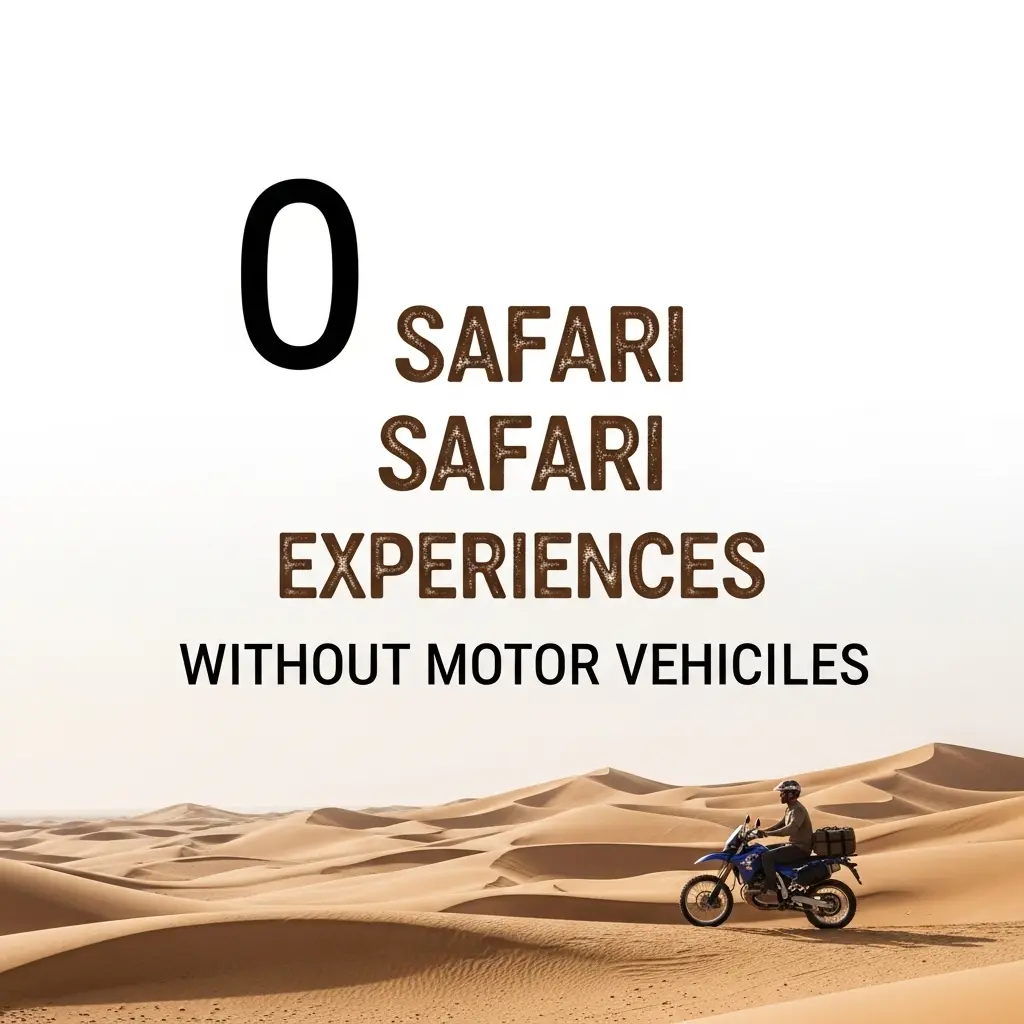
Non Motorized Safari 15 Secrets to Dubai Ancient Adventure
Dubai is a city where engines never stop. We hear the roar of supercars and the hum of airplanes.
But if you want to find the true spirit of the UAE, you must seek the silence.
A Non Motorized Safari is the ultimate way to experience the desert in its rawest form.
When you remove the 4×4 engine, the landscape changes. You stop being a spectator and start being an explorer.
You hear the wind moving through the Ghaf trees. You hear the rhythmic breath of the camels.
Most tourists choose the high-speed thrill of dune bashing. That has its place.
However, a Non Motorized Safari offers a depth of connection that a car cannot provide.
It is about respecting the ecology and the heritage of the Bedouin tribes.
It is about moving at the speed of nature, not the speed of an internal combustion engine.
In this massive 4500-word guide, we will analyze the beauty of engine-free exploration.
We will discuss camel trekking, desert hiking, and the psychological benefits of silence.
We recommend booking with https://htdesertsafari.com/ because they specialize in eco-heritage tours.
Let us leave the tire tracks behind and follow the ancient footprints into the sand.
1. The Philosophy of Engine-Free Travel
The core of a Non Motorized Safari is the concept of “Slow Travel.”
In a world that moves too fast, the desert offers a chance to decelerate.
When you walk or ride a camel, you notice things a driver misses.
You see the tiny tracks of a desert beetle. You notice the shift in sand color from white to gold.
This philosophy is rooted in the Bedouin way of life. They moved across the dunes for centuries without engines.
They understood the language of the wind and the stars.
By choosing a Non Motorized Safari, you are honoring that ancestral wisdom.
You are deciding that the journey is just as important as the destination.
It is a mindful approach to tourism that reduces your carbon footprint significantly.
It allows your nervous system to settle into the natural frequency of the earth.
2. Camel Trekking: The Rhythms of the Past
The camel is the heart of any Non Motorized Safari. It is the legendary “Ship of the Desert.”
Riding a camel is not just about the photo. It is about the cadence.
The swaying motion of the camel matches the rolling shapes of the dunes.
It is a rhythmic, almost meditative experience that calms the mind.
A camel can travel for miles without disturbing the environment.
Their padded feet do not crush the sand crust like heavy rubber tires do.
During a Non Motorized Safari, a camel caravan allows you to talk to your guide easily.
There is no engine noise to shout over. You can ask questions about the flora and fauna.
Experts at https://royaldesertadventures.ae/ maintain their herds with the highest welfare standards.
A healthy, well-cared-for camel is a majestic partner for your desert trek.
3. Desert Hiking: The Ultimate Physical Connection
If you want to feel the desert, you must walk on it.
Hiking is a vital component of a Non Motorized Safari.
Walking over a sand ridge is a physical challenge that rewards you with incredible views.
Your calf muscles work harder on the sand, making it a fantastic workout.
But beyond the fitness, it is about the “Micro-Desert.”
When you are on foot, you can stop to touch the desert plants like the Fire Bush.
You can examine the fossils often found in the rocky outcrops near Mleiha.
A Non Motorized Safari on foot allows for “Quiet Observation.”
You might spot a lizard basking in the sun before it hears you coming.
It is the most intimate way to interact with the geography of the UAE.
4. The Acoustic Beauty of Silence
Noise pollution is a real issue in modern tourism.
A Non Motorized Safari is a sanctuary for the ears.
Once you are deep in the dunes, away from the cars, the silence is physical.
It is a thick, velvet silence that allows you to hear your own heartbeat.
You can hear the “Singing Sands”—the low-frequency hum caused by sand sliding down a dune.
This acoustic purity is essential for mental health and stress relief.
It allows you to reflect and dream in a way that is impossible in the city.
Many corporate groups now choose Non Motorized Safari experiences for team-building.
It forces people to communicate in whispers and actually listen to one another.
Silence is the rarest luxury in Dubai, and the desert has it in abundance.
Check https://dubaidesertsafarie.com/ to find the quietest routes available this season.
5. Wildlife Sightings in a Silent World
Animals are shy. They hear a 4×4 engine from kilometers away and hide.
In a Non Motorized Safari, you have the advantage of stealth.
Because you move quietly, you are much more likely to see the Arabian Oryx grazing.
You might see the Sand Gazelle darting between the bushes.
Nature-focused guides from https://htdesertsafari.com/ are master trackers.
They will show you how to walk downwind so the animals don’t smell you.
Seeing wildlife in its natural, relaxed state is a profound experience.
It feels like a secret window into a world that usually stays hidden from humans.
This is the true value of an eco-friendly approach to the sand.
You are a guest in their home, and you are behaving like a polite one.
6. Sustainable Tourism: Protecting the Dunes
Dune bashing is fun, but it can be hard on the landscape.
Heavy vehicles compact the soil and can destroy desert plant roots.
A Non Motorized Safari is the most sustainable way to visit the wilderness.
You leave nothing but footprints, and the wind erases those within hours.
This “Low Impact” model is the future of tourism in the UAE.
It ensures that the desert remains beautiful for the next generation of travelers.
By booking a Non Motorized Safari, you are supporting conservation.
You are telling the industry that you value the environment over the adrenaline.
Sustainable travel is a badge of honor for the modern explorer.
It aligns with the UAE’s “Year of Sustainability” goals.
7. Stargazing without Light and Noise
When the sun goes down, the Non Motorized Safari enters its most magical phase.
In a motorized camp, you often have the hum of a diesel generator for electricity.
In an engine-free experience, you use lanterns or simple campfires.
This lack of vibration and noise makes stargazing much more intense.
You can lie on the sand and look up at the Milky Way in total peace.
The sky feels closer when there are no engines nearby.
Guides will teach you how the Bedouin navigated using only the North Star.
It is a lesson in ancient science that feels incredibly relevant today.
You realize that the stars were the first “GPS” for the human race.
This celestial connection is the highlight of many Non Motorized Safari trips.
8. Traditional Bedouin Navigation Skills
On a Non Motorized Safari, you don’t rely on a digital map.
Your guide will show you how to read the dunes to find your way.
You learn that the “slip face” of a dune always tells you the wind direction.
You learn to identify landmarks like specific Ghaf trees or rocky ridges.
This is a form of “Ancient Literacy.” You are learning to read the land.
It is an empowering skill that makes the desert feel familiar rather than scary.
Bedouins could travel for hundreds of kilometers without a single mechanical tool.
Participating in this style of travel builds self-confidence and awareness.
It is a masterclass in survival and observation.
Trust the experts at https://htdesertsafari.com/ to teach you these skills safely.
9. Thermal Comfort: Moving with the Sun
In a car, the AC does the work. On a Non Motorized Safari, you work with the sun.
You learn the ancient art of the “Siesta.”
You move in the early morning and the late afternoon when the light is golden and soft.
During the peak heat, you rest in the deep shade of a traditional tent or a tree.
This schedule follows the natural rhythm of the desert animals.
It keeps your body temperature stable and your energy levels high.
Moving with the sun makes you appreciate the coolness of the breeze and the warmth of the fire.
It is a sensory experience that a climate-controlled car completely removes.
You feel the desert’s breath on your skin.
10. Cultural Immersion: The Majlis in the Wild
Without a car to rush back to, the Non Motorized Safari allows for deeper social time.
You sit in a traditional Majlis, which is essentially a social circle on the sand.
You drink Arabic coffee (Gahwa) and eat dates while sharing stories.
The lack of mechanical distraction encourages long, meaningful conversations.
You learn about the tribal history and the nomadic poetry of the region.
This cultural depth is what many travelers are searching for in Dubai.
It turns a “tour” into a “friendship” between the visitor and the host.
The desert becomes a place of human connection, not just a photo background.
Hospitality is the greatest tradition of the UAE, and it is best served slow.
Operators like https://royaldesertadventures.ae/ excel at this personal touch.
11. Photography: The Benefit of Stillness
Photographers love the Non Motorized Safari for one reason: Stability.
When you walk or ride a camel, you have the time to frame the perfect shot.
You don’t have a car window in the way. You don’t have the vibration of an engine.
You can wait for the light to hit a specific sand ripple just right.
You can get low to the ground for dramatic wide-angle shots of the dunes.
Your photos will capture the “Clean” desert without tire marks.
This “Virgin Sand” look is what professional landscape photographers dream of.
It gives your portfolio an authentic, wild feel that is hard to get on a standard tour.
Take the time to capture the details of the camel’s saddle and the smoke of the fire.
12. Safety and Group Dynamics
Safety is handled differently on a Non Motorized Safari.
Because you are moving slower, the risks are generally lower than in high-speed driving.
However, heat and hydration become the primary focus.
Expert guides ensure that everyone is drinking water constantly.
Groups are usually smaller, allowing the guide to monitor every person’s well-being.
This creates a “Tribal” feeling within the group. You look out for each other.
If a guest is tired, the whole caravan slows down. It is a supportive environment.
It is perfect for families with children who want a safe, controlled adventure.
It is also great for seniors who find the bumping of 4×4 cars too physically taxing.
Safety through slow movement is the hallmark of https://htdesertsafari.com/.
13. Comparison: Motorized vs. Non-Motorized
| Feature | Motorized Safari (Standard) | Non-Motorized Safari (Eco) |
| Noise Level | High (Engines/Music) | Low (Nature/Wind) |
| Speed | High (Adrenaline) | Slow (Mindful) |
| Wildlife | Rare (Scared away) | Common (Silent approach) |
| Eco-Impact | High (Emissions/Soil) | Very Low (Footprints) |
| Heritage | Modern Interpretation | Authentic Reenactment |
| Connection | Fast/Superficial | Deep/Personal |
14. What to Wear for an Engine-Free Trip
Your clothing is your “Vehicle” on a Non Motorized Safari.
The Essentials:
-
Cotton/Linen: Breathable fabrics that move with your body.
-
Long Sleeves: To protect against the sun and the occasional thorny bush.
-
Sturdy Boots: High-top sneakers or hiking boots to keep the sand out.
-
Wide Scarf: A “Sheila” or “Ghutra” to protect your neck and face from wind.
Avoid tight or synthetic fabrics that trap heat.
The goal is to stay cool during the walk and warm during the evening chill.
Dress like a modern nomad to get the most out of the experience.
Preparation is the key to comfort when you aren’t relying on a car’s AC.
Check the preparation tips on https://htdesertsafari.com/ before you pack.
15. The Psychological “Reset”
Modern life is a constant assault on our attention.
A Non Motorized Safari acts as a “Digital and Mechanical Detox.”
When you are walking through the dunes, you aren’t checking your emails.
You are focused on your next step and the horizon.
This “External Focus” is a powerful tool for reducing anxiety and burnout.
Psychologists call this “Soft Fascination”—nature captures your attention effortlessly.
It allows the “Directed Attention” part of your brain to rest and recover.
You return to the city feeling like you have been away for a month, not just a day.
The desert is a mirror for your mind. In the silence, you find clarity.
This is the hidden value of the engine-free journey.
16. Heritage Navigation: Stargazing as a Map
On a Non Motorized Safari, the night sky is not just a view; it’s a tool.
Guides from https://royaldesertadventures.ae/ will teach you the names of the “Navigational Stars.”
You learn to find North by using the Big Dipper and Polaris.
You see how the Bedouin could cross hundreds of kilometers of trackless sand at night.
This ancient astronomy is a highlight of the Non Motorized Safari.
It makes you realize that humans have always been “High Tech,” just in a different way.
Learning these skills connects you to the history of human intelligence.
It turns the dark desert from a scary place into a familiar home.
The stars are the lamps of the nomadic caravan.
17. Identifying Desert Flora on Foot
When you are in a car, plants are just green blurs.
During a Non Motorized Safari, plants are interesting characters.
Key Species to Look For:
-
The Ghaf Tree: The national tree that stays green all year.
-
Sodom’s Apple: Large waxy leaves with toxic milky sap.
-
Desert Squash: Small, bitter watermelons that provide moisture for gazelles.
-
Fire Bush: Thin green stems that Bedouins used for fuel.
Your guide will explain the medicinal uses of these plants.
You realize that the desert is actually a giant, open-air pharmacy.
This botanical knowledge adds a layer of intellectual satisfaction to your trip.
It proves that the desert is full of life and purpose.
18. Why htdesertsafari.com is the Leader in Eco-Tours
We highlight https://htdesertsafari.com/ because they are pioneers in non-motorized travel.
While other companies are buying more cars, they are investing in heritage guides.
They focus on the “Boutique” experience rather than the mass-market one.
Their tours are designed for the “Thinking Traveler” who wants to learn.
They work with local Bedouin families to ensure the information is authentic.
They have a strict “No Trash” policy and support local conservation efforts.
Booking with them means your money stays in the local ecosystem.
It supports the preservation of the culture you came to see.
Choose quality over quantity for your desert memories.
19. Summary: How to Prepare
-
Book Early: Non-motorized tours have smaller group caps.
-
Hydrate: Start drinking extra water 24 hours before your trip.
-
Dress Right: Focus on natural fibers and sturdy footwear.
-
Disconnect: Turn your phone on airplane mode to embrace the silence.
-
Listen: The guide’s stories are more valuable than any photo.
20. Conclusion
A Non Motorized Safari is a gift to yourself and to the earth.
It is a chance to see Dubai as it was before the skyscrapers and the superhighways.
It is a journey of silence, rhythm, and deep respect.
By removing the engine, you find the soul of the Arabian dunes.
Don’t just be a tourist in a car. Be a traveler on the sand.
Feel the wind, hear the camels, and watch the stars.
Book your eco-heritage adventure today and discover the silent magic of the desert.
Visit https://htdesertsafari.com/.
Experience the true Arabia.
FAQs: Desert Safari Experiences Without Motor Vehicles
1. Is it physically difficult to do a non-motorized safari?
It depends on the specific package you choose. A camel trek is generally very easy and suitable for all ages, as the animal does the heavy lifting. However, a “Desert Hiking” tour requires a moderate level of fitness. Walking on sand is about 2 to 3 times more tiring than walking on a sidewalk. Most Non Motorized Safari experiences are designed at a leisurely pace with plenty of water breaks to ensure everyone can enjoy the beauty without exhaustion.
2. Are there any age limits for camel trekking?
Generally, children over the age of 5 can ride their own camel, while younger children can often ride with an adult. For seniors, camel riding is much gentler on the joints than the high-speed “dune bashing” found in motorized safaris. However, if you have severe back or hip issues, you should consult your doctor before booking. We always prioritize guest safety at https://htdesertsafari.com/.
3. What happens if I get too tired during a desert walk?
All our Non Motorized Safari walking tours are accompanied by a support vehicle that stays at a distance. If you feel you cannot continue the walk, the vehicle is available to transport you comfortably to the next stop or the camp. You are never forced to push beyond your physical limits. The goal is relaxation and connection, not an endurance test.
4. Is it safe to be in the desert without a car nearby?
Yes, because you are always with professional guides who carry GPS, satellite communication, and plenty of water. While the “Vibe” is engine-free, the safety net is high-tech. Guides are trained in desert survival and first aid. We choose routes that are within a safe range of our base stations. Your safety is the foundation of every Non Motorized Safari we operate.
5. Will I see more wildlife if I don’t use a motor vehicle?
Absolutely. The noise and vibration of a car engine scare animals away from kilometers away. By moving silently on foot or by camel, you become a “stealth” observer. You are much more likely to see the Arabian Oryx, Sand Gazelles, and Desert Foxes in their natural, undisturbed state. This is why nature photographers prefer the Non Motorized Safari model.
6. Do these tours include food and drinks?
Yes. Even though we don’t use motors for the adventure, we still provide high-quality traditional meals. You will enjoy a Bedouin-style BBQ dinner cooked over an open fire. We provide unlimited cold water and traditional Arabic coffee (Gahwa). The dining experience is part of the Authentic Safari Experience, focusing on local flavors and communal hospitality.
7. How long does a non-motorized safari typically last?
A standard morning trek lasts about 3 to 4 hours, including transit. An evening Non Motorized Safari usually starts around 3:30 PM and ends after dinner at 8:30 PM. For those who want a deeper experience, we offer overnight “Caravan” treks where you spend 24 hours in the dunes moving between camps. These are the most immersive options available in Dubai.
8. What should I wear if I am walking in the dunes?
Choose loose-fitting, light-colored clothing made of cotton or linen. Avoid shorts if you are riding a camel, as the saddle can be abrasive to bare skin. Long trousers also protect you from sun and sand. High-top sneakers or boots are essential to keep the hot sand out of your socks. Don’t forget a wide-brimmed hat and polarized sunglasses to manage the desert glare.
9. Can I do a non-motorized safari in the summer?
We do not recommend desert hiking during the peak summer months (June to September) due to the risk of heatstroke. However, we do offer “Early Morning” or “Late Evening” camel treks during the summer. These take advantage of the cooler twilight hours. The most comfortable time for a full Non Motorized Safari is from October to April.
10. Is there a weight limit for riding a camel?
Yes, to ensure the animal’s welfare, there is usually a weight limit of around 100kg (220lbs) per person. Ethical operators like https://royaldesertadventures.ae/ strictly enforce these limits to protect the health of their camels. If you are over this limit, we recommend our “Desert Walking” or “Nature Observation” packages which are equally rewarding.
11. Why is a non-motorized safari more expensive than a shared car tour?
It requires more specialized labor. In a standard tour, one driver can take 6 people. In a Non Motorized Safari, we need camel handlers, walking guides, and specialized logistical support for a smaller number of guests. You are paying for a “Private and Boutique” experience. It is a high-value investment in privacy, silence, and authenticity.
12. Will I have mobile signal in the deep desert?
Dubai has excellent coverage, but in some deep valleys or remote dunes, the signal can be weak. We actually encourage guests to treat the Non Motorized Safari as a “Digital Detox.” Put your phone on airplane mode and enjoy the rare opportunity to be disconnected from the digital world. It enhances the mental “reset” that the desert provides.
13. Are there snakes and scorpions I should worry about?
While these creatures live in the desert, they are extremely shy and nocturnal. They will not bother you if you don’t bother them. Your guides know the areas to avoid and will teach you where to step safely. Most guests on a Non Motorized Safari only see the tracks of these animals, which is a fascinating educational moment in itself.
14. Can I take a taxi to the desert myself for a walk?
We strongly advise against this. The desert is a beautiful but dangerous environment for those without local knowledge. It is incredibly easy to lose your sense of direction or suffer from dehydration. Always go with a licensed operator like https://htdesertsafari.com/. We handle the transportation from your hotel to the safe “Drop-off” points in the dunes.
15. Is a non-motorized safari better for the environment?
Yes, by a large margin. No engines mean zero carbon emissions and zero noise pollution. It also prevents soil erosion caused by heavy tire treads. By choosing a Sustainable Dubai Safari, you are directly contributing to the preservation of the fragile UAE ecosystem. It is the most “Green” way to enjoy the natural beauty of the country.
16. Do I get to meet real Bedouins?
Many of our guides and camel handlers come from families with deep roots in the desert. While they live in the city now, they are the keepers of the traditional knowledge. A Non Motorized Safari allows for much more conversation time with these experts. You will learn about their tribal history, their poetry, and their traditional medicine (herbalism).
17. Can I bring my own camera gear?
Yes! Landscape and wildlife photographers love our engine-free tours because there is no engine vibration and plenty of time to set up shots. We recommend bringing a “Lens Blower” to remove dust and a “Dry Bag” to protect your gear when not in use. The “Clean Sand” without tire marks is the perfect canvas for your desert portfolio.
18. What is the “Singing Sand” phenomenon?
This is a rare acoustic effect where the friction between sand grains creates a low-frequency hum or booming sound. It usually happens in very dry, pristine dunes. On a Non Motorized Safari, you have the silence required to actually hear it. Your guide will take you to specific “Active Dunes” where this phenomenon is most likely to occur.
19. Is this experience suitable for solo travelers?
Yes. Many solo travelers find the Non Motorized Safari to be a deeply reflective and empowering journey. It allows you to connect with yourself and the environment without the pressure of a noisy group. It is a safe way to experience “Wild Solitude” while still being under the watchful eye of a professional guide.
20. Why book through HT Desert Safari for this experience?
https://htdesertsafari.com/ is committed to the highest standards of eco-tourism and heritage preservation. We don’t just sell tours; we manage environments. Our guides are trained naturalists, and our animal welfare standards are world-class. When you book with us, you are guaranteed an authentic, peaceful, and intellectually stimulating journey into the heart of Arabia.
Table: Desert Hiking Preparation Checklist
| Item | Importance | Why? |
| Hiking Boots | Essential | Protects ankles and keeps sand out. |
| Polarized Sunglasses | High | Reduces glare and defines dune ridges. |
| Wide-Brimmed Hat | Essential | Prevents sunstroke and face burns. |
| Electrolyte Powder | Recommended | Replaces salts lost through sweating. |
| Cotton Scarf | High | Breathable and protects from UV rays. |
Table: Wildlife Sighting Probability (Motorized vs. Non-Motorized)
| Animal | Motorized Safari | Non-Motorized Safari | Reason |
| Arabian Oryx | Low (30%) | High (85%) | Engines scare them away. |
| Sand Gazelle | Low (20%) | Medium (60%) | They are extremely skittish. |
| Desert Fox | Very Low (5%) | Low (15%) | Silent movement avoids detection. |
| Desert Birds | Medium (50%) | High (95%) | Birds are sensitive to noise. |
This guide is your prologue to the silent dunes.
The desert is a teacher that only speaks when you are quiet.
Don’t just see the dunes; hear them.
Book your Non Motorized Safari today at https://htdesertsafari.com/.
Find the silence within.