
Eco Friendly Desert Safari 19 Ways to Travel Sustainably in Dubai
The desert looks tough.
It looks like an endless ocean of invincible sand.
It survives the scorching sun.
It survives the lack of rain.
But in reality, the desert ecosystem is incredibly fragile.
It is a delicate balance of life.
Small shrubs hold the sand together.
Tiny beetles clean the earth.
Shy animals like the Arabian Oryx and the Gordon’s Wildcat rely on silence and space to survive.
Mass tourism threatens this balance.
Thousands of cars bashing the dunes every day can destroy vegetation.
Litter can kill wildlife.
Noise pollution scares away the animals.
But tourism does not have to be destructive.
It can be a force for good.
It can fund conservation.
It can raise awareness.
This is the rise of the Eco Friendly Desert Safari.
This is a new way to explore Dubai.
It is for the traveler who cares.
It is for the person who wants to leave footprints, but not scars.
In this comprehensive guide, we will explore what it means to be a sustainable tourist in the desert.
We will look at the operators who are doing it right.
We will look at the simple choices you can make to protect this beautiful landscape for future generations.
If you love nature, this is the most important guide you will read today.
1. Understanding the Fragility of the Dunes
To protect something, you must understand it.
The desert is not just dead sand.
It is a living habitat.
The plants here grow very slowly.
A Ghaf tree can take decades to reach maturity.
When a car drives over a small bush, it destroys years of growth.
It removes a food source for insects and gazelles.
It destabilizes the dune, leading to erosion.
An Eco Friendly Desert Safari respects the vegetation.
The drivers stay on established tracks.
They do not blaze new trails just for a thrill.
They understand that the “empty” space is actually someone’s home.
It is the home of the lizard hiding under the sand.
It is the home of the seeds waiting for rain.
When you book a sustainable tour, you are voting for the protection of this habitat.
2. The Problem with Mass Dune Bashing
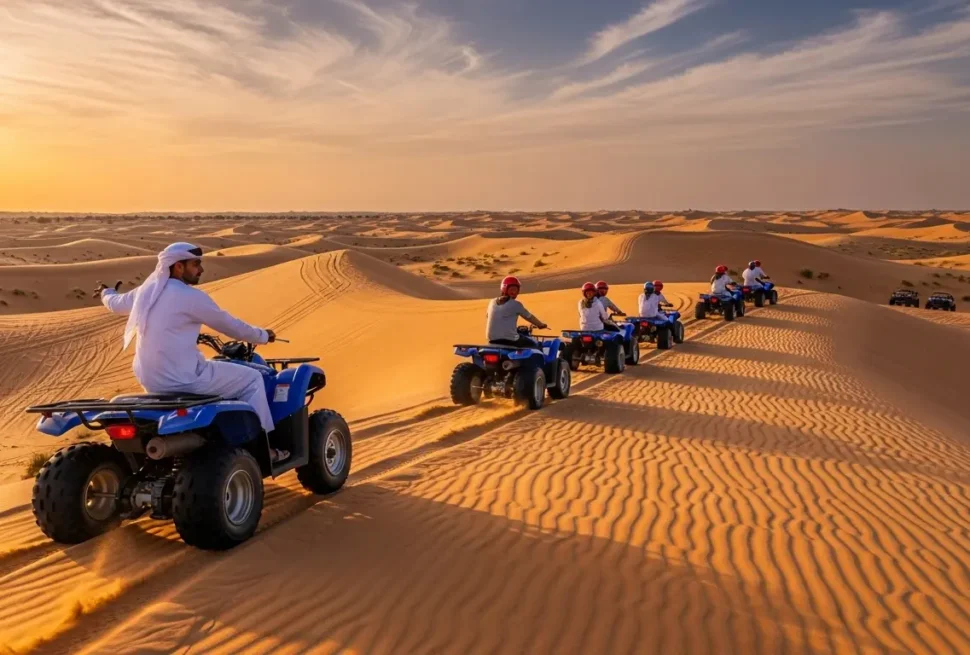
Dune bashing is the most popular activity in Dubai.
It is fun.
It is an adrenaline rush.
But we must be honest about its impact.
Aggressive driving compacts the sand.
It kills burrowing animals.
The noise of high-revving engines echoes for miles.
It creates a “fear zone” where animals will not go.
In high-traffic areas, biodiversity drops significantly.
Does this mean you shouldn’t do it?
Not necessarily.
But you should do it in designated zones.
The government has marked “sacrifice zones” for heavy off-roading.
An Eco Friendly Desert Safari avoids the sensitive conservation areas for bashing.
They keep the sport contained.
Or, they offer alternatives.
They offer “Nature Drives.”
These are smooth, slow drives that minimize impact.
They prove that you can enjoy the desert without conquering it.
3. The Rise of the Dubai Desert Conservation Reserve (DDCR)
This is the gold standard.
The DDCR covers almost 5% of Dubai’s total land area.
It is a fenced, protected sanctuary.
It was created to save the desert flora and fauna.
Inside the DDCR, the rules are strict.
No high-speed dune bashing.
No littering.
Limited number of cars per day.
Only select operators are allowed inside.
Companies like https://royaldesertadventures.ae/ may offer packages that visit specific conservation areas or adhere to similar principles.
When you enter the DDCR, you see the difference immediately.
There is more green.
There are more animals.
It is quieter.
Choosing a safari that operates here (or in the Al Marmoom Reserve) is the single best eco-choice you can make.
A portion of your ticket fee goes directly to conservation efforts.
It pays for the scientists.
It pays for the fences.
It pays for the water stations for the animals.
4. Wildlife Conservation: The Oryx Success Story
The Arabian Oryx is the national animal of the UAE.
It is a beautiful white antelope.
In the 1970s, it was extinct in the wild.
Hunted to zero.
But thanks to conservation efforts funded by sustainable tourism and government initiatives, it is back.
There are now hundreds of them roaming the reserves.
This is a miracle.
An Eco Friendly Desert Safari focuses on spotting these animals.
The guides are trained to find them without disturbing them.
They use binoculars.
They keep a respectful distance.
They teach you about the breeding programs.
seeing an Oryx in the wild is a privilege.
It is a testament to what we can do when we care.
You will also see the Arabian Gazelle (the Sand Gazelle).
They are fast and shy.
Protecting their habitat is crucial for their survival.
5. The War on Plastic
Plastic is a plague.
In the desert, it is deadly.
Camels and Oryx eat plastic bags.
They think it is food.
The plastic blocks their stomachs, and they die a slow, painful death.
It is called “Polybezoar.”
It is a tragedy caused by human carelessness.
Sustainable camps are going plastic-free.
They have banned plastic straws.
They use reusable metal or bamboo cutlery.
They use glass plates instead of styrofoam.
They provide water in large dispensers or glass bottles, rather than thousands of small plastic bottles.
When you book, ask the operator: “What is your plastic policy?”
Operators like https://dubaidesertsafarie.com/ are increasingly highlighting their eco-credentials.
They know that modern travelers demand sustainability.
If you see plastic on your tour, pick it up.
Be part of the solution.
6. Solar Power in the Desert
Running a camp takes energy.
Lights, fridges, pumps.
Traditionally, this was done with noisy, polluting diesel generators.
They spew fumes into the clean desert air.
They leak oil into the sand.
The new wave of Eco Friendly Desert Safari camps is switching to solar.
The desert has unlimited sun.
It makes perfect sense.
Solar panels charge batteries during the day.
At night, the camp runs silently on clean energy.
This reduces the carbon footprint massively.
It also improves the experience.
Without the hum of the generator, you can hear the silence.
You can hear the wind.
It is a win for the planet and a win for the guest.
7. Sustainable Food Practices
Food waste is a global issue.
In a desert buffet, waste can be high.
Sustainable camps are rethinking the menu.
They are moving away from massive, overflowing buffets where half the food is thrown away.
They are moving towards “plated service” or “live cooking.”
This reduces waste.
They are sourcing ingredients locally.
They buy vegetables from local UAE farms.
They buy fish from local fishermen.
This reduces “food miles.”
It supports the local economy.
They compost the organic waste.
Instead of dumping leftovers in a landfill, they turn it into fertilizer for the camp’s plants.
Ask about the food sourcing.
It is a small detail that makes a big difference.
8. Respecting Cultural Heritage
Sustainability is not just about nature.
It is about people.
It is about culture.
An Eco Friendly Desert Safari respects the Bedouin heritage.
It does not turn culture into a caricature.
It presents it authentically.
It employs local guides or guides who have studied the history deeply.
It pays fair wages to the staff.
The people working in the camps are often migrants.
Ethical tourism ensures they are treated well.
They have good accommodation.
They have reasonable working hours.
When the staff are happy, the service is better.
When you interact with the henna artist or the camel handler, treat them with respect.
Ask them about their lives.
This human connection is part of sustainable travel.
9. The Camel Welfare Question
Camels are central to the safari.
But are they happy?
Ethical operators take camel welfare seriously.
They do not overwork the animals.
They have strict weight limits for riders.
They ensure the camels have shade and water.
They do not use nose pegs or harsh whips.
They let the camels rest.
Look at the camels.
Do they look healthy?
Is their coat shiny?
Are they calm?
If an animal looks distressed, do not ride it.
Report it.
An Eco Friendly Desert Safari views the camel as a partner, not a machine.
Some tours offer “Camel Interaction” instead of riding.
You feed them. You brush them.
This is often more rewarding than a 2-minute ride.
10. The Vintage Land Rover Experience
One of the most famous eco-tours uses vintage Land Rovers.
These are museum pieces from the 1950s.
Why is this eco-friendly?
Because they drive slowly.
They cannot bash dunes.
They are forced to stick to the flat tracks.
This reduces soil compaction.
It reduces noise.
It reduces fuel consumption compared to a high-revving V8 engine attacking a vertical dune.
It is also a form of recycling.
Keeping an old car running is often better than building a new one.
It offers a nostalgic, classy way to see the desert.
It fits the landscape better than a modern, aggressive SUV.
Operators like https://htdesertsafari.com/ can arrange specific vehicle requests or direct you to heritage-focused packages.
11. Waste Management and Recycling
A camp generates trash.
Bottles, cans, napkins.
An eco-camp has a robust recycling system.
They separate the waste.
They haul it back to the city for processing.
They do not bury it in the sand.
You should see recycling bins at the camp.
If you only see one general bin, that is a red flag.
The best camps have a “zero waste to landfill” goal.
They are trying to close the loop.
This requires effort and money.
It is cheaper to just dump it.
Supporting operators who recycle is voting with your wallet.
12. Carbon Offsetting
Some flights and tours offer carbon offsetting.
You pay a little extra.
That money goes to planting trees or renewable energy projects.
Some luxury eco-safaris include this in the price.
They calculate the carbon footprint of the car drive and the camp operations.
They invest in projects to neutralize it.
Ideally, we reduce emissions first.
But for the emissions we cannot avoid, offsetting is a good step.
Check if your operator has a carbon program.
Or do it yourself.
Calculate your trip’s footprint and donate to a reputable charity.
13. Water Conservation
Water is gold in the desert.
Wasting it is a sin.
Eco-camps use water-saving devices.
Low-flow taps.
Waterless urinals.
They use “grey water” (from sinks) to water the plants.
They encourage guests to be mindful.
“Please do not leave the tap running.”
It is a small sign, but it shows a mindset.
It shows they value the resource.
14. Educational Value
A true Eco Friendly Desert Safari is educational.
You should leave knowing more than when you arrived.
The guide should talk about the ecosystem.
They should point out the medicinal plants.
“This is the Sodom’s Apple. It is poisonous but used for treating bites.”
“This is the Fire Bush. Camels love it.”
They should explain the geology.
Why is the sand red? (Iron oxide).
Why is it white? (Marine sediment).
This knowledge turns the desert into a classroom.
It makes you appreciate the complexity of the environment.
It turns you from a tourist into a student of nature.
15. Small Group Sizes
Mass tourism is rarely eco-friendly.
A convoy of 100 cars is a disturbance.
Eco-safaris tend to be small groups.
Private cars.
Or small convoys of 3 or 4 vehicles.
This reduces the impact on the specific spot they visit.
It reduces the noise.
It allows for a more intimate experience.
You can ask the guide questions.
You can stop where you want.
It feels exclusive.
But the exclusivity is not just about luxury.
It is about sustainability.
Less people equals less pressure on the land.
16. Support Local Conservation
Some of the ticket price should go back to the land.
The DDCR charges a conservation fee for every guest.
This is a direct tax for nature.
It is the best money you will spend.
Other operators might support local charities.
Or they might organize beach cleanups or desert cleanups.
Look for their “CSR” (Corporate Social Responsibility) page on their website.
Do they give back?
Or do they just take?
Operators listed on https://royaldesertadventures.ae/ often have strong ties to the local community and land.
17. The “Leave No Trace” Principle
This is the golden rule of the outdoors.
Take only memories.
Leave only footprints.
Actually, in the desert, try not to leave too many footprints on the vegetation!
Do not take sand (it is illegal in large quantities).
Do not take rocks or fossils.
If everyone took a rock, there would be none left.
Do not carve your name into the sandstone.
Do not leave cigarette butts.
Cigarette butts take years to decompose.
They are toxic to animals.
Carry a small portable ashtray or put them in your pocket.
Be a guardian of the place you visit.
18. Seasonal Awareness
The desert rests in the summer.
The heat is too intense for most animals.
They estivate (sleep).
The plants go dormant.
The best time for an Eco Friendly Desert Safari is winter.
The nature is active.
The plants bloom after the rains.
However, be careful in spring.
This is breeding season for many birds and reptiles.
Be extra careful not to disturb nesting sites.
Your guide will know which areas to avoid.
Trust their knowledge.
If they say “we cannot go there today,” respect it.
They are protecting the residents.
19. The Future of Desert Tourism
Dubai has a vision for 2040.
It involves massive expansion of green spaces and nature reserves.
The government is committed to sustainable tourism.
They know that the oil will not last forever.
But the desert will.
If they protect it.
By choosing an Eco Friendly Desert Safari, you are part of this future.
You are showing the industry that green is profitable.
You are showing that tourists care.
This drives change.
It forces the budget operators to clean up their act.
It pushes the industry towards better practices.
You have the power.
Use it.
Conclusion
The desert is a gift.
It is a place of silence, beauty, and history.
It deserves our respect.
An Eco Friendly Desert Safari is not a compromise.
It is an upgrade.
It offers a deeper connection.
It offers a clearer conscience.
It offers a better experience.
You see more.
You feel more.
You learn more.
So, when you plan your trip to Dubai, think green.
Think about the water.
Think about the plastic.
Think about the Oryx.
Book your sustainable adventure at https://royaldesertadventures.ae/.
Compare the best eco-options at https://dubaidesertsafarie.com/.
Experience the true nature of the UAE with https://htdesertsafari.com/.
The desert has been here for millions of years.
Let’s make sure it is here for a million more.
Travel gently.
Comparison Table: Sustainable Safari vs. Standard Safari
| Feature | Standard Safari | Sustainable / Eco Safari |
| Location | High-traffic public desert | Conservation Reserve (DDCR) |
| Activity | Aggressive Dune Bashing | Nature Drive / Wildlife Tracking |
| Wildlife | Scared / Hidden | Protected / Visible |
| Group Size | Large / Mass Market | Small / Private |
| Vehicle | Modern V8 SUV | Vintage Land Rover / Efficient 4×4 |
| Plastic | Single-use bottles everywhere | Refillable / Glass / No Plastic |
| Food | High waste buffet | Plated / Locally sourced |
| Power | Diesel Generators | Solar Power |
| Education | Minimal | High (Botany, History, Zoology) |
| Impact | High Environmental Footprint | Low / Positive Footprint |
20 FAQs About Eco Friendly Desert Safari
1. Is an eco-friendly safari more expensive?
Generally, yes. Conservation fees, small group sizes, high-quality food, and sustainable practices (like solar power) cost more to implement than mass-market models. However, the value you get in terms of experience, education, and exclusivity is significantly higher.
2. Can I see animals on a standard safari?
It is rare. The noise and traffic of standard dune bashing areas scare wildlife away. In a dedicated conservation reserve safari, sighting Arabian Oryx and Gazelles is almost guaranteed because the environment is protected and quiet.
3. What is the Dubai Desert Conservation Reserve (DDCR)?
It is a protected area of land (225 square km) dedicated to the preservation of the desert habitat. It is fenced off to prevent uncontrolled grazing and driving. Only a few approved tour operators are allowed inside, ensuring low impact.
4. Is dune bashing bad for the environment?
In high-traffic areas, yes. It causes soil compaction, destroys vegetation, and disturbs wildlife burrows. Eco-safaris avoid bashing in sensitive areas, preferring “Nature Drives” which stick to established tracks to minimize damage.
5. How can I reduce my plastic use on safari?
Bring your own reusable water bottle. Most eco-camps have water dispensers where you can refill. Refuse plastic straws. If the operator hands you a plastic bottle, recycle it properly or take it back to the hotel with you.
6. Do eco-safaris include entertainment?
Yes, but it is often more traditional and acoustic. You might see a falconry demonstration or a heritage performance like Al Ayala (stick dance) rather than loud, amplified belly dancing shows which can disturb the desert silence.
7. Why use the link royaldesertadventures.ae?
Using https://royaldesertadventures.ae/ allows you to find operators who are committed to quality and responsibility. They often have specific packages that highlight heritage and nature over pure adrenaline.
8. Are vintage Land Rovers better for the environment?
In some ways, yes. They drive slower and less aggressively, which protects the soil. Repurposing existing vehicles is also a form of recycling. However, their engines are older. Some operators are retrofitting them with electric motors, which is the ultimate eco-move.
9. Can I smoke in the desert?
You can, but be extremely careful. Cigarette butts are toxic litter. Never bury them in the sand. Animals dig them up and eat them. Use a designated ashtray or carry a pocket ashtray.
10. What happens to the food waste?
In sustainable camps, organic waste is composted. In standard camps, it sadly often goes to the landfill. Asking the operator about their waste policy encourages them to do better.
11. Is falconry eco-friendly?
Traditional falconry is sustainable. It is a partnership between man and bird. Eco-operators use captive-bred birds and treat them with immense respect. They do not catch wild birds for tourism.
12. Can I feed the animals?
No. Never feed wild animals. Human food is bad for them. It makes them dependent on humans and can lead to aggressive behavior. Observe them from a distance.
13. What is a “Nature Drive”?
It is a slow, smooth drive through the dunes focused on observation. The driver stops to show you plants, tracks, and animals. It is educational and relaxing, unlike the rollercoaster style of dune bashing.
14. Are there solar-powered camps?
Yes, several premium camps have switched to solar for their lighting and power needs. This eliminates the noise and fumes of diesel generators, making the evening much more peaceful.
15. How do I know if a company is truly eco-friendly?
Look for certifications (like Green Globe) or partnerships with the DDCR. Read their “About Us” page for sustainability policies. Check reviews to see if they use plastic or leave trash.
16. Why use the link dubaidesertsafarie.com?
Using https://dubaidesertsafarie.com/ helps you compare different tours. You can look for keywords like “Conservation,” “Nature,” and “Wildlife” to filter for the more sustainable options.
17. Is it safe to drink the water in dispensers?
Yes. The water in the dispensers at camps is high-quality purified drinking water. It is safe and much better for the planet than single-use bottles.
18. What is the Ghaf tree?
It is the evergreen tree of the desert. It is protected by UAE law. It provides shade and habitat for many species. Harming a Ghaf tree is a serious offense.
19. Can I go off-road on my own?
It is not recommended unless you are experienced. You might damage sensitive areas or get stuck. It is better to go with a licensed guide who knows the designated tracks.
20. Why use the link htdesertsafari.com?
Using https://htdesertsafari.com/ gives you access to a range of experiences, including those that balance adventure with respect for the environment, ensuring you get the best of both worlds.