
Desert Safari with No Phone 19 Reasons to Unplug Now
We are addicts.
We are addicted to the black mirror in our pockets.
We check it when we wake up.
We check it when we eat.
We check it even when we are in the most beautiful places on Earth.
We travel to see the world, but we view it through a 6-inch screen.
We record the concert instead of listening to it.
We photograph the food instead of tasting it.
We film the sunset instead of feeling it.
We are present physically, but absent mentally.
This guide is a challenge.
It is a radical proposition.
It is an invitation to do a Desert Safari with No Phone.
Imagine leaving your device at the hotel.
Or locking it in the glove box of the Land Cruiser.
Imagine spending six hours in the Dubai desert without a single notification.
No emails.
No Instagram stories.
No WhatsApp groups.
Just you.
The sand.
The wind.
And the people around you.
It sounds terrifying to some.
It sounds like freedom to others.
In this extensive guide, we will explore why you should do this.
We will discuss the psychology of the digital detox.
We will explore how your senses change when you remove the filter of technology.
We will provide a roadmap for surviving and thriving during your Desert Safari with No Phone.
Are you brave enough to disconnect?
Let’s find out.
1. The Fear of Missing Out (FOMO)
The first hurdle is psychological.
It is FOMO.
“If I don’t post it, did it even happen?”
This is the mantra of the modern age.
We validate our experiences through the likes of others.
We need an audience.
But when you commit to a Desert Safari with No Phone, you face this fear head-on.
You realize that the experience is for you.
It is not for your followers.
It is not for your colleagues.
It is a private moment between you and the universe.
The first hour is the hardest.
You will reach for your pocket.
It is a reflex.
You will feel a “phantom vibration.”
You will wonder if someone is trying to reach you.
But as the Land Cruiser hits the dunes, the fear fades.
The adrenaline takes over.
You realize that the world continues to spin without your input.
This realization is humbling.
It is liberating.
2. The Return of the Senses
Technology numbs us.
It overloads our visual cortex.
It distracts our hearing with notifications.
When you remove the phone, your senses wake up.
You start to notice details you would have missed.
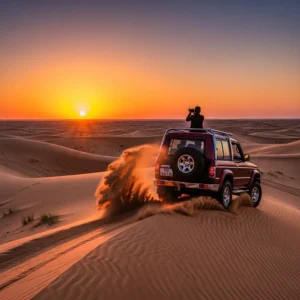
On a Desert Safari with No Phone, you see the texture of the sand.
You notice the millions of ripples created by the wind.
You see the way the light changes from white to gold to purple.
You hear the engine of the car roaring.
You hear the silence of the wind when the car stops.
You hear the crunch of your boots on the sand.
You feel the heat on your skin.
You feel the coolness of the evening breeze.
You smell the exhaust.
You smell the charcoal of the BBQ.
You smell the sweet scent of the Shisha.
Your brain is no longer processing a digital feed.
It is processing reality.
The resolution of reality is higher than 4K.
The colors are more vibrant than any filter.
3. Dune Bashing: Fear vs. The Screen
Usually, when people go dune bashing, they film it.
They hold their phone up with one hand.
They watch the screen to make sure they are getting the shot.
They are disconnected from the danger.
They are disconnected from the thrill.
When you do a Desert Safari with No Phone, there is no buffer.
You are in the car.
You are sliding sideways down a 50-meter dune.
You are holding the handle, not a phone.
You look out the window, not at a screen.
The fear is real.
The excitement is visceral.
You scream louder.
You laugh harder.
You make eye contact with the driver.
You share a moment of terror and joy with your fellow passengers.
This shared adrenaline bonds you.
If you were all on your phones, you would be in separate bubbles.
Without phones, you are a team surviving the ride.
4. The Driver: Your First Human Connection
Without a phone to look at, you have to look at people.
The first person is your driver.
Usually, tourists ignore the driver.
They are too busy scrolling.
But on a Desert Safari with No Phone, the driver is your guide.
He is your host.
Talk to him.
Ask him about his life.
Ask him about the car.
Ask him about the desert.
Drivers have incredible stories.
They know the names of the dunes.
They know where the camels hide.
They know the history of the land.
When you engage with them, the ride changes.
They drive better.
They show you secret spots.
They appreciate being treated as humans, not just operators.
Booking with https://royaldesertadventures.ae/ ensures you get professional drivers who are great conversationalists.
They are used to interacting with guests.
They will respect your digital detox.
They might even tell you stories about the Bedouins that you won’t find on Google.
5. The Camel Ride: Feeling the Rhythm
Riding a camel is often just a photo op.
People jump on.
Snap a selfie.
Jump off.
They don’t actually experience the ride.
Without a phone, you have to hold on with two hands.
You feel the muscle of the animal.
You feel the strange, swaying gait.
You look at the camel’s head.
You look at the desert from a high vantage point.
You notice the silence of the camel’s footsteps.
They have soft pads that make no noise on the sand.
This is how people traveled for thousands of years.
Without a device, you connect to that history.
You understand the patience required to cross a desert.
You slow down to the camel’s pace.
It is meditative.
It is rhythmic.
6. The Sunset: Watching, Not Recording
The sunset is the most photographed event in the desert.
Everyone wants the perfect shot of the sun touching the horizon.
There is a wall of phones blocking the view.
But a camera cannot capture the scale.
It cannot capture the dynamic range of the human eye.
On your Desert Safari with No Phone, you just sit.
You sit on a dune.
You watch the sun go down.
It takes about 3 minutes for the sun to disappear once it touches the horizon.
Watch the whole process.
Watch the colors shift.
Watch the shadows lengthen and race across the sand.
Feel the temperature drop instantly.
This is a celestial event.
It is the earth rotating.
Witnessing it with your own eyes creates a memory.
Recording it creates a file.
Files get lost.
Memories burned into your mind with emotion last forever.
7. The Camp: Social Dynamics
You arrive at the camp.
Usually, this is when people check their messages.
“I have signal!”
They upload their stories.
They check their likes.
They ignore the environment.
You, the rebel without a phone, are present.
You look around.
You see the architecture of the camp.
You smell the food.
You look at the other tourists.
You see a family laughing.
You see a couple arguing over a photo.
You become an observer of human nature.
You are in the moment.
You are approachable.
Because you are not looking down, people look at you.
They smile.
You start conversations.
“Where are you from?”
“How was the drive?”
You meet people from Brazil, Germany, India.
You share a table.
You share bread.
This connection is the essence of travel.
It is impossible if you are glued to a screen.
8. The Food: Tasting Mindfulness
We are guilty of “mindless eating.”
We eat while watching Netflix.
We eat while scrolling Twitter.
We don’t taste our food.
At the safari, the food is traditional.
Hummus.
Tabbouleh.
Grilled meats.
Fresh bread.
On a Desert Safari with No Phone, dinner is an activity.
Look at the food.
Smell the charcoal on the chicken.
Taste the lemon in the salad.
Feel the texture of the bread.
Eat slowly.
Savor every bite.
This is mindfulness.
It aids digestion.
It increases satisfaction.
You realize that Arabic food is complex and delicious.
You appreciate the effort of the chefs cooking in the desert heat.
Operators like https://dubaidesertsafarie.com/ offer excellent buffet options.
Enjoying them fully is a sign of respect.
9. The Entertainment: Respecting the Art
The lights dim.
The music starts.
The Tanoura dancer spins.
The belly dancer enters.
Look around the audience.
90% of them are watching the show through their phone screens.
They are recording a video they will never watch again.
They are missing the energy.
Put your eyes on the dancer.
Watch their expression.
Watch the sweat.
Watch the skill.
Clap your hands.
Cheer.
Performers feed off the energy of the crowd.
If the crowd is a sea of phones, the energy is dead.
If there is one person watching intently, smiling, and clapping, the performer dances for that person.
You become part of the show.
You honor their art with your attention.
Attention is the most valuable currency you have.
Spend it on the real world.
10. The Fire: The Original TV
In the old days, people sat around the fire.
They stared into the flames.
They told stories.
The fire was the television.
It is mesmerizing.
It changes constantly.
It is warm.
Sit by the bonfire at the camp.
Stare into the coals.
Let your mind wander.
This is “fire gazing.”
It induces a trance-like state.
It relaxes the brain.
It stimulates creativity.
Ideas will come to you.
Solutions to problems will appear.
This is what happens when you stop consuming content and start generating thoughts.
The Desert Safari with No Phone gives your brain the space it needs to breathe.
11. Stargazing: The Cosmic Perspective
Walk away from the camp lights.
Find a dark spot.
Look up.
The desert sky is a masterpiece.
Without the light pollution of the city, you see thousands of stars.
You see the Milky Way.
You see constellations.
This is the ultimate screen.
It is high definition.
It is 3D.
It is infinite.
Looking at the stars induces a feeling of “awe.”
Psychologists say that awe is vital for mental health.
It makes us feel small.
When we feel small, our problems feel small.
Our stress about emails and deadlines seems ridiculous in the face of a galaxy.
This perspective shift is the goal of the Desert Safari with No Phone.
It resets your priorities.
12. The Safety Net: You Are Not Alone
You might worry.
“What if there is an emergency?”
“What if I get lost?”
You are with a professional tour operator.
The driver has a phone.
The camp manager has a phone.
You are not stranded.
You are safe.
Give the tour operator’s number to your family before you leave.
Tell them: “I am going offline for 6 hours. Call this number if it is life or death.”
Knowing that a safety net exists allows you to relax.
You don’t need your phone because they have phones.
Trust the experts at https://htdesertsafari.com/.
They handle thousands of guests.
They have protocols.
You can let go of control.
13. Bringing Alternatives: The Analog Tools
If you don’t have a phone, what do you do with your hands?
Bring a film camera.
Or a disposable camera.
This allows you to take photos without seeing them instantly.
It delays the gratification.
It prevents you from spending 20 minutes editing and posting.
You take the shot and move on.
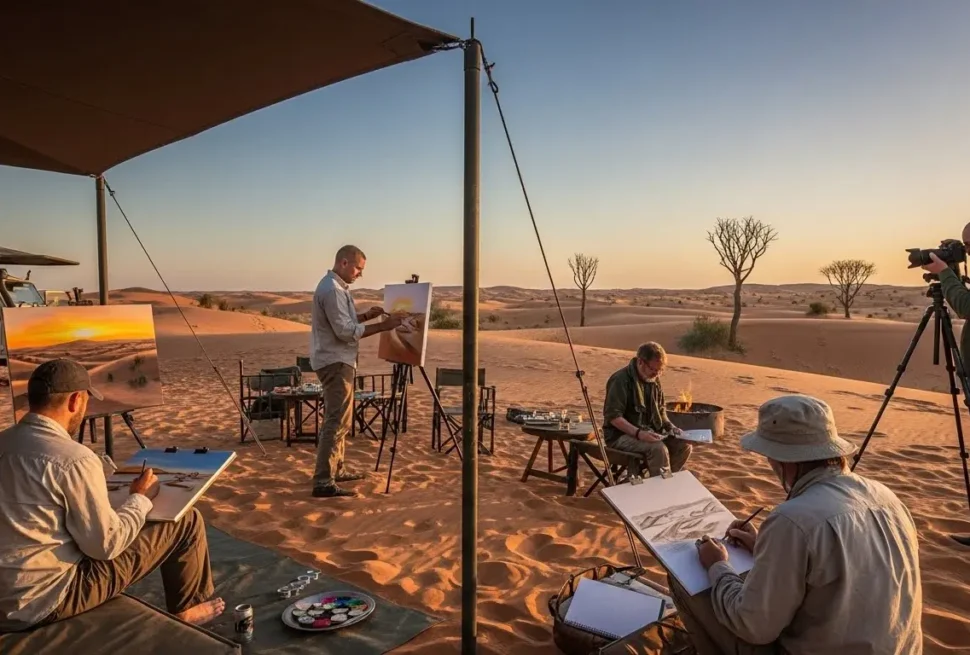
Bring a notebook and a pen.
Write down what you see.
Write down how you feel.
Sketch the dunes.
Journaling is a powerful tool for memory retention.
Writing “The sand feels like warm sugar” is more evocative than a photo of sand.
Bring a physical book.
Read during the drive to the desert.
Reading paper is different from reading a screen.
It calms the mind.
14. The Withdrawal Phase
Be prepared.
You will feel withdrawal.
Dopamine addiction is real.
Around hour two, you might feel bored.
You might feel anxious.
You might reach for your pocket phantomly.
This is normal.
It is your brain craving the hit of a new notification.
Recognize it.
Say to yourself: “I am feeling bored. That is okay.”
Boredom is good.
Boredom is the birthplace of creativity.
Push through the discomfort.
Look at the horizon.
Breathe.
The feeling will pass.
And on the other side of boredom is peace.
15. The Social Experiment
Observe how others interact with you.
When you don’t have a phone, you look open.
You look available.
People are more likely to talk to you.
Staff are more likely to joke with you.
You become a magnet for interaction.
You might make a new friend.
You might learn something new.
In a world where everyone is looking down, the person looking up is the leader.
You lead the social interaction.
You set the tone.
16. The Memory Game
Without a gallery of 500 photos, how will you remember?
You will remember better.
Studies show that “cognitive offloading” (taking a photo) actually signals the brain that it doesn’t need to store the memory.
“The camera has it, so I can forget it.”
When you don’t take a photo, your brain knows it is the only hard drive.
It pays more attention.
It encodes the memory deeper.
It records the smell.
It records the temperature.
Years later, you will close your eyes and be back in the desert.
The memory will be vivid and multi-sensory.
The Desert Safari with No Phone creates stronger neural pathways.
17. The Return: Re-entry Shock
The drive back to the city is quiet.
Usually, people are editing photos.
You are just sitting.
Reflecting.
Processing.
When you get back to the hotel, turn your phone on.
It will buzz.
100 messages.
50 emails.
Don’t panic.
Realize that nothing terrible happened in 6 hours.
The world didn’t end.
The emails can wait.
You have proven to yourself that you are not indispensable.
This is a relief.
You can step away.
You can take a break.
And life goes on.
18. Why Royal Desert Adventures?
Choosing the right partner for this challenge is key.
You need an operator who respects your wish for privacy.
You don’t want a guide who keeps saying “Give me your phone, I take photo!”
You want a guide who understands.
https://royaldesertadventures.ae/ offers private car options.
This is ideal for the Desert Safari with No Phone.
You can tell the driver: “I am doing a digital detox. Please help me enjoy the silence.”
They will take you to quieter spots.
They will drive you away from the crowds.
They will support your mission.
19. The Long-Term Impact
This isn’t just about one evening.
It is about changing your relationship with technology.
After a successful Desert Safari with No Phone, you might change your habits.
Maybe you will leave your phone in the kitchen at night.
Maybe you will do “Phone Free Sundays.”
You realize that you have the power to disconnect.
You realize how good it feels.
The desert teaches you that you are enough.
You don’t need a filter.
You don’t need a like.
You just need air, water, and a view.
Conclusion
The desert is the ultimate place to unplug.
It is a landscape of emptiness.
It demands your attention.
It rewards your presence.
A Desert Safari with No Phone is the ultimate luxury.
Luxury is not gold taps or expensive cars.
Luxury is time.
Luxury is attention.
Luxury is peace of mind.
Give yourself this gift.
Lock the phone away.
Open your eyes.
And see the world as it truly is.
Book your detox journey at https://royaldesertadventures.ae/.
Find the best nature-focused tours at https://dubaidesertsafarie.com/.
Escape the noise with https://htdesertsafari.com/.
The signal is weak.
But the connection is strong.
Go find it.
Comparison Table: Digital Safari vs. Analog Safari
| Feature | Digital Safari (With Phone) | Analog Safari (No Phone) |
| Focus | Capturing the moment | Living the moment |
| Memory | Stored in Cloud | Stored in Brain |
| Senses | Visual dominant | All 5 senses engaged |
| Anxiety | Low battery anxiety / FOMO | Withdrawal then Peace |
| Social | Connected to followers | Connected to people present |
| Time | Passes quickly (distracted) | Passes slowly (savored) |
| Safety | Feeling of control | Trust in others |
| Outcome | Great content | Great mental health |
| Sunset | Viewed through screen | Viewed directly |
| Dinner | Photographed | Tasted |
20 FAQs About Desert Safari with No Phone
1. Is it safe to go without a phone?
Yes. Your driver and tour guide have phones and radios. They are your safety net. You are never truly isolated from help, just isolated from distractions.
2. How will I find my driver without a phone?
The pickup is arranged at your hotel lobby. The concierge can help locate the driver. Once you are with the driver, you stay with them. They will guide you.
3. What if I need to take photos?
Bring a dedicated camera (DSLR, Mirrorless, or GoPro). Or bring a disposable film camera for a fun, retro vibe. This keeps the phone away but preserves the memories.
4. Can I bring my phone but keep it off?
Yes, this is a good middle ground. Keep it in your bag, powered down, or in flight mode. Use it only for emergencies. But be warned: the temptation to check it is strong.
5. What do I do if I get bored?
Embrace it. Look at the sand. Talk to the person next to you. Meditate. Boredom is a withdrawal symptom from constant stimulation. It passes and leads to relaxation.
6. How do I tell my family I am offline?
Send a message before you leave: “I am going on a desert safari and will be offline for 6 hours. I will message you when I am back.” This manages expectations and prevents worry.
7. Can I bring a book?
Yes! A book is a great companion for the drive to the desert or the time before dinner. It is an analog form of entertainment that fits the vibe.
8. Will the guide take photos for me?
Yes. Most guides are happy to take photos of you using their phone or your camera, and they can send them to you later or you can check them on your camera screen.
9. Is there a clock at the camp?
Usually no. But the flow of the evening is dictated by the sun and the show schedule. You don’t need to know the exact time. Let the events guide you.
10. What if I get separated from my group?
Stay where you are. The camps are enclosed. The drivers do headcounts. If you don’t have a phone, simply ask a staff member for help. They all have radios.
11. Why use the link royaldesertadventures.ae?
Using https://royaldesertadventures.ae/ allows you to book private or VIP options where the staff are more attentive, which is helpful when you are doing a “no phone” challenge and need a bit more guidance.
12. Can I do this alone (solo traveler)?
Yes. It is a powerful experience for solo travelers. It forces you to interact with others or be comfortable in your own company. It builds confidence.
13. What if I have a medical condition?
Inform your driver immediately upon pickup. Since you don’t have a phone to call for help, they need to know to watch out for you.
14. Is it harder to navigate the camp without a phone?
Not really. The camps are not huge. The layout is simple (stage in the middle, food on the sides). You can navigate by sight.
15. Will I sleep better afterwards?
Likely yes. The reduction in blue light exposure and the reduction in cortisol (stress) from not checking emails usually leads to a very deep sleep that night.
16. Why use the link dubaidesertsafarie.com?
Using https://dubaidesertsafarie.com/ helps you find tours that focus on nature and wildlife, which are more engaging for a “no phone” experience than a loud party safari.
17. Can I bring a smartwatch?
Try not to. It buzzes. It tracks. It is a tether to the digital world. Take it off and let your body exist without being measured.
18. What is the hardest part of the challenge?
The car ride to the desert. Usually, we scroll to kill time. Without a phone, you have to look out the window or talk. It feels long at first, then relaxing.
19. Can I write a journal instead?
Yes. Bringing a notebook is highly recommended. Write down your thoughts as they clear. You will have amazing ideas in the silence.
20. Is it worth it?
100%. The mental clarity and the depth of the memory you form are worth far more than the temporary dopamine hit of a like on Instagram.