Desert Safari Gateway to History 15 Ancient Secrets Revealed
When we look at Dubai today, we see glass and steel.
We see the tallest buildings on earth.
We see artificial islands and supercars.
But this is just the surface.
Beneath the asphalt and the luxury lies a story that is thousands of years old.
It is a story written in the sand.
To truly understand the United Arab Emirates, you must leave the city.
You must go back to the source.
A Desert Safari Gateway to History is not just a tourist attraction.
It is a time machine.
It transports you back to an era before oil.
It takes you to a time when survival was a daily battle.
Most visitors treat the desert as a playground.
They come for the adrenaline of dune bashing.
They come for the barbecue dinner.
While these are fun, they are only one layer of the experience.
If you look deeper, the desert safari reveals the soul of the nation.
It explains why hospitality is so important here.
It explains the connection between the people and the land.
It explains the resilience that built a nation.
This guide will serve as your historical handbook.
We will explore how the safari experience mirrors the ancient Bedouin life.
We will decode the symbols you see at the camp.
We will uncover the secrets of the dunes.
By the end of this journey, you will not just see sand.
You will see the footprints of history.
The Bedouin: Architects of the Desert
The history of the UAE is the history of the Bedouin.
“Bedouin” comes from the Arabic word Badawiyin.
It means “people of the desert.”
These were the nomadic tribes who roamed these sands for centuries.
They did not build stone castles.
They did not leave behind massive monuments like the Pyramids.
Their legacy is intangible.
It is in their poetry, their values, and their survival skills.
A Desert Safari Gateway to History introduces you to this lifestyle.
When you drive into the dunes, you are following their paths.
The Bedouins moved with the seasons.
In winter, they stayed in the desert to graze their camels.
In summer, they moved to the coast or the oases like Liwa and Al Ain.
This movement was dictated by resources.
Water and grass were more valuable than gold.
The tribes of the UAE, such as the Bani Yas and the Manasir, were masters of this terrain.
They knew every dune.
They knew every star.
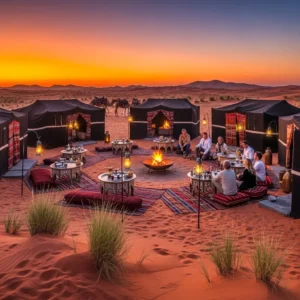
When you visit a desert camp, you are stepping into a recreation of their home.
The layout of the camp is significant.
It is usually circular or square, creating a protected courtyard.
This offered safety from the wind and wild animals.
Understanding the Bedouin mindset is key to understanding modern Emiratis.
The values of loyalty, bravery, and generosity come from this harsh life.
In the desert, you could not survive alone.
You needed your tribe.
You needed your neighbors.
This interdependence created a society bound by strong social codes.
The Tent: Bayt Al Sha’ar
The structure you sit in during dinner is historic.
It is called Bayt Al Sha’ar.
This translates to “House of Hair.”
Bedouin tents were woven from the hair of goats and sheep.
Why hair?
It is a brilliant engineering material.
When it is dry, the weave is loose.
This allows the breeze to pass through, keeping the tent cool.
When it rains, the fibers swell.
The weave tightens and becomes waterproof.
It is natural climate control.
The women of the tribe were the architects.
They sheared the animals.
They spun the wool.
They wove the long strips of fabric on ground looms.
Then they stitched them together.
A tent could be packed up in hours.
It could be carried by a camel.
In your Desert Safari Gateway to History, look at the tent fabrics.
They are often black with red or white stripes.
This pattern is traditional.
The interior creates a “Majlis.”
The Majlis is the sitting place.
It is where guests were received.
It is where disputes were settled.
Sitting on the floor cushions keeps you cool.
It also signifies equality.
Everyone sits at the same level.
There is no head of the table.
This architecture reflects a society that valued mobility and community.
The Camel: The Engine of Civilization
You cannot have a safari without a camel ride.
But do not look at the camel as just a ride.
Look at it as technology.
The camel was the Bedouin’s car, truck, and grocery store.
It is called the “Ship of the Desert” (Ata Allah – Gift of God).
Without the camel, human life in the UAE desert would have been impossible.
They provided transport across the Empty Quarter.
They could carry loads of up to 200kg for 50 kilometers a day.
They provided milk.
Camel milk is a superfood.
It is rich in Vitamin C, which is rare in the desert.
It kept the Bedouins healthy.
They provided wool for the tents.
They provided leather for sandals and water bags.
Their dung was used as fuel for fires.
Even their urine was used for medicinal purposes (hair washing).
When you ride a camel on your safari, you are feeling the rhythm of history.
This swaying motion is how news traveled.
It is how brides traveled to their weddings.
It is how spices traveled from the coast to the interior.
Operators like https://htdesertsafari.com/ ensure their camels are healthy.
They treat them with the respect due to a partner in survival.
Notice the camel’s feet.
They are broad and soft.
They do not sink into the sand.
They do not damage the delicate desert vegetation.
The camel is the ultimate eco-friendly vehicle.
Water: The Struggle for Life
Water defines the history of the UAE.
The search for water dictated all movement.
In a Desert Safari Gateway to History, you learn about this struggle.
Bedouins were expert hydrologists.
They knew how to find sweet water under the salt.
They looked for specific plants like the Ghaf tree.
Ghaf trees have roots that go 30 meters deep.
If you see a Ghaf tree, there is water underneath.
They also used the Falaj system.
This is an ancient irrigation method used in oases.
Underground tunnels brought water from the mountains to the plains.
This allowed for date palm farming.
Dates were the fuel of the people.
They provided sugar and calories.
Combined with camel milk, a human can survive on just dates and milk for months.
This diet is simple but complete.
In the safari camp, you are given unlimited water bottles.
It is easy to take this for granted.
But imagine this landscape 100 years ago.
Every drop was precious.
Water was never wasted.
Guests were offered water first.
Denying water to a traveler was a crime.
This reverence for water is still part of the Islamic culture of the region.
The Coffee Ritual: A Symbol of Peace
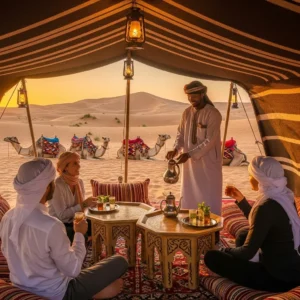
The most important ceremony you will witness is the coffee pouring.
This is not just a caffeine fix.
It is a diplomatic ritual.
It is called Gahwa.
Arabic coffee is brewed with cardamom and saffron.
It is served in small cups called Finjan.
The server holds the pot (Dallah) in his left hand.
He holds the cups in his right hand.
He serves the guest of honor first.
He pours only a small amount.
Just a sip or two.
This is called Sabah.
Why so little?
It ensures the coffee is hot.
It also signals that the host is ready to pour again and again.
It forces interaction.
If you fill the cup to the top, it is rude.
It means “Drink this and leave.”
Filling it a little means “Stay, I enjoy serving you.”
When you receive the cup, use your right hand.
Drink it.
If you want more, hand the cup back.
If you are finished, shake the cup gently from side to side.
This silent signal comes from the noisy majlis.
Or from times when tribes spoke different dialects.
The shake is universal.
In a Desert Safari Gateway to History, participate in this.
Do not just grab the cup.
Engage with the server.
Understand that for centuries, this cup settled wars.
It sealed marriage contracts.
It welcomed weary travelers who might have died without it.
The Connection to the Coast: Pearls
The desert history is tied to the sea.
Most Emirati tribes had a dual lifestyle.
In winter, they were in the desert.
In summer, they went to the coast for pearl diving.
The heat in the desert was unbearable in summer (50°C+).
The coast was humid but offered wealth.
Pearl diving was the main economy before oil.
Men would dive for months.
They used no oxygen tanks.
Just a nose clip made of turtle shell.
And a stone weight tied to their foot.
They dove 20 meters deep.
They held their breath for two minutes.
They collected oysters hoping for a pearl.
It was dangerous work.
Many died or went blind from the salt water.
The pearls were traded to India and Europe.
This trade brought wealth (rice, spices, silk) to the desert.
Your safari guide might tell you about this.
The songs of the pearl divers are famous.
They are rhythmic and deep.
They mimic the rowing of the boats.
Sometimes, these songs are played in the camp.
Understanding this duality—Desert and Sea—is crucial.
The Emirati is a man of two worlds.
He is a Bedouin and a Sailor.
This adaptability is the secret to their modern success.
Falconry: Hunting for Survival
You will likely hold a falcon on your safari.
It makes for a great photo.
But the history is about hunger, not photos.
Falconry was a method of survival.
The desert has very little game.
The Houbara Bustard and the Desert Hare are fast.
A human cannot catch them.
A camel cannot catch them.
But a falcon can.
Bedouins trapped wild falcons during their migration in autumn.
They trained them with incredible patience.
They used them to hunt meat for the family during winter.
The falcon was a partner.
It lived in the tent.
It had a name.
It was treated like a child.
In the spring, the Bedouin did something amazing.
He released the falcon.
He let it go back to the wild to breed.
This ensured the sustainability of the falcon population.
This is ancient conservation.
Today, falconry is a sport of Sheikhs.
The birds are bred in captivity.
They race for millions of dollars.
But the bond remains.
In a Desert Safari Gateway to History, watch the falconer.
Watch how he handles the bird.
It is a relationship of trust.
The hood on the falcon’s head keeps it calm.
When the hood is removed, the hunter awakes.
The Dress Code: Adaptation to Environment
You might wear the Kandura or Abaya at the camp.
These clothes are not costumes.
They are survival gear.
The Kandura (men’s white robe) reflects the sun.
It keeps the body cool.
The loose fit creates an airflow chimney.
The Ghutra (headscarf) protects the head from heat.
It can be wrapped around the face during sandstorms.
It filters the dust.
The Agal (black rope) holds the scarf.
But originally, it was used to tie the camel’s legs at night.
The Abaya (women’s black cloak) provides modesty.
But the Burqa (face mask) is often misunderstood.
The metallic-looking mask worn by older women is not a veil.
It mimics the features of a falcon.
It was a sign of beauty and status.
It also protected the skin from the harsh sun.
In a Desert Safari Gateway to History, trying these on connects you to the climate.
You realize how practical they are.
You feel the difference in temperature.
Modern Emiratis still wear this dress with pride.
It is a symbol of their identity.
It connects them to their ancestors.
The Fire: Al Warriah
At night, the camp centers around a fire.
This is the Al Warriah.
Fire was the lighthouse of the desert.
In the flat, dark landscape, a fire could be seen for miles.
It signaled safety.
It signaled hospitality.
“Come here, we have food and warmth.”
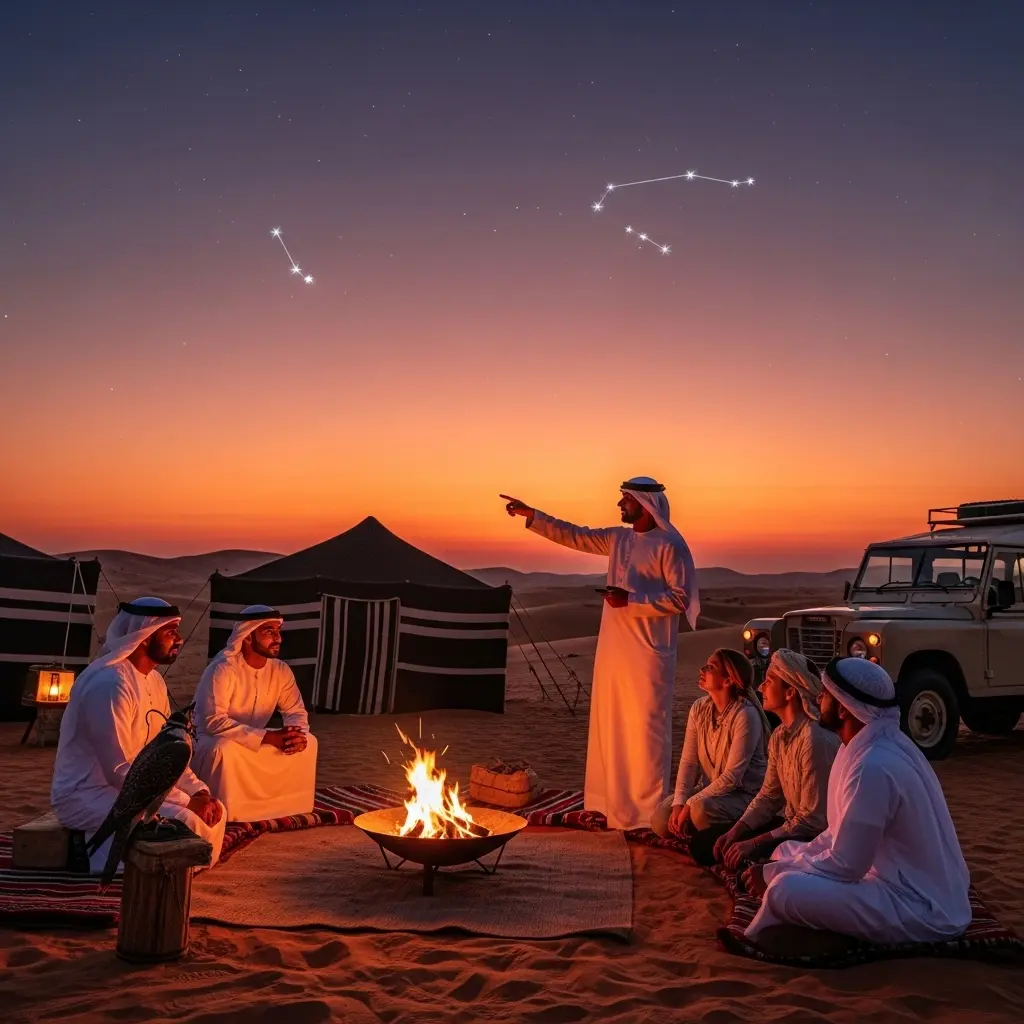
The fire pit was the school.
Elders sat around it.
They recited poetry (Nabati poetry).
They told stories of genealogy.
They taught the younger generation about the stars.
Oral history was the only library.
Nothing was written down.
Everything was memorized.
Poetry was the news broadcast.
It carried news of wars, rains, and births.
Sitting by the fire in your safari camp echoes this.
Listen to the crackle.
Imagine the silence of the Empty Quarter.
Imagine the voice of a poet reciting verses about his camel.
This atmosphere is preserved by operators like https://royaldesertadventures.ae/.
They create intimate spaces for this reflection.
They do not drown out the fire with loud music.
They let the fire speak.
Traditional Arts: Yola and Nabati
The entertainment you see has roots.
The Yola dance is famous.
Men spin dummy rifles.
They throw them high in the air.
They catch them rhythmically.
This is a victory dance.
It celebrates bravery in battle.
It celebrates the skill of the warrior.
It is performed at weddings and national days.
The music is driven by drums.
It is primal and energetic.
Another art form is Taghrouda.
This is chanted poetry.
It was used by camel riders.
The rhythm of the chant matches the footsteps of the camel.
It encouraged the camels to walk faster.
It kept the rider awake on long journeys.
If you are lucky, you might hear this on a specialized tour.
It is a haunting sound.
It uses the human voice as an instrument.
These arts are UNESCO Intangible Cultural Heritage.
They are protected.
Seeing them on a Desert Safari Gateway to History is a privilege.
It is not just a show.
It is an identity.
The Ghaf Tree: The Tree of Life
We mentioned the Ghaf tree before.
But it deserves its own section.
It is the national tree of the UAE.
It is an evergreen.
It survives where nothing else can.
It provided the only shade in the desert.
It was the majlis before tents were pitched.
Tribal meetings happened under Ghaf trees.
It provided food.
Its leaves were eaten by camels.
Its pods were eaten by humans in times of famine.
It provided medicine.
It stabilized the dunes.
Cutting a Ghaf tree was forbidden.
It was considered a crime against the community.
Today, you will see Ghaf trees protected by fences.
You will see them in the conservation reserves.
When your guide points one out, look closely.
It looks gnarled and dry.
But it is alive.
It represents the resilience of the Emirati people.
They survived against the odds, just like the tree.
The Influence of Islam
Islam arrived in the region in the 7th century.
It shaped the culture profoundly.
The hospitality, the modesty, the dietary laws.
Everything is influenced by faith.
The call to prayer would echo across the dunes.
Prayers gave structure to the day.
Dawn, noon, afternoon, sunset, night.
In the desert, the direction of Mecca (Qibla) was found by the stars.
The cleanliness required for prayer led to ingenuity.
If water was not available, sand was used for ablution (Tayammum).
On your safari, you will see prayer rooms in the camp.
You will see the respect for Halal food.
No pork is served.
Alcohol is often kept separate.
This religious framework provided a moral code.
It emphasized charity (Zakat).
It emphasized protection of the weak.
A Desert Safari Gateway to History respects these values.
It offers a glimpse into a life guided by faith.
It is a peaceful and disciplined life.
Navigation: The Ancient GPS
How did they not get lost?
The desert looks the same everywhere.
Bedouins were master navigators.
During the day, they used landmarks.
They knew the shape of specific mountains.
They knew the color of the sand changed from region to region.
They used the wind direction.
The ripples in the sand told them North or South.
At night, they used the stars.
The desert sky is incredibly clear.
They knew the constellations intimately.
They used them to navigate to water sources.
This knowledge was life or death.
Getting lost meant dying of thirst.
Guides on safaris today use GPS.
But the old guides still have the mental map.
They can navigate by instinct.
Ask your guide about this.
Ask him to show you the North Star.
It connects you to the ancient science of the Arabs.
Modern Preservation: The DDCR
History is not just in the past.
It is being preserved now.
The Dubai Desert Conservation Reserve (DDCR) is a prime example.
It covers 5% of Dubai’s land area.
It was created to protect the desert habitat.
It brought back the Arabian Oryx.
The Oryx was extinct in the wild in the 1970s.
Sheikh Zayed, the father of the nation, started a breeding program.
Now, there are hundreds in the reserve.
A Desert Safari Gateway to History often takes place here.
Access is limited.
Only select operators like https://dubaidesertsafarie.com/ can enter.
This prevents overcrowding.
It protects the plants and animals.
It preserves the landscape as it was 100 years ago.
Visiting the reserve is the closest you can get to the pre-oil era.
There are no power lines.
There are no buildings.
Just nature.
It is a living museum of natural history.
The Transformation: From Pearls to Oil
The final chapter of the history is the great change.
In the 1950s and 60s, oil was discovered.
Before this, the life was hard.
Electricity did not exist.
Roads did not exist.
The transformation was rapid.
Within one generation, Bedouins moved from tents to villas.
They moved from camels to Land Cruisers.
But they did not forget their roots.
The Sheikhs ensured that heritage was preserved.
They established festivals for camel racing.
They supported heritage villages.
They encouraged the youth to learn falconry.
A desert safari is part of this preservation.
It reminds the modern generation of where they came from.
It shows tourists the humble beginnings of this global city.
It creates a bridge between the past and the future.
When you sit in the camp, looking at the Burj Khalifa glow in the distance, you see the contrast.
From sand to skyscrapers in 50 years.
It is a miraculous story.
Conclusion
A Desert Safari Gateway to History is more than a tour.
It is an education.
It challenges the stereotype of Dubai as just a plastic city.
It reveals a culture that is deep, resilient, and welcoming.
It teaches us about survival.
It teaches us about sustainability.
It teaches us about community.
When you book your trip, look for the history.
Ask the questions.
Taste the heritage.
You will leave with more than just photos.
You will leave with respect.
Respect for the people who tamed this land.
Respect for the culture that welcomes the world.
The desert is waiting to tell you its secrets.
Are you ready to listen?
Start your historical journey at https://htdesertsafari.com/.
Experience the authentic traditions with https://royaldesertadventures.ae/.
Find the best cultural packages at https://dubaidesertsafarie.com/.
The past is present in the dunes.
Comparison Table: Modern vs. Ancient Desert Life
| Feature | Ancient Bedouin Life | Modern Safari Experience |
| Transport | Camels | 4×4 Land Cruisers |
| Shelter | Goat Hair Tents | Permanent Heritage Camps |
| Water | Wells & Oases | Bottled Mineral Water |
| Food | Dates, Milk, Dried Meat | BBQ Buffet & Fresh Bread |
| Light | Fire & Stars | Electric Lanterns & LEDs |
| Navigation | Stars & Landmarks | GPS & Apps |
| Clothing | Survival Gear (Kandura) | Cultural Dress-up |
| Purpose | Survival & Trade | Leisure & Education |
20 FAQs About Desert Safari as a Gateway to History
1. Is a desert safari historically accurate?
While a desert safari is a commercial tourism product, the “Heritage” and “Cultural” safaris strive for high historical accuracy. They use authentic materials for tents, serve traditional recipes, and employ guides who are knowledgeable about history. They recreate the atmosphere and lifestyle of the Bedouin, even if they add modern comforts like toilets and safety gear.
2. Can I see real Bedouins on a safari?
Most Bedouins have moved to modern housing in cities or government settlements. You are unlikely to meet a nomadic Bedouin living in a tent today. However, many of the camp owners, guides, and falconers are descendants of Bedouin tribes. They carry the knowledge and traditions of their ancestors and are proud to share them with guests.
3. What is the significance of the “dallah” coffee pot?
The Dallah is the ultimate symbol of Emirati hospitality. Its shape is iconic and is even featured on the 1 Dirham coin. It represents the readiness to serve guests at any time. A Dallah that is cold or empty is a sign of a poor host. In history, the sound of the pestle pounding coffee beans in a mortar was a signal to neighbors to come and share.
4. Why are the tents black?
The tents are black because they are made from the wool of black goats. This material is durable and readily available from the herds the Bedouins kept. The dark color also provides deep shade, which is essential in the blinding desert sun.
5. Did Bedouins really hunt with falcons?
Yes, absolutely. Falconry was not a sport; it was a necessity. In the winter, the desert provided very little plant food. Meat was needed for protein. Falcons could catch fast prey like hares and bustards that humans could not catch. It was a partnership for survival.
6. What is “Nabati” poetry?
Nabati is the vernacular poetry of the Arabian Peninsula. It is not written in classical Arabic but in the dialect of the people. It has been used for centuries to record history, express love, announce wars, and describe the beauty of nature. It is the “people’s poetry” and is still very popular today.
7. Is the food served actually traditional?
In heritage camps, yes. Dishes like Harees (wheat/meat porridge), Thareed (bread stew), and Luqaimat (sweet dumplings) are 100% traditional. Standard commercial camps might serve a more generic international BBQ (hummus, pasta, grilled chicken), which is less historically accurate but caters to mass tastes.
8. Why do men wear white and women wear black?
Men wear white (Kandura) to reflect the sun’s heat during the day when they were often outdoors working or traveling. Women wear black (Abaya) which is traditionally worn over colorful clothes. While black absorbs heat, the loose fabric allows air circulation. Historically, women’s movements were more private or within the tent/settlement, so the color was less about sun reflection and more about modesty and tradition.
9. What is the “Ghutra” used for?
The Ghutra (headscarf) is a multi-tool. It protects the head from sunburn. It wraps around the face to filter dust during storms. It can be used as a bandage, a rope, a prayer mat, or a bag to carry items. It is an essential piece of survival kit.
10. How did they find water?
They used a combination of deep ecological knowledge and memory. They knew which plants indicated groundwater. They followed animal tracks (birds often fly to water). They memorized the location of wells (Bir) and oases. They guarded these water sources fiercely.
11. What is the Dubai Desert Conservation Reserve?
The DDCR is a protected area of land dedicated to preserving the desert ecosystem. It prevents development and over-grazing. It allows the native plants and animals (like the Oryx) to thrive. It is an attempt to keep a part of Dubai exactly as it was in history.
12. Can I stay overnight like a Bedouin?
Yes, many operators offer overnight camping. You sleep in tents or under the stars. This is the closest you can get to the real experience. The silence of the night and the cold desert air give you a taste of the Bedouin reality.
13. What languages did Bedouins speak?
They spoke Arabic, but with distinct tribal dialects. The poetry and oral history preserved these dialects. Today, modern Arabic is standardized, but the local Emirati dialect still retains many Bedouin words related to the desert and camels.
14. Why is the camel called “Ata Allah”?
“Ata Allah” means “Gift of God.” The Bedouins believed the camel was a specific gift sent to help them survive in an environment where no other animal could. Its milk, meat, wool, and transport capabilities were seen as a divine blessing.
15. Is sandboarding historical?
No, sandboarding is a modern adventure sport added for tourists. Bedouins did not slide down dunes for fun; they conserved their energy. However, walking through the dunes is historical.
16. What is the “Majlis” culture?
Majlis culture is about open communication and hospitality. The Majlis is an open space where people can come to meet the Sheikh or the head of the family. It is a place for discussion, mediation, and bonding. It is the foundation of Emirati political and social life.
17. Why do they use saffron in coffee?
Saffron was a valuable trade spice. Adding it to coffee showed wealth and high esteem for the guest. It adds a distinct floral aroma and a golden color to the coffee, distinguishing it from the dark coffee of other regions.
18. What happened to the pearl divers?
The pearl diving industry collapsed in the 1930s due to the invention of cultured pearls in Japan. This caused great economic hardship in the UAE until the discovery of oil. However, the maritime heritage is still celebrated in festivals and museums.
19. Why use the link royaldesertadventures.ae?
Links like https://royaldesertadventures.ae/ connect you with operators who focus on the “Royal” or “Heritage” aspect of the safari. They often use high-quality setups that better reflect the historical grandeur of the Sheikhs’ desert retreats.
20. Is the safari experience educational?
Yes, if you choose the right one. A heritage safari acts as an open-air museum. You learn about botany, zoology, astronomy, history, and sociology. It is a fantastic educational experience for adults and children alike, moving beyond just “fun” to “knowledge.”