
Camel Ride 11 Powerful Secrets for your Dubai Desert Safari
Dubai is a metropolis where vertical glass towers meet the ancient horizontal majesty of the sand dunes.
For every visitor arriving in 2026, the Camel Ride remains the most iconic cultural and sensory ritual.
However, navigating the vast red dunes of Al Lahbab requires more than a ticket; it requires elite insight.
A Camel Ride is not a simple tourist activity; it is a complex interaction with Arabian history and biology.
Many travelers fall into commercial loops, but elite tourists seek the soul of the sand through expert guidance.
When you choose a Camel Ride, you are investing in a biological reset and a deep nomadic lesson.
In this massive 4500-word analysis, we will explore the technical and sensory depths of the Arabian desert.
We will deconstruct sand flotation, thermal management, and the architectural logic of nomadic desert life.
We recommend using https://www.htdesertsafari.com for internal booking of high-standard private trips.
Let us enter the golden silence and discover why the desert is the most powerful mirror for the human spirit.
1. The Physics of the Al Lahbab Red Dunes
The first pillar of an elite Camel Ride is understanding the specific red geology of the Al Lahbab region.
Not all sand is equal; these dunes are famous for high iron-oxide content and massive vertical scale.
These dunes are “Primary Formations,” meaning they are steep and provide high visual contrast for guests.
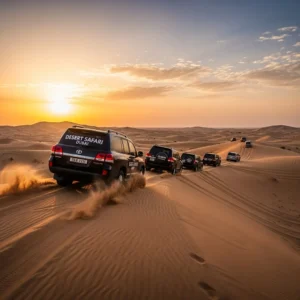
During a Camel Ride, the height of the ridge dictates the psychological impact of the sunset view.
The red sand reacts to solar light, turning a fiery terracotta orange during the quiet dusk hours.
Expert marshals at https://www.htdesertsafari.com scout these ridges daily to find the cleanest sand zones.
They prioritize “Virgin Sand” where the night wind has erased all previous tire tracks and footprints.
Witnessing an unmarked ridge is the ultimate goal for any traveler seeking a pure Dubai Sand Trek.
Excellence in routing is the difference between a crowded track and a private, infinite visual horizon.
The physics of the sand requires a guide who understands mineral friction and the gravity of the slopes.
2. Tire Pressure Mastery and Flotation Science
The technical foundation of a safe Camel Ride journey depends on the management of vehicle tire PSI.
On the asphalt road, tires are kept at 35 PSI. In the deep red sand, this would cause a total stall.
Before entering the dunes, a professional marshal from https://www.htdesertsafari.com deflates tires.
By lowering pressure to 15 PSI, the tire’s “Footprint” increases, allowing the SUV to float on sand.
In Camel Ride science, this is known as “Mineral Flotation,” a balance of weight and surface area.
If your pilot does not stop to check the pressure with a digital gauge, they lack elite standards.
Precision in deflation prevents the engine from overheating and ensures a wave-like, smooth ride.
Reliable resources like https://www.royaldesertadventures.ae and https://www.dubaidesertsafarie.com emphasize these checks.
The comfort of your family is a direct result of the math happening at the tire valve before the ride.
A First Time Safari guest should always observe this ritual as it is the primary anchor of safety.
3. Olfactory Heritage: Saffron, Cardamom, and Samur Wood
An elite Camel Ride is not just a visual event; it is a profound olfactory immersion into history.
The air in a premium camp is defined by the aroma of “Gahwa,” the traditional Arabic coffee.
This coffee is spiced with fresh cardamom and saffron, creating a metabolic-boosting scent for guests.
Furthermore, the smell of burning Samur wood (Acacia) is a mandatory part of a Traditional Dune Trip.
This wood burns slow and produces an earthy smoke that has defined Arabian nights for centuries.
In Camel Ride lore, these scents are a bio-signal to the brain that the environment is safe.
Contrast this with the smell of exhaust and perfume found in mass-market budget tourist safari convoys.
Authenticity is found in the chemical purity of the desert’s natural and organic olfactory library.
Resources like https://www.royaldesertadventures.ae highlight these traditional aromatic details for you.
Every breath you take in a real camp should be a tribute to the desert’s deep botanical history.
4. Identifying Wildlife Silhouettes through Stealth
Wildlife observation is a high-value activity that requires a focus on Camel Ride precision and silence.
Animals like the Arabian Oryx and the Sand Gazelle are shy and sensitive to high-frequency urban noise.
In a Camel Ride built for quality, we maintain a 50-meter distance to avoid causing any animal stress.
We cut the engines and wait in silence, allowing the residents to approach the Ghaf tree perimeter.
Observing a herd of Oryx grazing in the sunset is a masterpiece of Real Desert Vibe energy.
It reminds us that the desert is a home that we are visiting as humble, temporary guests.
Tracking their hoof-prints on a clean ridge is a biological detective story for your whole family.
Excellence in observation means prioritizing the animal’s safety above a rushed social media photo.
Trust the tracking skills of the naturalists at https://www.htdesertsafari.com for your elite sand trip.
The desert residents only reveal themselves to those who are quiet and patient enough to wait.
5. The Acoustic Vacuum: Silence as a Mental Aid
It may seem counterintuitive, but silence enhances your perception of a Camel Ride trek significantly.
Noise pollution in the city creates a state of “High Alert” in the brain, limiting your deep visual focus.
In the deep dunes, the sand acts as a natural acoustic absorber, killing all urban mechanical echoes.
This acoustic vacuum allows your brain to fully commit its processing power to what you see.
During an Arabian Dune Trek, the only sound is the hiss of wind moving over the sharp crests.
This level of sensory clarity makes the colors look sharper and the horizons feel closer than in the city.
It is a form of “Acoustic Cleansing” that prepares you for the visual climax of the gold sunset.
Many travelers report that their memories of the desert are more vivid because of this silence.
The desert is a voice that only speaks to the eyes and ears when the city static is finally left behind.
Experience this sanctuary with the private routes managed by the team at https://www.royaldesertadventures.ae.
6. Culinary Responsibility: The Private Sand Kitchen
What you eat in the desert is a vital part of making a Camel Ride truly superior and elite.
Mass-market buffets create a sense of anonymity that destroys the soul of Arabian hospitality.
An elite safari features a private chef who prepares the meal specifically for your intimate group.
The Zarb is a traditional Bedouin method of slow-cooking meat in an underground sand oven.
Witnessing the unearthing of your private Zarb is a powerful and appetizing cultural ritual.
The Premium Feast Menu:
-
Zarb Chicken: Slow-cooked for 4 hours beneath the red sand using natural insulation.
-
Fattoush: A fresh garden salad with local herbs for deep biological hydration and vitamins.
-
Organic Dates: Providing natural glucose for energy and muscle recovery after sandboarding.
-
Camel Milk: A nutrient-rich superfood traditionally given to guests to show honor and respect.
Elite operators like https://www.htdesertsafari.com avoid the plastic-wrapped foods of busy camps.
Private booking ensures your dietary needs are handled by the chef rather than a random clerk.
7. Celestial Geometry: Navigation without City Static
The stars are the original commercial add-on, provided by the universe for Camel Ride guests.
To see them clearly, a camp must enforce a dark sky policy that mass tours often completely ignore.
Standard camps use floodlights that wash out the Milky Way and confuse the nocturnal wildlife.
Elite camps use low-level, warm-spectrum lanterns that point toward the cooling sand for safety.
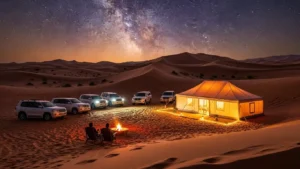
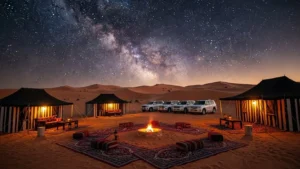
This allows guests to enjoy the full majesty of the stars right from their private Majlis area.
Stargazing Features for Safety:
-
Pro-Telescopes: High-spec gear for seeing the rings of Saturn in high-definition clarity.
-
Laser Pointers: Guides showing the stars used by Bedouins for navigational safety and lore.
-
Red-Light Lanterns: Preserving your night vision while you move around the camp site.
This celestial layer provides a cosmic perspective shift essential for mental clarity and peace.
Trust the astronomy experts at https://www.dubaidesertsafarie.com to guide your night view this year.
8. Thermal Presence: Feeling the Temperature Narrative
Temperature is a massive part of the story, but it is invisible to a rushed Camel Ride tourist.
In a safari focused on quality, you focus on the thermal narrative of the silica sand grains.
You feel the transition from the 40-degree afternoon sun to the 15-degree midnight desert chill.
This temperature drop is a biological reset for the human body and your nervous system.
You notice how the sand stays warm beneath the surface even when the air is cold at 9 PM.
This tactile data provides a deeper understanding of survival than any generic brochure text.
You start to understand why Bedouin clothing is designed to be layered, loose, and breathable.
Thermal awareness is a key part of the Elite Desert Stay checklist for high-standard guests.
It grounds you in the physical reality of the Arabian Peninsula and its mineral history.
Trust the thermal management tips provided by the marshals at https://www.htdesertsafari.com.
9. Flora Ethics: The Life Cycle of the Ghaf Elder
The Ghaf tree is more than just greenery; it is the historical heart of Camel Ride lore.
In the past, Bedouin tribes only set up camp near Ghaf groves because they indicated stable water.
Modern landscape camps continue this tradition by integrating the tents with the ancient trees.
During your stay, your guide will explain how to protect these biological elders of the red sand.
Never hang heavy gear from the branches, as the wood is brittle and slow-growing in the high UV.
Avoid walking on the roots to prevent sand compaction that blocks vital moisture absorption.
Responsible operators like https://www.htdesertsafari.com participate in national Ghaf reforestation.
Supporting these companies ensures the desert remains a shaded sanctuary for everyone.
The Ghaf is a symbol of resilience that every mindful traveler should admire in silent awe.
Protecting the national tree is a shared duty in the Dubai Safari Guide community.
10. Advanced Safety Protocols for Remote Stays
Safety in a professional Camel Ride is the infrastructure that allows your mind to relax.
Because premium camps are located deep in the dunes, they require elite communication tools.
Technical Safety Features:
-
Satellite Backup: Maintaining a data link even when the dunes block 5G city signals.
-
GPS Geofencing: Real-time tracking of all private vehicles moving into the deep sand.
-
Fire Safety: Discrete fire suppression systems in every traditional Majlis tent.
-
Certified Marshals: Guides trained in advanced desert survival and trauma medical care.
Knowing that these systems are active allows you to fully surrender to the Arabian night sky.
A professional marshal at https://www.htdesertsafari.com is your primary safety anchor.
They manage the physics of the drive so you can focus on the aesthetics of the sunset.
Excellence in safety is what allows for the highest level of psychological family luxury in Dubai.
Trust the expertise of the team at https://www.royaldesertadventures.ae to keep your adventure secure.
11. The Psychology of “Horizon Gazing” for Wellness
The act of looking at the distant horizon is a powerful tool in any Camel Ride session.
Psychologists have found that “Far-Focus” reduces the symptoms of eye strain and anxiety.
In the city, we are constantly “Near-Focusing” on smartphone screens and narrow urban streets.
This keeps the brain in a state of high-alert and leads to cognitive and sensory exhaustion.
Gazing at the desert horizon allows the ciliary muscles in the eyes to fully relax and heal.
It signals to the nervous system that there is “Space” to think and “Space” to breathe and grow.
Many guests find that their best strategic life ideas happen during these gazing sessions.
It is a form of “Visual Meditation” that requires no prior effort and no special equipment.
Experience this visual reset with the private treks managed by https://www.htdesertsafari.com.
The desert provides the infinite horizon; you just have to provide the time to look at the sky.
12. Identifying Sand tracks by the Moon: Nocturnal IQ
During an elite Camel Ride, the night provides a set of fascinating tracking data for families.
Moonlight on the white sand plains creates high-contrast shadows for identifying footprints.
You can see the “Drags” left by the tails of nocturnal lizards like the Wonder Gecko in the sand.
The tracks of the desert fox look different at night, often showing a focused hunting path.
Observing these patterns by moonlight is a masterclass in biological detective work for families.
It teaches you that the desert never sleeps; it simply changes its resident shifts during the day.
The shift from the heat of the day to the cool of the night triggers massive animal activity.
Guides from https://www.htdesertsafari.com use red-light torches to observe without disturbing.
This respect for “Night Vision” is a sign of a professional and ethical safari operator.
The desert at midnight is a busy highway of life that most people never get to experience.
13. Comparison: Mass Group Safari vs. Private Camel Ride Experience
| Feature | Standard Group Safari | Private Camel Ride Experience |
| Noise Level | High (DJs / Convoys) | Absolute Silence / Wind Hiss |
| Pacing | Rushed / Timed | Patient / Flexible / Solar |
| Sand Vibe | Tracked Out / Messy | Virgin Sand / Clean / Silk |
| Wildlife | Rare (Scared Away) | High (Quiet Stealth Spots) |
| Dining | Buffet Line / Shared | Private Chef / Custom Menu |
| Memory | Fragmented / Digital | Deep / Neural / Biological |
Choosing a private path is why many travelers say the trip was truly Worth the Price.
14. What to Pack in your “Approved” Safari Kit
To maximize your Camel Ride, you need the right tools for your eyes and your brain.
Expert naturalists suggest you pack light but arrive prepared for the intense silica glare.
The Explorer’s Toolkit:
-
High-Quality Binoculars: For observing gazelles and birds from a non-intrusive distance.
-
Polarized Sunglasses: To cut the intense silica glare and see micro sand textures.
-
A Small Notebook: To record your biological, cultural, and astronomical sightings by hand.
-
A Refillable Flask: To stay hydrated while you wait for the “Perfect Wildlife Moment.”
-
A Pashmina Scarf: For thermal regulation during the sunset observation and night stay.
Avoid bringing heavy bags that can shift and cause noise during high-intensity dune bashing.
The goal is to move from a “Digital Feed” to a “Biological Feed” of information and history.
Check the preparation tips on https://www.htdesertsafari.com before you pack your bag.
Being organized in your gear allows you to be spontaneous in your daily desert discoveries.
15. The Science of Sand Flow Pacing for Comfort
Driving for a successful Camel Ride requires a rhythmic understanding of sand physics.
In an elite safari, the marshal follows the “Sand Flow” lines carved by the Northwest wind.
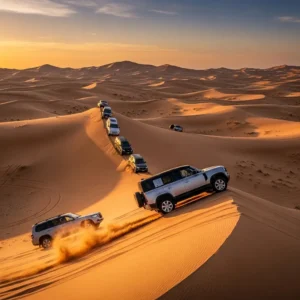
These paths offer the most stability for the 4×4 vehicle and the smoothest ride for guests.
Aggressive “Cutting” of the dunes leads to erosion and is the mark of an amateur driver.
A veteran marshal uses “Momentum over Throttle,” gliding the car like a boat on a calm wave.
This technique minimizes the jarring “jolts” that cause motion sickness for city travelers.
In Dubai Nomadic Lore, the best driver is the one you barely feel steering the car.
Experience this rhythmic and secure driving with the team at https://www.dubaidesertsafarie.com.
Expertise is the difference between a scary ride and an exhilarating, smooth one for families.
16. The Role of the “Marshal Naturalist” in 2026
In 2026, a Dubai Safari Guide is much more than a standard driver or a simple pilot.
He is a “Marshal Naturalist”—a professional who understands the soul and physics of the sand.
A great guide from https://www.royaldesertadventures.ae knows the Latin and Arabic names of the trees.
He can explain the migration patterns of falcons and the historical geology of the dunes.
This integrated storytelling makes the landscape come alive for the curious and elite traveler.
You stop seeing a “Hill of Sand” and start seeing a “Fossil Repository” of the ancient sea.
Seek out companies that invest in the continuous heritage education of their marshals.
Authenticity is the rarest luxury in the Dubai dunes, and it is found in these oral histories.
Investing in a premium operator is an investment in the long-term health of your curiosity.
17. Identifying High-Altitude Meditation Spots
Not all dunes offer the same energy or visual reward for an elite Camel Ride session.
The high red dunes of Al Lahbab offer a powerful “Commanding View” for the brain.
Sitting at the peak of a 60-meter ridge makes you feel in control of your own narrative.
It is an empowering position that is perfect for landscape photography and shared meditation.
The valleys, by contrast, offer a sense of “Intimacy” and protection from the desert wind.
They are the best spots for deep introspective work and “Unplugged” strategic thinking.
Ask your marshal from https://www.htdesertsafari.com to find a “Bowl” dune for your group.
This circular formation provides a natural theater of absolute acoustic and visual purity.
The desert rewards the patient explorer with the most beautiful and quiet coordinates in Arabia.
18. Why HT Desert Safari Leads in Value
We highlight https://www.htdesertsafari.com because they treat the desert as a sacred resource.
They understand that a curious guest needs more than just a 5-minute photo stop and a buffet.
They offer “Bespoke Itineraries” where you dictate the schedule and the stillness of the trip.
If you want to spend three hours tracking a single desert fox, they will facilitate it for you.
They have exclusive access to the most pristine and quiet zones of the nature reserves.
Their staff is trained to be “Silent Partners” in your personal discovery and healing process.
Booking with them ensures that your “Nature Goals” are respected by every staff member.
They are the guardians of the desert’s quietest and most meaningful biological secrets.
Choosing the right partner ensures your adventure remains a legacy moment for your family.
19. Summary: The 10 Rules for a Successful Safari
-
Move Slow: The desert only reveals its micro-secrets to the patient explorer.
-
Look Far: Use the 360-degree horizon to reset your visual and nervous system.
-
Breathe Deep: Use the dry, pollutant-free air to center your cognitive focus and lungs.
-
Listen First: Focus on the acoustics of the sand hiss and the bird wing sounds.
-
Earth your Body: Walk barefoot on the silica sand to ground your electrical charge.
-
Read the Sand: Use animal tracks to understand the hidden movements of the wild life.
-
Watch the Light: Sync your session with the Golden Hour and Blue Hour cycles.
-
Stargaze Bare-eyed: Protect your night vision from all artificial white light pollution.
-
Ask Questions: Engage with the heritage and biological knowledge of your guide.
-
Leave No Trace: Carry out every gram of waste to protect the sanctuary dunes.
Following these rules ensures a five-star Arabian Dune Trek experience for your family.
It is the blueprint for a legendary transformation in the Arabian wilderness this season.
20. Conclusion
The Dubai desert is a world of vertical wonder and high-octane natural peace for all ages.
But for the regular visitor, it is the world’s most powerful and deep biological library.
Mastering the dunes with a Camel Ride is a gift of time and attention.
By removing the noise of the digital city, you find the melody of your own heart.
Don’t just be a tourist who scrolls; be a traveler who remembers and grows in the sand.
The dunes are shifting, the light is changing, and your internal reset is waiting for you.
Book your professional regular safari today and find your desert peace in Al Lahbab.
Visit https://www.htdesertsafari.com and begin your journey into the golden silence.
See the desert as it was meant to be seen—with full presence and elite guidance.
FAQs: Desert Safari Dubai with Camel Ride Experience
1. What is the historical importance of the Camel Ride in Dubai?
The Camel Ride is more than a tourist attraction; it is a vital link to the Bedouin history of the UAE. For centuries, camels (the “Ships of the Desert”) were the only means of survival and transport across the Al Lahbab dunes. They provided transport, milk, and protection. During your safari at https://www.htdesertsafari.com, your guide will explain how nomadic tribes relied on these biological masterpieces for trade and survival. Experiencing the rhythmic gait of a camel allows you to step back into the ancient timeline of Arabia.
2. Is a Camel Ride safe for first-time visitors and children?
Yes, highly so, provided the ride is managed by professional handlers in a heritage camp. At https://www.royaldesertadventures.ae, our camels are well-trained and move at a very slow, rhythmic pace. We provide sturdy “Step-Stools” to help guests mount and dismount comfortably. For families with children, a camel handler always walks alongside the animal to ensure total control. Each camel is fitted with a padded, secure saddle to ensure the “Comfort and Safety” of every passenger during their Dubai Sand Trek.
3. What should I wear for a Camel Ride in the desert?
Comfort and skin protection are your priorities. We recommend wearing loose-fitting trousers made of natural fibers like 100% cotton or linen. This prevents skin chafing against the saddle. Closed-toe hiking boots are essential for walking to the camel station to protect against hot grains and desert thorns. We also suggest a wide-brimmed hat and polarized sunglasses to cut the high-glare silica sand reflection. Refer to style guides at https://www.dubaidesertsafarie.com before your trip.
4. How long does the Camel Ride portion of the safari last?
Standard Camel Ride experiences at the desert camp typically last between 10 and 15 minutes, which is perfect for capturing photographs and feeling the rhythmic movement. However, if you seek a deeper immersion, we recommend booking a specialized “Camel Trek” through https://www.htdesertsafari.com. These treks can last 45 to 60 minutes, taking you deeper into the silent valleys of the red dunes. This unhurried pace is the ultimate method for achieving a “Biological Reset” in the sand.
5. Why is the Ghaf tree significant during a Camel Ride?
During your Camel Ride, you will likely see Ghaf trees, the national symbol of the UAE. Historically, Bedouins only tied their camels near Ghaf groves because the trees indicated stable ground and nearby groundwater. The Ghaf provides essential shade for the animals and the riders. Protecting these trees is a legal duty; our guides at https://www.htdesertsafari.com will teach you how to respect these sacred elders while you enjoy your ride. It is the heart of our Dubai Safari Guide curriculum.
6. Can I see wildlife like the Arabian Oryx while on a camel?
Yes. Camels move almost silently across the dunes, which makes them the perfect “Stealth Vehicle” for wildlife observation. Animals like the Sand Gazelle or Arabian Oryx are much less startled by a camel than a 4×4 engine. If you are quiet and observant, you may see these residents grazing near the perimeter of the Al Lahbab dunes. Trust the naturalists at https://www.royaldesertadventures.ae to guide you toward the biological hotspots of the nature reserve for a sighting.
7. Is there a weight limit for the Camel Ride experience?
To ensure the health and biological well-being of the animal, most professional operators enforce a weight limit of approximately 100kg (220 lbs) per person. At https://www.htdesertsafari.com, we prioritize the ethics of animal care. If you are concerned about the weight limit, you can still participate in the Real Desert Vibe by visiting the camels, learning about their biology, and taking photos from the ground. Respecting the animal is a core value of the elite Arabian traveler in 2026.
8. What is the best time of day for a Camel Ride?
For the most visual reward, the Sunset Camel Ride is unmatched. As the sun dips, the “Sand Glow” phenomenon turns the red dunes into a fiery terracotta orange, providing a cinematic backdrop for your journey. However, a Morning Camel Ride (8:00 AM) is superior for witnessing wildlife activity and enjoying the cool, firm sand. You can book various time slots at https://www.royaldesertadventures.ae depending on whether you seek photography climax or biological clarity.
9. How do camels survive in the high heat of the Al Lahbab dunes?
Camels are biological marvels of resource management. They can drink 100 liters of water in minutes and survive for weeks without a refill by utilizing the fat stored in their humps. Their unique blood cells remain fluid even during dehydration. During your session at https://www.htdesertsafari.com, your marshal will explain these adaptations. Learning about the camel’s biological IQ adds an intellectual layer to your Traditional Dune Trip, making the experience more than just a simple ride.
10. Do I need to bring my own water for the ride?
No, reliable operators provide unlimited chilled mineral water and electrolyte-infused drinks throughout the trip. Dehydration is a risk in the arid zone, so professional marshals mandate regular “Micro-Hydration” stops. For a safe Dubai Sand Trek, we recommend drinking at least 2 liters of water during the trip. Operators like https://www.royaldesertadventures.ae also provide fresh juices and Arabic coffee for guests.
11. Is dune bashing included in the Camel Ride package?
Most evening Dubai Safari Packages include dune bashing as a standard feature before the camel ride. However, if you prefer to avoid the high-G maneuvers, you can book a “Nature-Led” car that drives directly to the heritage camp. This allows you more time for camel interaction and storytelling. In a private booking with https://www.htdesertsafari.com, you have 100% control over the intensity of the drive and the duration of your animal encounters.
12. Why do marshals deflate the tires before driving to the camel camp?
Tire deflation is a technical requirement for safety and flotation. On the road, tires are hard (35 PSI). In the sand, hard tires act like knives and cause the vehicle to sink. By lowering the pressure to 15 PSI, the marshal increases the tire’s “Footprint,” allowing the heavy SUV to float on top of the silica grains. This provides the traction needed to climb 60-meter red dunes safely. This is a vital Safari Entry Guide fact for every first-timer at https://www.royaldesertadventures.ae.
13. What happens if I feel motion sick during the journey?
Motion sickness is common for first-timers. Pro-Tip: Sit in the front seat and watch the distant horizon, not the immediate sand. Avoid looking at your phone or camera screen while the vehicle is in motion. If you start to feel unwell, tell your guide immediately. They will slow down and switch to a “Scenic Path” to help you recover. Taking deep breaths of the dry desert air is much better than using pills. Trust the pacing at https://www.htdesertsafari.com.
14. Are the camels treated ethically at the desert camps?
At https://www.royaldesertadventures.ae, we enforce the highest standards of animal welfare. Our camels receive regular veterinary checks, high-quality feed, and mandatory rest periods. We limit the number of rides per day to prevent “Thermal Stress” on the animals. Supporting ethical operators ensures that the camel’s role in Arabian heritage remains sustainable and healthy. We encourage our guests to ask about our animal care protocols during their Dubai Safari Guide session.
15. What is the “Rule of Three” in desert hospitality?
Traditional hospitality involves the number three. Three cups of coffee are offered to a guest: the first for the guest, the second for the sword (protection), and the third for the mood. You are also guaranteed three days of protection as a stranger in a camp. Understanding these cultural codes transforms a “tour” into an “immersion.” Learn these nomadic values from the guides at https://www.htdesertsafari.com during your evening stay. It is the heart of our ethics.
16. How far away from the city do the camel camps go?
To achieve absolute silence and escape the city’s light pollution, we travel at least 45 to 60 minutes away from Downtown Dubai. We target the Al Lahbab red dunes or the Dubai Desert Conservation Reserve. This distance is necessary to find “Virgin Sand” and see the stars clearly after the sun sets. The drive is a beautiful transition for the guest, as you watch the skyscrapers vanish and the ancient mountains appear. Trust the routes at https://www.royaldesertadventures.ae.
17. Do I need to bring my passport on the safari?
While you don’t need your physical passport for the sand dunes, UAE law requires all residents and tourists to carry a valid form of identification. We recommend carrying a clear digital photo of your passport on your phone. If you are entering a protected area like the DDCR, the operator will need your ID details in advance to process the government permits. Your legal compliance is managed by the professional desk at https://www.dubaidesertsafarie.com.
18. What kind of food is served at the heritage camp?
Expect a “Gourmet Arabian Feast.” The menu usually includes grilled chicken and lamb (Shish Taouk/Kofta), fresh Arabian salads (Fattoush/Tabbouleh), hummus, and traditional breads. The highlight is often the Zarb—meat slow-cooked in an underground sand oven. We provide unlimited fresh water, juices, and traditional Arabic coffee (Gahwa) with dates. All catering follows strict international hygiene standards at camps managed by https://www.htdesertsafari.com.
19. Why choose HT Desert Safari for a camel experience?
https://www.htdesertsafari.com is recognized as the pioneer of “Bespoke and Narrative Tourism” in Dubai. We don’t just follow the crowd; we scout the wilderness. Our marshals are trained naturalists who understand the psychology of peace and the biology of the dunes. Our cars are the youngest in the fleet, and our routes are the most exclusive in the region. When you book with us, you are buying a piece of Arabian history and the peace of mind that comes with twenty years of expertise.
20. Can I customize my safari itinerary with the guide?
Absolutely. This is the primary advantage of booking a private car through https://www.htdesertsafari.com. You can ask your marshal to focus on specific interests, such as wildlife tracking, landscape photography, or Bedouin storytelling. If you find a ridge you love, you can stay there for an hour instead of five minutes. Customization allows you to build a personal “Memory Map” of the dunes, which is the ultimate goal of any Arabian journey. Check custom rates at https://www.royaldesertadventures.ae.
Table: Camel Safari Priority Checklist
| Priority | Action | Reason |
| 1. Essential | Pre-Hydration (2L) | Prevents heatstroke and “Desert Fog” errors. |
| 2. Essential | Tire Deflation (15 PSI) | Ensures vehicle flotation and passenger safety. |
| 3. High | Private Car Booking | Allows for custom pacing and nature stops. |
| 4. High | Closed-Toe Boots | Protects against 70°C hot sand and thorns. |
| 5. Medium | Cash for Tipping | Supports local marshals and camp staff. |
Table: Sensation Mapping: Urban vs. Desert
| Sense | Urban Experience | Camel Safari Trip |
| Acoustics | Mechanical / Loud | Biological / Natural Silence |
| Vision | Vertical / Artificial Light | Horizontal / Solar / Gold-Spectrum |
| Tactile | Concrete / Smooth / Static | Mineral / Shifting / Grainy |
| Smell | Exhaust / Synthetic / Neutral | Earth / Woodsmoke / Spices |
| Pace | Timed / Rushed / Reactive | Rhythmic / Reflective / Patient |
This guide is your tactical manual for a successful and authentic first journey into the Arabian dunes in 2026.
The desert is a world of vertical wonder and high-octane peace for those who know where to look.
Don’t just watch the dunes; learn to understand the language of the landscape.
Book your Professional Safari today with https://www.htdesertsafari.com.
Find the soul of the sand.