
Desert Safari Camps Traditional Design: 7 Best Ways to Enjoy Dubai History
Dubai is a city of sharp contrasts. On one side, you have the soaring steel of the Burj Khalifa.
On the other side, you have the timeless silence of the sand dunes.
To truly understand the heart of the UAE, you must step away from the skyscrapers.
You must enter the world of Desert Safari Camps with a focus on heritage.
Many modern camps are flashy. They use neon lights and modern furniture.
But a Desert Safari Camps Traditional Design experience is different.
It takes you back to a time before the oil boom. It honors the Bedouin way of life.
The architecture is simple. The materials are natural. The atmosphere is grounded in history.
If you are a traveler who values authenticity over spectacle, this is for you.
You want to sit on a hand-woven rug, not a plastic chair.
You want to smell the woodsmoke of a real bonfire.
In this guide, we will explore the elements of traditional camp design.
We will discuss why these heritage-focused camps offer a superior cultural experience.
We will show you how operators like https://htdesertsafari.com/ curate these historical spaces.
Let us pull back the goat-hair curtain and step into the past.
1. The Architecture of the Bedouin Tent
The foundation of Desert Safari Camps is the tent. In Arabic, this is called “Bait Al Sha’ar”.
Historically, these tents were woven from goat or sheep hair.
The color was typically black with white stripes.
In a traditional design camp, you will see these authentic materials.
The fabric is breathable. It keeps the interior cool during the day and warm at night.
Modern “tourist” camps often use cheap synthetic canvas.
But heritage camps stick to the heavy, textured weaves.
The structure is held up by wooden poles. There are no steel frames.
This flexibility allowed Bedouins to pack and move within minutes.
When you sit inside a real “Bait Al Sha’ar”, you feel the history.
You feel the labor that went into weaving the fabric.
It creates a sensory connection to the ancestors of the land.
2. The Art of Majlis Seating
In Arabic culture, the Majlis is the place of sitting.
It is where guests are received. It is where stories are told.
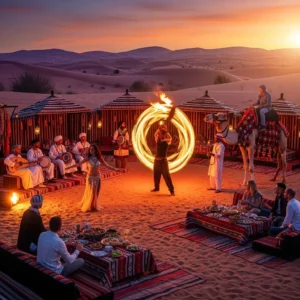
In Desert Safari Camps Traditional Design, the Majlis is the centerpiece.
Forget about high tables and plastic chairs.
Authentic seating is low to the ground. It uses thick carpets and “Sadu” cushions.
Sadu is a traditional weaving technique using geometric patterns.
The colors are usually bold reds, blacks, and whites.
Sitting on the floor encourages equality. Everyone is at the same level.
It forces you to slow down. It changes your perspective.
You are closer to the earth. You feel the texture of the sand beneath the rugs.
This layout is essential for a true Arabic Camp Decor.
It facilitates conversation. It fosters a sense of community among travelers.
3. Lighting with Lanterns and Fire
Modern lighting can ruin the desert vibe. Harsh LED floodlights kill the stars.
Traditional design favors “Fanoos” lanterns.
These are metal lanterns with intricate cut-outs.
When a candle or a low-wattage bulb is placed inside, it casts patterns on the sand.
It creates a soft, golden glow. It feels intimate.
The most important light source, however, is the fire.
A traditional camp always has a central fire pit.
This was the original heater and stove for the Bedouin.
Watching the flames dance against the dark sky is a primal experience.
It provides a focal point for the evening.
At https://htdesertsafari.com/, the lighting is curated to preserve the night sky.
They avoid light pollution so you can see the Milky Way.
4. Natural Materials and Sustainability
Bedouins lived in harmony with the desert. They wasted nothing.
Desert Safari Camps Traditional Design reflects this eco-conscious mindset.
You will see wood, palm fronds, and stone.
“Arish” is a common material. These are walls made from dried palm leaves.
They allow the wind to pass through, providing natural air conditioning.
The pathways are often lined with stones or simple wooden planks.
There is no concrete. There is no asphalt.
This means the camp can be removed without leaving a permanent scar on nature.
It is the definition of sustainable tourism.
By choosing a traditional camp, you are supporting environmental preservation.
You are choosing a footprint that the wind can eventually erase.
Operators like https://royaldesertadventures.ae/ are leaders in these green designs.
5. The Culinary Heritage: The Underground Oven
Food is the soul of hospitality. In the desert, cooking was an outdoor event.
A traditional camp design includes a “Mandi” or “Zarb” pit.
This is an oven dug into the sand.
The meat and rice are placed inside and covered with hot coals.
The sand acts as an insulator. The food slow-cooks for hours.
When the lid is lifted, the aroma fills the entire camp.
It is a theatrical and delicious part of the Traditional Safari Dining.
You won’t find this in a modern, industrial kitchen camp.
Traditional design ensures the kitchen is part of the experience.
You see the bread being baked on a “Saj” (domed griddle).
You see the coffee being brewed in a “Dallah” over the embers.
It turns a meal into a cultural lesson.
6. Scent and Atmosphere: Bakhoor and Frankincense
Design is not just visual. It is olfactory.
A traditional camp should smell like the Middle East.
You will encounter the scent of “Bakhoor” (scented wood chips).
These are burned on charcoal in a “Mabkhara” burner.
The smoke is thick and sweet. It is used to welcome guests.
It clears the mind. it sets a sacred tone for the evening.
In the Majlis, you might also smell the roasting of green coffee beans.
This aroma is the signature of Authentic Dubai Safari hospitality.
It tells your brain: “You are home. You are safe.”
The combination of woodsmoke and incense is a powerful design element.
It creates a memory that lasts longer than any photograph.
7. The Heritage Village Concept
Some operators go beyond a single camp. They build a “Heritage Village”.
This is a sprawling Desert Safari Camps setup that mimics a small settlement.
There are different zones for different crafts.
One area for the blacksmith. One for the weaver. One for the falconer.
The layout follows the logic of an old Emirati village.
The houses are built close together to provide shade.
There is a central square for communal dances like the “Al Ayyala”.
Walking through a heritage village feels like a time-travel expedition.
It provides educational depth that a standard camp lacks.
It is perfect for families who want their children to learn history.
You can compare village layouts at https://dubaidesertsafarie.com/.
8. Why Traditional Design Matters for Comfort
Some people think “Traditional” means “Uncomfortable”.
This is a mistake.
Traditional design was perfected over thousands of years for one goal: survival.
Bedouins knew how to stay cool in 50-degree heat.
They knew how to block the wind during a sandstorm.
By using natural ventilation and thick fabrics, these camps are often more comfortable than modern ones.
A low Majlis seat is actually better for the back than a stiff plastic chair.
The sand provides a natural, orthopaedic base.
Traditional design is human-centric.
It creates a cozy, “hygge” feeling in the middle of the wilderness.
It removes the “industrial” feel of mass tourism.
9. The Role of Water in Design
In the desert, water is life. Traditional camps often feature a “Sabeel” or a well replica.
Water was traditionally stored in clay pots called “Jirra”.
These pots are porous. They allow a small amount of water to evaporate through the walls.
This process cools the water inside naturally.
In a Desert Safari Camps Traditional Design, you will see these clay pots used as decor.
Sometimes they are used as functional water dispensers.
The sound of trickling water is a luxury in the dunes.
It provides a psychological cooling effect.
It reminds the guest of the preciousness of every drop.
10. Handcrafted Details and Trinkets
Look at the walls and poles. You will see hand-carved details.
Traditional design favors the “imperfect” over the “machine-made”.
You will see hammered brass plates. You will see old rifles (deactivated) as decor.
You will see “Barjeel” (wind tower) replicas.
These small details add layers of storytelling to the space.
Every item has a history. The driver or host can tell you where it came from.
This turns the camp into a living museum.
It provides a rich background for photography.
Your photos will look like they belong in a history book.
They won’t look like a generic tourist photo.
11. Choosing the Right Partner for Heritage
Not every company understands Arabic Camp Decor.
Many simply buy a “safari kit” from a factory.
To find the best, you must look for operators who invest in local artisans.
https://htdesertsafari.com/ is known for its commitment to Emirati culture.
They employ heritage experts to design their spaces.
They maintain the camps using traditional methods.
When you book with them, you are getting an curated experience.
You are seeing the desert through the eyes of those who love it.
Check their gallery to see the difference in design.
12. Conclusion
The desert is a place of deep roots.
A Desert Safari Camps Traditional Design trip is a way to touch those roots.
It is a break from the plastic and the fast-paced world.
It is an invitation to sit, breathe, and listen to the ancestors.
The beauty of the Sadu weave. The glow of the Fanoos. The taste of Mandi.
These are the elements of a perfect night.
Do not settle for a generic camp.
Demand history. Demand authenticity.
Book your heritage adventure today.
Visit https://htdesertsafari.com/.
Experience the desert as it was meant to be.
FAQs: Desert Safari Camps with Traditional Design
Here are 20 detailed questions and answers to help you find the most authentic experience.
1. What makes a camp “traditional” rather than “modern”?
A traditional camp focuses on natural materials and Bedouin heritage. You will see goat-hair tents, Arish (palm frond) walls, and low Majlis seating on the sand. Modern camps often use steel structures, LED lights, and western-style furniture. Traditional design prioritizes the feeling of an old settlement rather than a contemporary party venue.
2. Is floor seating mandatory in traditional camps?
While traditional design emphasizes floor seating on cushions (Majlis), most reputable operators like https://htdesertsafari.com/ provide “VIP” areas with raised tables and chairs for those with mobility issues or back pain. You can enjoy the traditional aesthetic while still having the comfort of a chair.
3. Do traditional camps have electricity?
Yes, for safety and food hygiene, all licensed camps have electricity. However, traditional design hides the wires and uses warm-toned bulbs or lanterns to mimic candle light. Some eco-friendly camps use solar power to stay true to the sustainable nature of Bedouin life.
4. Are the restrooms also traditional?
No, for hygiene reasons, the restrooms are modern. They feature Western-style toilets, running water, and sinks. However, the exterior of the toilet block is often disguised with Arish or stone to blend into the Traditional Desert Design.
5. What is “Sadu” weaving?
Sadu is the traditional embroidery and weaving technique used by Bedouin women. It uses vibrant colors and geometric patterns that represent desert life (like camels or palm trees). In a traditional camp, you will see Sadu used for cushions, rugs, and wall hangings.
6. Is the food different in a traditional camp?
Traditional camps often prioritize authentic cooking methods. This includes the “Zarb” (underground oven) and “Saj” bread making. While the menu is a buffet, the focus is on Emirati and Levantine flavors like Mandi, Kabsa, and fresh Hummus, rather than international fast food.
7. Are traditional camps more expensive?
They can be slightly more expensive because maintaining natural materials like goat hair and palm fronds is more labor-intensive than using synthetic canvas. However, the value of the cultural immersion is much higher. You are paying for a heritage experience.
8. Can I see how the tents are made?
Many Heritage Desert Village setups have a dedicated area where a lady demonstrates traditional weaving. You can see the hand-looms and the raw wool. It is a fascinating look into the labor-intensive crafts of the past.
9. Is there air conditioning in a traditional tent?
Generally, traditional tents are designed for natural ventilation. However, during the extreme summer months, many operators install discreet AC units or misting fans inside the tents. In winter, the natural breathability of the fabric is enough to keep you comfortable.
10. What is a “Bait Al Sha’ar”?
This literally translates to “House of Hair”. It is the traditional black and white tent made from goat or sheep wool. It is the icon of Bedouin life and a mandatory feature of any Desert Safari Camps Traditional Design.
11. Why is the fire pit so important?
The fire pit (Mankal) was the social hub of the Bedouin camp. It provided warmth, light, and a way to cook coffee. In a modern safari, it maintains that social function, acting as a place for guests to gather and share stories under the stars.
12. Is the entertainment also traditional?
Yes. Traditional camps usually feature the “Tanoura” dance and “Al Ayyala” (stick dance). They avoid loud, modern pop music and instead use the “Oud” (lute) or “Tablah” (drum) to create a more acoustic and authentic atmosphere.
13. Are these camps suitable for children?
Absolutely. Children find the traditional layout very exciting. It is like an outdoor museum. They can play in the sand, sit on the colorful cushions, and see the camels up close. It is a great way to introduce them to Middle Eastern history.
14. How do I know if a camp is authentic before booking?
Check the photos on https://htdesertsafari.com/ or https://royaldesertadventures.ae/. Look for natural colors (beige, brown, black), low seating, and a lack of plastic. Read reviews that mention “culture”, “authenticity”, and “Bedouin vibe”.
15. What should I wear to a traditional camp?
Modest, comfortable clothing is best. Loose trousers and a cotton shirt are ideal. Since you will be sitting on the floor, avoid very short skirts. Bring a shawl or jacket, as the traditional open-air design can be chilly at night in winter.
16. Are traditional camps smaller than modern ones?
Often, yes. Authentic design is hard to scale to 1000 people. Boutique heritage camps usually limit their capacity to 50 or 100 guests. This creates a much more intimate and personalized experience.
17. Do traditional camps offer Shisha?
Yes, Shisha is a deeply rooted social custom in the region. Most traditional camps have a dedicated “Shisha Corner” with comfortable floor cushions and low tables, mirroring the social cafes of old Dubai.
18. What is “Arish” architecture?
Arish is a type of construction using palm fronds. The leaves are woven together to create walls and roofs. It is remarkably effective at allowing cool breezes to pass through while blocking the sun. You will see many Arish huts in a Heritage Safari Tour.
19. Can I buy traditional crafts at the camp?
Many heritage camps have a small souk (market) area. Here, you can buy authentic sand art, Sadu-patterned bags, or local spices. Purchasing these items directly supports the artisans who keep the traditions alive.
20. Why book through htdesertsafari.com?
They specialize in the “Quality over Quantity” approach. They have vetted the camps for design integrity and cultural accuracy. They ensure that your “traditional” safari is not just a marketing gimmick, but a genuine tribute to Emirati heritage.
Table: Traditional vs. Modern Camp Comparison
| Feature | Traditional Design | Modern/Commercial |
| Tent Material | Woven Goat Hair (Bait Al Sha’ar) | Synthetic Canvas/Plastic |
| Seating | Low Majlis with Sadu Cushions | High Tables and Plastic Chairs |
| Lighting | Hand-crafted Lanterns & Bonfire | LED Floodlights & Neon |
| Cooling | Arish (Palm Frond) Ventilation | Industrial Fans/Large AC Units |
| Cooking | Underground Zarb Pit | Standard Gas Stoves |
Table: Key Heritage Elements to Look For
| Element | Significance |
| Dallah | The traditional coffee pot, symbol of welcome. |
| Mabkhara | Incense burner used for Bakhoor. |
| Sadu | The colorful, geometric weaving of the Bedouin. |
| Gahwa | Spiced Arabic coffee served in small cups. |
| Falconry | The ancient sport of kings and survival. |
This guide is your key to the past.
Don’t just visit Dubai; experience its soul.
The dunes are calling.
Book your Traditional Desert Safari now at https://htdesertsafari.com/.
Walk where the Bedouins walked.