Desert Safari Experiences at Different Dune Heights 10 Secrets to High Altitude Adventure
Dubai is a city of vertical ambition. We see it in the Burj Khalifa and the high-rise clusters of the Marina.
However, this verticality extends beyond the city steel. It exists in the natural world of the shifting sands.
Understanding Dune Heights is the secret to choosing the right adventure for your personality and safety.
Not all sand dunes in the United Arab Emirates are created equal. Some are gentle ripples. Others are towering mountains.
When you book a trip, you are often choosing a specific elevation without even realizing it.
The height of a dune changes the physics of the drive. It changes the light for your photos. It changes the wildlife you see.
In this massive 4500-word analysis, we will explore the science of desert elevation.
We will discuss why Al Lahbab offers a different thrill compared to the plains of Al Aweer.
We will show you why booking with https://htdesertsafari.com/ is essential for reaching the highest peaks.
Let us climb the ridges and see the desert from every possible angle.
1. The Science of Sand Accumulation
Why are some Dune Heights so much greater than others? It is a matter of wind and time.
Sand dunes are formed by the interaction between the prevailing wind and the ground surface.
In the UAE, the “Shamal” wind carries fine sand particles across the peninsula.
When the wind hits an obstacle or slows down, the sand drops. Over centuries, these piles grow.
The highest dunes are usually found in areas where the wind is consistent and the sand supply is high.
Red dunes are typically older and higher because the iron oxide has had time to coat the grains.
This makes the sand stick together better, allowing for steeper inclines and greater verticality.
Understanding this science helps you appreciate the ancient history beneath your tires.
You aren’t just driving on sand; you are driving on a geological timeline.
2. Low Dunes: The Gentle Introduction
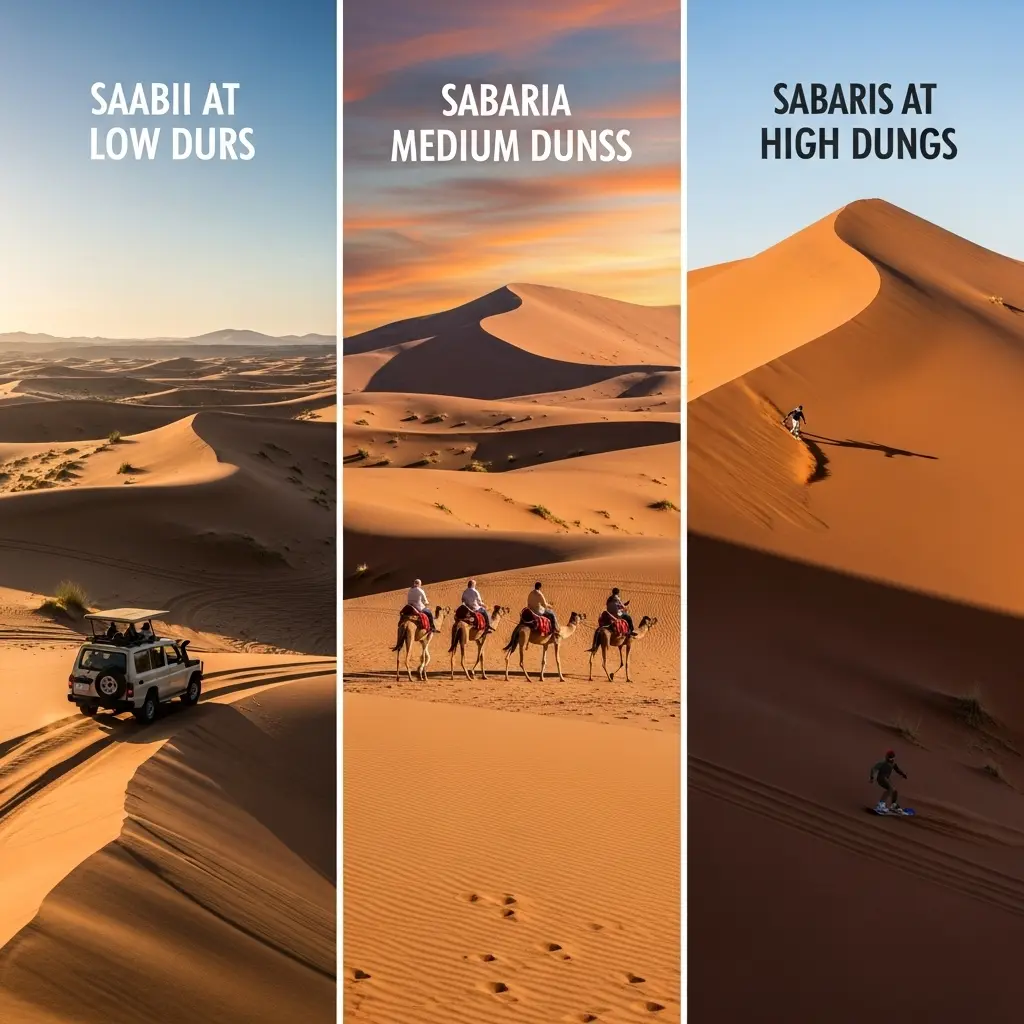
For many travelers, a Dune Heights experience starts at the 5 to 10-meter level.
These are known as “Low Dunes” or sand plains. They are most common near the city limits.
Al Aweer is a prime example of this topography. The dunes are undulating but not intimidating.
This elevation is perfect for beginners who are nervous about motion sickness.
It is also the ideal height for traditional camel trekking.
A camel does not need to struggle up a 50-meter ridge for you to enjoy the view.
Low dunes provide a vast, open horizon where you can see for miles in every direction.
They are often the best places to spot desert shrubs and the Arabian fox.
For a family with very young children, this is the safest and most comfortable elevation.
Check the family-friendly routes at https://royaldesertadventures.ae/ for these gentle slopes.
3. Medium Dune Heights: The Balanced Thrill
As you move further into the desert, the Dune Heights increase to 15-30 meters.
This is the standard height for most commercial desert safaris in Dubai.
At this elevation, the “Bashing” becomes a true rollercoaster experience.
The 4×4 vehicles have enough vertical space to perform side-slips and crest-crossings.
You feel the “stomach-drop” sensation as the car descends into the valleys.
Medium dunes offer a great balance between adrenaline and scenic beauty.
They are high enough to provide a “Golden Hour” shadow play that photographers love.
But they are low enough that the car engine does not overheat during the climb.
Most of the conservation reserves in Dubai feature this medium-level topography.
It provides enough shelter for wildlife without being a barrier to their movement.
4. The High Peaks: The Red Dunes of Al Lahbab
Now we enter the realm of the giants. In Al Lahbab, Dune Heights can reach 50 meters or more.
This is the “Big Red” territory that most adrenaline seekers dream of.
Driving at this elevation requires a “Master Class” level of skill from your marshal.
The car must maintain high momentum to conquer the steep gravity of the ridge.
When you sit on the peak of a 50-meter dune, the city of Dubai looks like a toy set.
The 360-degree views are unparalleled. You can see the Hatta mountains in the distance.
These high dunes act as natural acoustic barriers, creating pockets of absolute silence.
However, the risk of a “rollover” is higher here if the driver is inexperienced.
This is why we recommend https://htdesertsafari.com/ for high-altitude treks.
Their drivers are specifically trained for the extreme physics of the Al Lahbab peaks.
5. The Physics of the “Slip Face”
The height of a dune is defined by its “Slip Face.” This is the steep, leeward side.
In Dune Heights navigation, the slip face is the most dangerous and exciting part.
As sand grains are blown over the crest, they reach a “Slope of Repose” (usually 34 degrees).
When a 4×4 drops over the crest, it essentially slides down a waterfall of sand.
The taller the dune, the longer the slide. This is what creates the “Big Thrill.”
Expert drivers use the steering wheel to “surf” the slip face, keeping the car pointed down.
If the car turns sideways on a high slip face, gravity can pull it over.
This is why understanding elevation is a safety requirement for off-roading.
The feeling of weightlessness on a 40-meter drop is the highlight of the trip.
It is a sensory overload that stays with you for a lifetime.
6. Photography and Elevation: Chasing the Shadow
For a photographer, Dune Heights are the most important variables in the desert.
Shadows are what give the desert its texture and “rhythm.”
On a flat plain, the light has nothing to interact with. The photos look flat.
On a high dune, the sun creates “Leading Lines” of shadow that stretch for hundreds of meters.
During the Golden Hour, the valleys between high dunes turn deep purple.
The crests turn a fiery, glowing orange. This contrast is the “Holy Grail” of desert shots.
The higher you are, the earlier the shadows start to form in the valleys.
This gives you a longer “shooting window” for dramatic landscape work.
Professional content creators always ask for the “High Ridge” spots.
Operators like https://dubaidesertsafarie.com/ know exactly which peaks catch the best light.
7. Wildlife Patterns at Different Elevations
Animals are smart; they use Dune Heights to regulate their own temperature.
The Arabian Oryx often grazes in the low “Valleys” where moisture collects and plants grow.
However, during the hot afternoon, they move to the “Shade” of the high dune ridges.
Predators like the Desert Fox use high dunes as observation posts.
They sit on the crest to scan the low plains for movements of rodents or hares.
Reptiles like the “Wonder Gecko” prefer the flatter, harder sand at the base of dunes.
If you want a complete wildlife experience, your safari must cover all elevations.
Tracking footprints is much easier on the medium-slopes where the sand is less prone to avalanching.
High dunes are often “clean” of animal life because the energy required to climb is too high.
Expert naturalist guides from https://htdesertsafari.com/ will explain these vertical habits.
8. Sandboarding: High vs. Low Starts
Your sandboarding experience is directly dictated by Dune Heights.
Low Dunes (10m):
Perfect for children and beginners. The speed is controlled.
If you fall, you don’t roll for very long. It’s about balance, not speed.
High Dunes (40m+):
This is the “Black Diamond” run of the desert.
You can reach speeds of 40 km/h on a steep red dune.
The climb back up is the “Price of Admission”—it is an intense cardio workout.
Most people underestimate the effort of walking up a high dune in the heat.
For every two steps forward, the sand makes you slide one step back.
This is why we suggest starting at a medium height to test your fitness.
The view from the top of a high sandboarding ridge is half the fun.
9. The Acoustic Secret of High Ridges
There is a phenomenon called “The Singing Sands” that only happens at certain Dune Heights.
When large volumes of sand avalanche down a steep, high slip face, they vibrate.
This creates a low-frequency hum or a “booming” sound that can be heard for miles.
It usually only happens on dunes higher than 30 meters where the sand is very dry.
The height provides the weight and speed necessary to trigger the acoustic resonance.
Indigenous guides tell legends of spirits or “Jinn” making these noises.
In reality, it is a rare piece of geological music.
Hearing a dune “sing” is one of the rarest experiences in the world.
It requires a high peak and a perfectly dry, windless day.
Ask your guide at https://royaldesertadventures.ae/ if they can help you find a “singing” ridge.
10. Thermal Variation and Elevation
Temperature isn’t just about the sun; it is about the Dune Heights.
In the evening, the cold air is heavier and sinks into the valleys.
This means that a valley floor can be 5 degrees colder than a dune peak at night.
In the morning, the peak of the dune catches the sun first.
This makes the ridges the best place for a sunrise breakfast.
During the summer, the “Ridges” catch the breeze, making them much cooler.
The valleys trap the heat and become “Ovens” with no airflow.
Professional drivers always park on the crests during photo stops for this reason.
They want the guests to enjoy the “Natural AC” of the high-altitude wind.
Managing guest comfort is a matter of vertical positioning.
11. Comparison Table: Dune Level Pros and Cons
| Dune Level | Best For | Risk Factor | Visual Style |
| Low (0-10m) | Camels / Seniors | Very Low | Wide Horizons |
| Medium (10-30m) | Balance / Wildlife | Medium | Balanced Shadows |
| High (30m-60m) | Adrenaline / Pro Photos | High | Dramatic Peaks |
| Extreme (60m+) | Pro Off-Roaders Only | Very High | Epic Vistas |
12. Safety Rules for High Altitude Peaks
Reaching the maximum Dune Heights comes with a set of mandatory safety rules.
The “Crest” Rule:
Never stand on the very edge of a high dune slip face.
The sand can “Shear” or collapse, causing you to fall dozens of meters.
The “Visibility” Rule:
When driving over a high peak, you are blind to what is on the other side.
Professional convoys use “Spotters” or radios to ensure no other car is in the valley.
The “Momentum” Rule:
If the car loses power halfway up a high dune, the driver must immediately reverse.
Trying to turn around on a steep slope will result in a rollover.
Companies like https://htdesertsafari.com/ use cars with reinforced roll cages for these high routes.
They prioritize your safety so you can enjoy the view without the fear.
13. The Role of Vegetation in Elevation
Vegetation is the “Glue” that allows Dune Heights to grow.
Plants like the Fire Bush or the Ghaf tree trap blowing sand around their roots.
Over decades, this creates a “Mound” that eventually turns into a dune.
If you see a dune with lots of greenery, it is likely a “Stable” dune.
Stable dunes are easier to walk on because the sand is packed tight by the roots.
“Migrating” dunes have no plants and are much higher and softer.
Migrating dunes can move several meters a year, swallowing roads and fences.
Understanding the vertical growth of the desert helps you identify these zones.
It teaches you respect for the tiny plants that hold the mountains of sand together.
Sustainable tourism means avoiding the crushing of these stabilizing plants.
14. Customizing Your High-Peak Experience
Some travelers want to spend their whole day at the maximum Dune Heights.
This is possible through “Private VIP” packages.
You can ask for a “High Ridge” setup where a table and cushions are placed on a peak.
You enjoy your sunset snacks while looking down at the other safari convoys.
It provides a sense of detachment and superior perspective.
It is the desert equivalent of a rooftop lounge in the city.
This exclusivity is the specialty of operators like https://htdesertsafari.com/.
They have the permits to enter the high-restricted zones of the reserves.
Elevate your trip by choosing the vertical path.
15. The Psychological Impact of High Vistas
Human psychology is wired to respond to high Dune Heights.
Looking out from a peak reduces stress and increases feelings of awe.
Awe is a powerful emotion that makes our daily worries feel smaller.
The vastness of the high-dune horizon acts as a mental “Reset Button.”
Many travelers report a sense of spiritual clarity after a ridge walk.
It is the feeling of being “On top of the world” without any skyscrapers in sight.
This emotional reward is why people keep returning to the red dunes.
It is a form of natural therapy that only the high desert can provide.
Don’t just stay in the car; get out on the crest and breathe.
The silence at 50 meters up is different from the silence in the valley.
16. Summary: Choosing Your Elevation
-
Adrenaline Seeker? Choose Al Lahbab and the 40m+ peaks.
-
Photography Enthusiast? Look for the 20m+ dunes for the best shadows.
-
Family with Infants? Stick to the 10m low plains of Al Aweer.
-
Wildlife Watcher? Focus on the valleys and medium slopes of the reserves.
-
First-Timer? A balanced 15-25m elevation is the perfect start.
Every meter of height adds a new layer to your desert story.
Choose your height based on your heart rate and your camera lens.
17. Why Expertise is Vertical
Dune driving is a 3D skill. Most people only think in 2D (left and right).
A professional marshal thinks in Dune Heights.
They feel the gravity. They hear the engine strain. They know the sand “Weight.”
When you book with https://htdesertsafari.com/, you are paying for this 3D intuition.
You are paying for the safety of a driver who has climbed ten thousand peaks.
They know exactly how much throttle is needed for a 30-meter climb.
They know how to “feather” the brakes on a 40-meter descent.
Experience is measured in elevation in the desert.
Trust the masters of the vertical sand.
18. The Future of High-Altitude Desert Tourism
As technology improves, we are reaching even greater Dune Heights.
Lightweight dune buggies with massive horsepower can now climb peaks that were once impossible.
Drones allow us to capture the “Top-Down” beauty of the high ridges safely.
However, with increased access comes increased responsibility.
We must protect the “Crests” from erosion and trash.
The high dunes are the most vulnerable parts of the ecosystem.
Supporting eco-conscious companies like https://royaldesertadventures.ae/ ensures these peaks stay clean.
The future of the desert depends on our respect for its vertical beauty.
Be an ethical explorer and leave only your fading footprints on the ridges.
19. The Spiritual View from the Top
For the Bedouins, the highest Dune Heights were places of prayer.
Being closer to the sky meant being closer to the creator.
The isolation of a high ridge provided the perfect environment for reflection.
In your safari, take 5 minutes to sit alone on a high crest.
Turn off your phone. Listen to the wind. Watch the eagle soar below you.
This moment of “Ridge Mindfulness” is the true luxury of the desert.
It costs nothing but provides everything.
It is a homecoming to the primal self.
The desert at height is a temple of silence.
20. Conclusion
The Dubai desert is not a flat plane; it is a world of vertical wonder.
Understanding Dune Heights allows you to tailor your adventure to your soul.
From the gentle ripples of the plains to the fiery red mountains of Al Lahbab.
Every elevation offers a different lesson in beauty and survival.
Don’t settle for a flat experience. Seek the peaks.
Follow the ridges. Drop into the valleys. Climb the giants.
Book your high-altitude adventure today.
Visit https://htdesertsafari.com/.
See the desert from the top.
FAQs: Desert Safari Experiences at Different Dune Heights
1. Is dune bashing at high elevations safe for everyone?
Dune bashing at extreme Dune Heights (40 meters and above) is a high-intensity activity. It is generally safe for healthy individuals, but we do not recommend it for pregnant women, seniors with brittle bones, or people with chronic back and neck injuries. The G-forces and sudden drops at high altitudes put more stress on the body than low-dune drives. For those who want the view without the bumps, we recommend a “Nature Drive” or a “Ridge-Top Transfer” with https://htdesertsafari.com/.
2. Where can I find the highest sand dunes in Dubai?
The highest and most dramatic sand dunes are located in the Al Lahbab region, approximately 45 minutes from the city center. These dunes are famous for their deep red color and can reach heights of up to 50-60 meters. Another area for high dunes is the Liwa Desert in the Empty Quarter (Abu Dhabi), which features “Tel Moreeb,” one of the highest dunes in the world at over 300 meters. For a standard Dubai tour, Al Lahbab is the undisputed king of elevation.
3. Does the height of the dune affect the temperature?
Yes, but perhaps not in the way you expect. While higher altitudes in mountains mean cooler air, in the desert, the ridges are often cooler because they catch the wind. The valleys between high dunes trap the heat and have very little airflow, making them feel like a sauna. In the evening, the process reverses; the cold air sinks into the valleys, making them chillier than the ridges. Understanding these Dune Heights thermal patterns helps you stay comfortable.
4. Is it harder to walk on a high dune?
Walking on a high dune is significantly more difficult than walking on a flat surface. Because high dunes are often made of fine, loose “migrating” sand, your feet sink deeply. For every step you take up a 30-degree incline, the sand will slide back about 30%. It is an excellent cardiovascular workout but requires patience. We recommend walking along the “Ridge Line” where the wind has packed the sand tighter and the walking is much easier.
5. What is “Big Red” and why is it famous?
“Big Red” (Al Hamar) is a massive dune in the Al Badayer area near the Dubai-Hatta road. It is famous because of its extreme Dune Heights and its distinct ruby-red color. It is a popular spot for both commercial safaris and local weekend off-roaders. Because it is so steep and high, it provides a natural arena for watching expert drivers attempt vertical climbs. It is the iconic landmark for high-altitude desert fans in the UAE.
6. Can a standard 4×4 handle the highest dunes?
Not always. Conquering extreme Dune Heights requires a vehicle with high torque, specialized off-road tires, and a lifted suspension. Most commercial safari cars (like the Toyota Land Cruiser or Nissan Patrol) are modified for this purpose. However, the driver’s skill is the most important factor. A driver must know how to maintain “momentum” without losing control. This is why we recommend booking with premium operators like https://royaldesertadventures.ae/ who maintain a fleet of high-performance vehicles.
7. Why do the high dunes look redder than the low ones?
The color of the sand is determined by the presence of iron oxide (rust). The red dunes are geographically older than the pale yellow dunes near the coast. Because high dunes take centuries to accumulate, the sand has had more time to oxidize, resulting in that deep, vibrant terracotta color. When you are at a high elevation in Al Lahbab, you are literally standing on ancient rust that has been polished by the wind for thousands of years.
8. Do high dunes move?
Yes. High dunes without vegetation are called “Migrating Dunes.” Depending on the wind speed and direction (like the Shamal wind), a 30-meter dune can move several meters in a single year. They are living, shifting mountains. This is why navigation in Dune Heights is so difficult; a ridge that was a safe path last week might have shifted or become a “Razorback” (a sharp, unstable peak) by the time you return.
9. Is the view from a high dune worth the extra cost?
In our opinion, yes. While low-dune safaris are cheaper and closer to the city, they don’t offer the “Epic” feel of the high peaks. From a 50-meter ridge, you get a 360-degree panorama of the wilderness. You can see the sunset stay visible for several minutes longer than in the valleys. It provides a sense of scale and majesty that is essential for a true Arabian experience. Check the VIP high-peak packages at https://htdesertsafari.com/.
10. How do I avoid motion sickness on high dunes?
Motion sickness is caused by the “stomach-drop” sensation of descending from high Dune Heights. To minimize this: 1) Sit in the front seat next to the driver. 2) Keep your eyes on the horizon, not on your phone or camera. 3) Ask your driver for a “Soft Drive” with fewer sharp drops. 4) Avoid eating a heavy meal 2 hours before the safari. Most drivers are very accommodating and will adjust the intensity if you feel unwell.
11. Can I do sandboarding on the highest dunes?
Yes, but be prepared for a long climb back up! Sandboarding from a high peak is a thrill like no other; it feels like snowboarding but with the warmth of the sun. The steeper the elevation, the more speed you will gather. We recommend high-dune sandboarding for active adults and teenagers. For small children, we suggest staying on the 5-meter slopes where they can safely slide without gaining too much momentum.
12. Are there animals on the high dune peaks?
You will rarely see large animals like the Arabian Oryx on the very top of a high migrating dune because there is no food or water there. Most wildlife stays in the valleys (Ghaf tree areas) where the plants are. However, you might see “Sand Fish” (skinks) or beetles on the ridges. Birds of prey, like the Desert Eagle Owl, also use the high Dune Heights as vantage points for hunting. Tracking animals is much easier at the base of the dunes than on the steep slip faces.
13. What is a “Razorback” dune?
A razorback is a high dune with a very sharp, narrow crest caused by winds blowing from two different directions. It looks like a knife-edge. These are the most dangerous Dune Heights for driving because there is no room for error. If the car’s wheels straddle the ridge incorrectly, the car can get stuck (high-centered) or tip over. Only elite marshals from companies like https://htdesertsafari.com/ are permitted to drive on these complex formations.
14. What is the best camera lens for high dunes?
To capture the majesty of high Dune Heights, you need a wide-angle lens (16mm to 24mm). This allows you to include both the foreground sand ripples and the distant horizon in one shot, emphasizing the scale. However, a telephoto lens (70-200mm) is also great for “compressing” the dunes, making them look like a series of repeating waves. Always use a polarizing filter to make the sky a deep blue and remove the glare from the sand.
15. Is it safe to do a safari on high dunes in the summer?
Summer safaris on high dunes are safe as long as you stay inside the air-conditioned car. The sand temperature on a high ridge in July can reach 70°C, which can melt the glue on your shoes. We do not recommend walking or sandboarding on high dunes between 11 AM and 4 PM in the summer. Morning or late-evening safaris are the only way to enjoy the Dune Heights during the hot months.
16. Why do drivers deflate tires for high dunes?
Deflating the tires (usually to 12-15 PSI) increases the “footprint” of the tire. This allows the vehicle to “float” on top of the sand rather than digging in. This is critical for conquering high Dune Heights. If the tires were at full pressure, the car would sink immediately on a steep incline. At the end of the safari, the driver will reinflate the tires before returning to the asphalt road for safety.
17. Do high dunes affect mobile phone signals?
Sometimes. While Dubai has excellent 5G coverage, the massive “mass” of a 50-meter sand dune can act as a shield, blocking the signal from a distant tower. If you are at the bottom of a deep valley between high dunes, you might lose signal. As soon as the car reaches the “Crest,” the signal usually returns. This is why we always recommend staying with the vehicle; the car is the best place to find a signal and stay visible.
18. What is a “Bowl” in desert terminology?
A bowl is a large, circular valley surrounded by high Dune Heights. Drivers love bowls because they can drive in a continuous circle around the inner walls, using centrifugal force to stay high on the slope. For passengers, it feels like being inside a giant salad bowl. It is one of the most exciting maneuvers in a desert safari and is only possible in regions with significant elevation like Al Lahbab.
19. Are there any trees on the high dunes?
Usually, no. High migrating dunes move too fast for trees to take root. Trees like the Ghaf are found in the “Inter-dunal” spaces—the flat areas between the dunes. However, you might see “dead wood” or old roots sticking out of a high dune peak. This means that a tree was once in a valley but was swallowed by a moving dune years ago. It is a hauntingly beautiful sight that shows the power of the shifting Dune Heights.
20. Why book with HT Desert Safari for high dunes?
https://htdesertsafari.com/ is famous for its “marshal training” program. They don’t just hire drivers; they train elite desert navigators. They know the topography of the UAE like the back of their hand. They understand that every guest has a different tolerance for height and adrenaline. They can provide a “mild” tour on low dunes or a “wild” tour on the highest peaks, all while maintaining a 100% safety record. When it comes to the desert, experience is the only thing that matters.
Table: Dune Elevation and Activity Guide
| Altitude | Activity Suitability | Target Audience |
| 0 – 5m | BBQ, Henna, Relaxation | Seniors, Infants, Relaxation seekers |
| 5 – 15m | Camel Trek, Quad Bikes | Beginners, Nature photographers |
| 15 – 35m | Standard Bashing, Sandboarding | Average Tourist, Families |
| 35 – 55m | Extreme Bashing, Ridge Walk | Adrenaline junkies, Pro Content Creators |
Table: Regional Dune Characteristics
| Location | Color | Avg. Height | Texture |
| Al Aweer | Yellow/Pale | 10m | Firm / Stable |
| Al Lahbab | Deep Red | 45m | Soft / Silky |
| Sweihan | Orange | 30m | Technical / Sharp |
| Liwa | Deep Gold | 100m+ | Massive / Crushing |
This guide is your prologue to the vertical desert.
Don’t just see the sand; feel the elevation.
Experience the dunes at every level of beauty and thrill.
Book your High Peak Desert Safari now with https://htdesertsafari.com/.
Climb the silence.