
Desert Safari Driver Secrets 15 Tales From the Front Seat
You sit in the back seat.
You hold onto the roll bar.
You scream as the car tips over the edge of a massive dune.
To you, it feels like chaos.
To you, it feels like a roller coaster without rails.
But look at the person in the front seat.
Look at the Desert Safari Driver.
They are calm.
One hand is on the wheel.
The other might be adjusting the radio.
They are smiling.
This is not chaos to them.
This is their office.
The experience of a desert safari is defined by the person behind the wheel.
They are the difference between a fun trip and a nightmare.
They are the masters of the sand.
But what is it really like to drive these beasts for a living?
What secrets do they know about the dunes that you don’t?
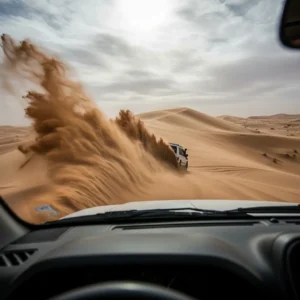
Seeing the Desert Safari From the Driver’s Seat changes your perspective entirely.
It is a world of physics, psychology, and mechanics.
In this massive guide, we are going to swap seats.
We are going to put you behind the wheel (metaphorically).
We will explore the modifications made to the cars.
We will learn the secret language of the horn.
We will discover how they handle screaming passengers and motion sickness.
We will show you why https://htdesertsafari.com/ employs only the elite of this profession.
Buckle up.
It is going to be a bumpy ride.
The Office with a View
Imagine your office changes shape every day.
Imagine your floor moves.
That is the life of a Desert Safari Driver.
The desert is never the same twice.
The wind moves the sand overnight.
A dune that was safe yesterday might be a drop-off today.
This keeps the job exciting.
It also keeps the driver alert.
Complacency is the enemy.
From the driver’s seat, the view is spectacular.
You see the golden hour light hitting the ripples.
You see the endless horizon.
But you also see the lines.
A driver does not just see “sand”.
They see “tracks”.
They see “soft patches”.
They see “hard crust”.
They are constantly reading the terrain like a book.
This visual literacy is what keeps you safe.
It is a skill that takes years to master.
The Machine: Not Your Average SUV
You might think that is just a Toyota Land Cruiser.
It looks like the one at the mall.
But underneath, it is a different beast.
A safari car is modified for war against the terrain.
First, the suspension.
It is upgraded.
Standard shocks would explode after one week of dune bashing.
They use heavy-duty shocks and springs.
This allows the car to absorb the impact of landing a jump.
Second, the cooling system.
Driving in soft sand puts immense load on the engine.
The RPM is high.
The speed is low.
This creates heat.
Drivers install larger radiators and extra fans.
Third, the roll cage.
Inside the car, you will see metal bars.
This is the roll cage.
If the car flips (which is rare but possible), the roof won’t collapse.
It protects the passengers.
Fourth, the tires.
They use specific all-terrain tires.
But the secret is not the rubber.
It is the air inside.
The Art of Deflation
Before you enter the desert, the driver stops.
They get out.
They walk around the car.
They let the air out of the tires.
Why?
On the road, tire pressure is around 35 PSI.
This makes the tire hard and efficient for tarmac.
In the sand, a hard tire cuts in.
It digs a hole.
It gets stuck.
A Desert Safari Driver drops the pressure to 12 or 15 PSI.
This makes the tire soft.
It bulges out at the bottom.
It increases the surface area.
It allows the car to “float” on top of the sand.
It is like wearing snowshoes instead of high heels.
This deflation is the most critical step of the safari.
Without it, even the most powerful car will get stuck in meters.
It changes the handling of the car.
The steering becomes heavy.
The car feels floaty.
The driver has to adjust their inputs.
Reading the Sand: The Color Code
Sand is not just yellow.
From the driver’s seat, sand has a color code.
Red sand is often iron-rich.
It can be soft or hard depending on the moisture.
White sand is usually very fine and soft.
It is treacherous.
Grey sand means it is wet or compact.
It offers good traction.
A Desert Safari Driver looks for the “clean” side of the dune.
The side where the wind hits is usually harder.
The “slip face” (the steep side) is soft.
If you drive up the slip face, you struggle.
If you drive up the windward side, you fly.
They also look for vegetation.
Plants mean there is a root system holding the sand.
But plants also create bumps.
Driving over bushes is bumpy and bad for the environment.
The driver weaves a path through these obstacles.
It is a high-speed game of chess.
Momentum is King
In the desert, speed is your friend.
But not just speed.
Momentum.
If you stop on an uphill slope, you are finished.
Gravity takes over.
The tires spin.
You dig a hole.
You are stuck.
A Desert Safari Driver knows they must keep moving.
They approach a dune with speed.
Just as they reach the top, they lift off the gas.
Gravity pulls them over the crest.
Then they accelerate down.
It is a rhythm.
Gas. Lift. Gas. Lift.
If they hesitate, they get stuck.
This is why the drive feels aggressive.
It has to be.
There is no room for hesitation in the dunes.
The Psychology of the Passenger
The driver is not just driving the car.
They are managing the people.
They look in the rearview mirror constantly.
They are reading your face.
Are you smiling?
Are you screaming in joy?
Or are you turning green?
Motion sickness is a major issue.
A good driver spots it early.
If a passenger goes quiet, they are usually feeling sick.
The driver will stop.
They will open the door.
They will offer water or lime.
They will drive smoother.
They also manage fear.
Some guests are terrified.
The driver will start slow.
They will build trust.
“See? The car is safe.”
Then they ramp up the excitement.
It is a delicate balance between thrill and comfort.
Check passenger tips at https://dubaidesertsafarie.com/.
The Language of the Horn
Safari cars rarely travel alone.
They travel in convoys.
This is for safety.
If one car breaks down, the others are there to help.
But how do they communicate?
Radio signals are used.
But the horn is faster.
One short beep might mean “I am overtaking.”
Two beeps might mean “Watch out, big drop.”
A long blast means “I am stuck, help!”
From the driver’s seat, you are constantly watching the lead car.
You follow their line.
If the lead car swerves, you swerve.
They saw a hole you didn’t see.
This trust in the convoy is essential.
You are a team.
Getting Stuck: The Badge of Honor
It happens to everyone.
Even the best Desert Safari Driver gets stuck.
We call it “bogged down”.
The car is resting on its belly.
The wheels are spinning in the air.
Tourists might panic.
Drivers laugh.
It is part of the job.
They jump out.
They grab the shovel.
They grab the tow rope.
It is a moment of camaraderie.
Other drivers swoop in.
They hook up the rope.
In 2 minutes, the car is free.
For the guest, this is often the highlight.
It feels like a real adventure.
“We got stuck in the desert!”
For the driver, it is a workout.
But they know exactly what to do.
Never spin the wheels when stuck.
It only digs you deeper.
That is rule number one.
The “Cresting” Technique
The most dangerous maneuver is “cresting”.
This is driving over the sharp peak of a dune.
You cannot see what is on the other side.
It could be a gentle slope.
It could be a 50-meter drop.
It could be another car coming up.
A skilled Desert Safari Driver approaches the crest at an angle.
They “side sweep” it.
They peek over the edge.
If it is clear, they turn down.
If it is dangerous, they turn away.
They never drive straight over a blind crest.
That is how accidents happen.
This technique is what separates the pros from the amateurs.
You will feel the car drift sideways before dropping.
That is the safety check.
Mechanical Empathy
Driving in the sand destroys cars.
The sand acts like sandpaper on moving parts.
The heat destroys rubber.
The bumps destroy suspension bushings.
A driver must have mechanical empathy.
They listen to the car.
Is that a rattle?
Is the engine sounding rough?
They check the fluids daily.
They clean the air filters daily.
You will see them blowing compressed air into the filters.
Clouds of dust come out.
If the engine can’t breathe, it loses power.
No power means getting stuck.
Maintenance is a daily ritual.
It ensures you get back home.
Trust the fleet at https://royaldesertadventures.ae/.
The Sunset Stop Strategy
The driver has a mental clock.
They know exactly when the sun sets.
They know the best dune for the view.
They race the sun.
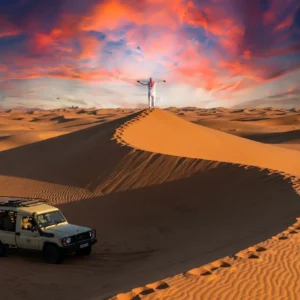
They want to park you at the highest point just as the sky turns orange.
This is for your photo.
They position the car so it looks heroic.
They offer to take your picture.
They have taken thousands of these photos.
They know the angles.
“Jump on three!”
While you enjoy the view, they check the car.
They check the tires.
They take a moment to breathe.
It is their break time too.
Night Driving: The Sixth Sense
Driving back to camp in the dark is hard.
The shadows disappear.
You lose depth perception.
The headlights flatten the terrain.
You cannot tell how deep a hole is.
A Desert Safari Driver uses memory.
They know the route.
They rely on the feel of the car more than their eyes.
They follow the GPS track.
They drive slower.
They use high-beam LED bars.
Seeing a convoy of lights snakes through the dark dunes is beautiful.
It requires intense focus.
One wrong move in the dark can damage the bumper.
The “Sweeper” Role
In a large convoy, there is a hierarchy.
The “Marshal” is in the front.
They pick the line.
The “Sweeper” is at the back.
They are usually the most experienced driver.
Their job is to make sure no one is left behind.
If a car gets stuck, the Sweeper stops to help.
If a car breaks down, the Sweeper picks up the passengers.
They carry extra tools.
They carry extra water.
They are the guardian angels of the safari.
Being a Sweeper is a position of responsibility.
It commands respect.
Dealing with the Heat
In summer, the desert is 50 degrees Celsius.
The sand is 65 degrees.
The car engine is running hot.
The AC is fighting a losing battle.
The driver has to manage the temperature.
They watch the gauge like a hawk.
If the needle climbs, they turn off the AC for a minute.
They turn the heater ON.
Yes, the heater.
This pulls heat away from the engine.
It makes the cabin hot, but it saves the engine.
They stop the car to let it cool.
They pour water on the radiator.
It is a battle against thermodynamics.
Driving in summer requires patience.
It requires knowing the limits of the machine.
The Cultural Ambassador
The driver is often the only local (or long-term resident) the tourist speaks to.
They are an ambassador.
Guests ask questions.
“Do you live in a tent?”
“How many camels do you have?”
The driver answers with patience.
They explain the culture.
They explain the history of the UAE.
They play Arabic music to set the mood.
They teach you how to say “Shukran” (Thank you).
This human connection is vital.
It turns a car ride into a cultural exchange.
Many tourists stay friends with their drivers for years.
They send Christmas cards.
They come back and ask for the same driver.
This is the true reward of the job.
Why HT Desert Safari Drivers are Elite
We don’t just hire anyone with a license.
We hire enthusiasts.
We hire people who love the desert.
Our drivers go through rigorous training.
They learn advanced recovery techniques.
They learn first aid.
They learn customer service.
We maintain our fleet to the highest standard.
When you book with https://htdesertsafari.com/, you are getting a captain.
Someone who takes charge.
Someone who ensures your safety while giving you the thrill of a lifetime.
We treat our drivers well, so they treat you well.
Conclusion
Being a Desert Safari Driver is not just a job.
It is a lifestyle.
It is a daily battle with the elements.
It is a daily performance for the guests.
From the driver’s seat, the desert is not just scenery.
It is a puzzle to be solved.
It is a playground to be mastered.
Next time you are in the car, watch the driver.
Watch their hands.
Watch their eyes.
You will see the skill.
You will see the passion.
And you will realize that the ride is only possible because of them.
So, when the ride is over, say thank you.
Shake their hand.
They have just brought you safely through one of the harshest environments on earth.
And they did it with a smile.
Book your ride with the masters.
Visit https://htdesertsafari.com/ to meet your pilot.
Explore the desert at https://royaldesertadventures.ae/ and https://dubaidesertsafarie.com/.
The car is waiting.
The engine is running.
Let’s go.
Driver’s Cockpit Checklist
| Item | Purpose | Importance |
| Tire Gauge | Checking PSI | Critical |
| GPS | Navigation | Critical |
| Radio | Convoy Comms | High |
| Water | Hydration | High |
| Tow Rope | Recovery | Critical |
| Shovel | Digging out | High |
| First Aid Kit | Safety | Critical |
| Music Playlist | Vibe setting | Medium |
20 FAQs with Long Answers
1. Do I need a special license to be a Desert Safari Driver?
Yes, absolutely. A standard UAE driving license is not enough. You must obtain a special Safari Driver License issued by the RTA (Roads and Transport Authority) and DTCM (Department of Tourism and Commerce Marketing). This involves passing a rigorous desert driving course, a theory test, and a practical exam in the dunes. The license must be renewed annually, ensuring drivers are fit and up-to-date with safety protocols.
2. What kind of cars are used for desert safaris?
The most common vehicles are the Toyota Land Cruiser and the Nissan Patrol. These are chosen for their legendary reliability, powerful engines (V6 or V8), and robust chassis. They are modified with roll cages, upgraded suspension, and safety equipment. You might also see Jeep Wranglers or Ford Raptors, but the Land Cruiser is the king of the desert fleet due to its durability.
3. Why do drivers deflate the tires?
Deflating tires increases the surface area of the tire in contact with the sand. This distributes the vehicle’s weight over a larger area, preventing it from sinking. It allows the car to “float” on top of the soft sand. Without deflation (usually down to 12-15 PSI), the tires would cut through the sand like a knife, and the car would get stuck immediately.
4. Is dune bashing dangerous?
Dune bashing is an extreme sport, so there is inherent risk, but with a professional Desert Safari Driver, it is statistically very safe. The cars are equipped with roll cages and seat belts. The drivers are trained to manage the risks. Accidents are rare and usually minor. The most common “injury” is motion sickness. However, pregnant women and people with back problems are advised not to participate.
5. How fast do the cars go in the desert?
It feels very fast, but the actual speed is often quite low, usually between 20 km/h and 50 km/h. The sensation of speed comes from the high RPM of the engine, the sliding motion of the car, and the steep angles. On flat salt flats, they might go faster, but in the technical dunes, it is about momentum and torque, not top speed.
6. What happens if the car flips over?
Rollovers are extremely rare in commercial safaris because drivers are trained to avoid side-slopes that are too steep. However, if it happens, the internal roll cage prevents the roof from collapsing. Passengers are buckled in. The convoy stops, and the guides extract the passengers. The cars are equipped with fire extinguishers and first aid kits.
7. Do drivers get lost in the desert?
Professional drivers rarely get lost. They know the area intimately. They use visual landmarks like specific dunes, Ghaf trees, or distant pylons. They also carry GPS units as a backup. Since they travel in convoys, if one driver is unsure, they follow the lead car. In the deep open desert, navigation is a serious skill, but tourist routes are well-known to them.
8. Why do drivers rev the engine so much?
Sand provides a lot of resistance. To keep the wheels turning and the car moving, the engine needs to produce high torque. This often means keeping the car in a lower gear and maintaining high RPM (Revolutions Per Minute). The sound of the roaring engine is the sound of the car fighting the friction of the sand.
9. Can I drive the car myself?
On a standard safari, no. Insurance regulations strictly prohibit guests from driving the registered safari vehicles. However, you can book a “Self-Drive” experience where you follow a guide in a specialized buggy or a rental jeep designated for off-road use. This is a different package and usually costs more.
10. How do drivers communicate with each other?
They use two-way radios (walkie-talkies) to chat, warn about obstacles, or coordinate stops. They also use the car horn for immediate signaling (e.g., stopping a convoy). And interestingly, they use hand signals out of the window if they are close enough. The camaraderie between drivers is high; they are constantly talking and joking.
11. What is the hardest part of being a safari driver?
The hardest part is often the physical toll. Bouncing around in a car for 4-6 hours a day can cause back pain. Also, maintaining focus in the blinding glare of the midday sun is exhausting. Dealing with car maintenance in the summer heat (changing a tire at 45°C) is physically grueling. It is a demanding job.
12. Do the cars have air conditioning?
Yes, all safari cars have powerful air conditioning. However, during extreme dune bashing, the driver might turn it off briefly to give the engine more power or to prevent overheating. But generally, the cabin is kept cool and comfortable for the guests.
13. How much tip should I give the driver?
Tipping is not mandatory but is customary and highly appreciated. If you felt the driver was safe, friendly, and skilled, a tip of 20 to 50 AED per person is standard. If they went above and beyond (taking photos, helping with kids), you can give more. It makes a big difference to their income.
14. What do drivers do when guests are at the camp?
While you are eating and watching the shows, the drivers are usually resting, praying, eating their own dinner, or preparing the car for the return journey. They reinflate the tires using an air compressor. They clean the sand out of the car. It is their downtime before the drive back to the city.
15. Why are there roll bars inside the car?
The roll bars (roll cage) are a mandatory safety requirement by the Dubai tourism authorities. They reinforce the structure of the vehicle cabin. In the unlikely event of a rollover, they prevent the roof from crushing the passengers. They are padded to prevent head injuries during bumps.
16. Can a safari driver refuse a passenger?
Yes. If a passenger is visibly intoxicated, aggressive, or refuses to wear a seatbelt, the driver has the right to refuse them for safety reasons. They are the captain of the ship. Safety protocols are non-negotiable.
17. How often are the cars serviced?
Safari cars undergo much more frequent servicing than road cars. They might get an oil change every few weeks. Suspension and tires are checked daily. The harsh environment degrades parts quickly, so rigorous maintenance is essential to prevent breakdowns in the middle of the desert.
18. Do drivers use manual or automatic cars?
Most modern safari cars are automatic (Tiptronic). Automatic transmissions are smoother in the sand and allow the driver to keep both hands on the wheel. They can manually select gears to hold high RPM when needed. Some old-school drivers prefer manual, but automatic is the industry standard now.
19. What if I feel sick during the drive?
Tell the driver immediately! Do not wait. The driver will stop the car on a flat spot. Getting out and breathing fresh air usually helps. The driver can also adjust their driving style to be gentler. They carry water and sickness bags just in case. They are used to it and will not be annoyed.
20. Why book with HT Desert Safari?
Booking with https://htdesertsafari.com/ ensures you are driven by the best. Our drivers are veterans with years of experience. We do not compromise on vehicle safety or maintenance. We ensure our drivers are well-rested and happy, because a happy driver means a happy guest. We offer the authentic Desert Safari From the Driver’s Seat experience with professionals you can trust.