Special Needs Desert Safari: A Complete Guide to Inclusive Adventures
Dubai is a city of superlatives. It has the tallest building and the largest mall.
But it also strives to be the most accessible city. The government calls people with disabilities “People of Determination”.
This shows a commitment to respect and inclusion. This commitment extends to the desert.
A Special Needs Desert Safari is not just a possibility. It is a fantastic reality.
Many families with disabled members skip the desert. They fear the sand.
They worry about the lack of facilities. They worry about medical emergencies.
These fears are understandable. The desert is a harsh environment.
However, with the right planning, it is accessible.
The tourism industry has adapted. Operators now offer specialized services.
There are vehicles with ramps. There are camps with paved paths.
There are staff trained to assist.
This guide is your comprehensive manual. We will cover every disability type.
We will look at mobility, sensory, and cognitive needs.
We will discuss logistics, safety, and equipment.
You do not have to leave anyone behind at the hotel.
Everyone deserves to see the golden dunes. Everyone deserves to feel the wind.
Let’s explore how to make this happen safely.
Why Accessible Tourism Matters in Dubai
Dubai takes accessibility seriously. It is part of the national vision.
Airports and malls are fully equipped. The desert is catching up fast.
A Special Needs Desert Safari is part of this vision.
Tour operators know that families travel together.
If one member cannot go, the whole family stays back.
So, they have created inclusive packages.
This allows multigenerational travel.
It allows children with autism to experience nature.
It allows grandparents in wheelchairs to see the sunset.
Inclusion enriches the experience for everyone.
It teaches us patience and perspective.
It slows down the pace of the tour. This is often a good thing.
It focuses on connection rather than just adrenaline.
We will guide you to the right providers.
We will help you ask the right questions.
Your dream trip is within reach.
Challenges of the Desert Terrain
We must be realistic. Sand is the enemy of wheels.
Standard wheelchairs sink in the sand immediately.
The ground is uneven. It is shifting and soft.
This makes mobility a primary challenge for a Special Needs Desert Safari.
The heat is another factor. Some conditions worsen with heat.
Multiple Sclerosis, for example, can flare up.
Dehydration happens faster.
The distance from the city is a concern.
You are about 45 minutes from a hospital.
Bathroom facilities are often basic.
Standard camp toilets are small. They may not fit a wheelchair.
Lighting can be dim at night. This affects those with low vision.
Noise levels can be high. This affects those with sensory processing issues.
Knowing these challenges is the first step.
Once we know the problems, we can find the solutions.
And believe us, there are solutions for all of them.
Mobility Impairments and Wheelchair Access
For guests who cannot walk, the vehicle is key.
You cannot climb into a high Land Cruiser.
You need a vehicle with easier access.
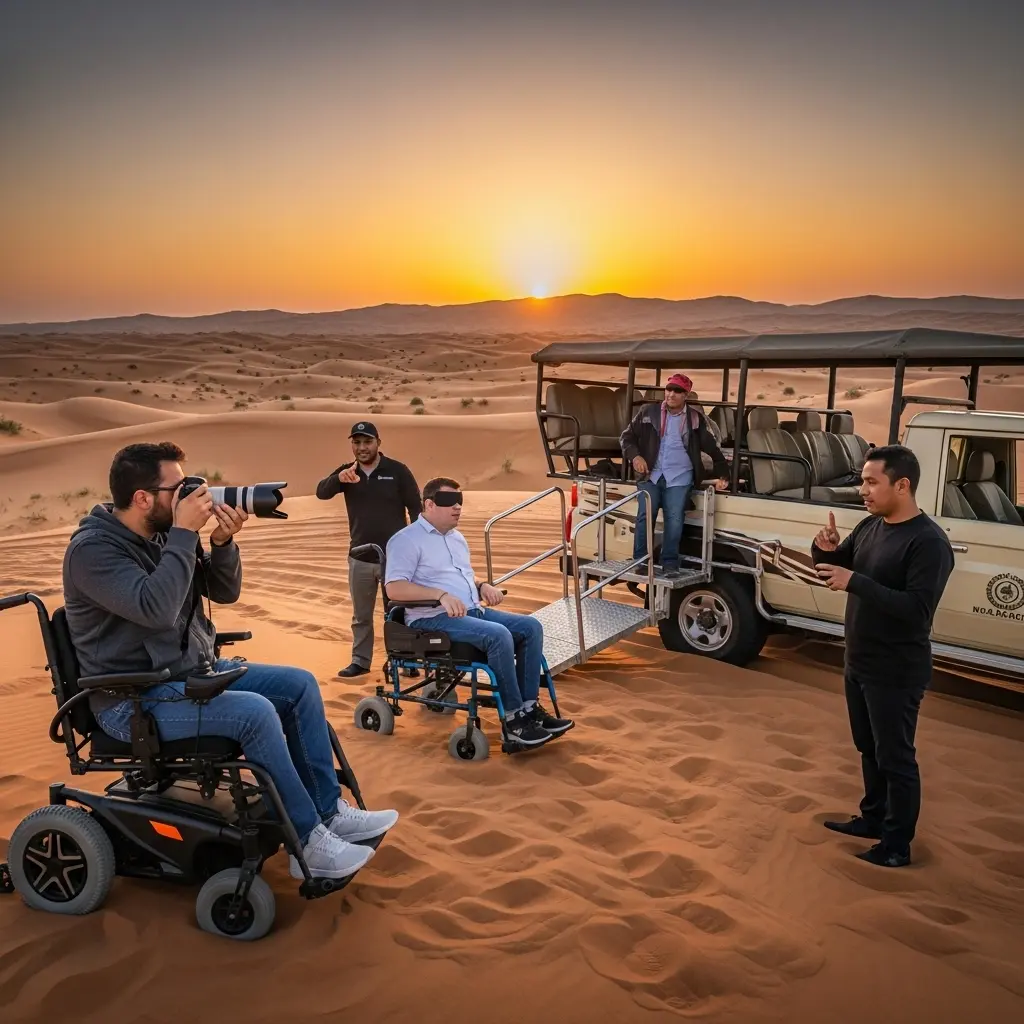
Some operators offer modified vans. They have hydraulic lifts.
Or they have ramps for wheelchairs.
For a Special Needs Desert Safari, a private transfer is mandatory.
Do not book a shared bus. It will not wait for you.
Once at the camp, you need a plan.
Ask for a camp with paved walkways.
Some camps place carpets over the sand. This helps a little.
But hard surfaces are better.
There are “beach wheelchairs” available for rent in Dubai.
These have huge balloon tires. They float on the sand.
You can rent one and bring it with you.
This changes everything. You can go deep into the dunes.
Without it, you are stuck at the entrance.
Ask the operator if they can provide assistance.
You need strong staff to push standard chairs on carpets.
Visual Impairments and the Sensory Experience
Blind or low-vision travelers experience the world differently.
The desert is a sensory masterpiece.
It is not just about seeing the view.
It is about feeling the temperature change.
It is about touching the fine grains of sand.
A Special Needs Desert Safari can be tailored for touch and sound.
The sound of the wind is distinct. The silence is profound.
The smell of the campfire is nostalgic.
The taste of the Arabic coffee is strong.
Guides should be descriptive. They should paint a picture with words.
“The dune rises to your left, high and steep.”
“The sand here is cool because it is in the shadow.”
Safety is crucial here. The ground is uneven.
Uneven ground is a trip hazard.
Guides must offer an arm for support.
They must warn of steps or drops.
In the camp, describe the layout clearly.
“The bathroom is at 3 o’clock. The stage is at 12 o’clock.”
This helps build a mental map.
Hearing Impairments and Communication
For deaf travelers, communication is the hurdle.
Drivers often talk while facing forward.
Lip reading is impossible from the back seat.
For a Special Needs Desert Safari, seating matters.
The guest should sit where they can see the guide’s face.
Or use a sign language interpreter if available.
Some specialized tour guides know basic sign language.
But mostly, you will rely on visual cues.
Agree on signals for “Stop”, “Go”, and “Danger”.
Written information is helpful.
Ask for the itinerary in writing.
Printed schedules help manage expectations.
At the show, the music is loud.
Deaf guests can feel the bass vibrations.
Sit them near the speakers if they enjoy the vibration.
Or sit them where they have a clear view of the visual performance.
The fire show is purely visual. It is highly enjoyable.
Ensure the lighting is good for communication at dinner.
Bring a small flashlight for signing in the dark.
Cognitive Disabilities and Autism
Travelers with autism or cognitive delays need predictability.
New environments can be overwhelming.
The desert has new smells, sounds, and textures.
A Special Needs Desert Safari requires preparation.
Show them photos of the desert beforehand.
Show them videos of the car ride.
Create a “Social Story” about the trip.
“First we get in the car. Then we drive. Then we see camels.”
This reduces anxiety.
Sensory overload is a risk at the camp.
The music can be very loud. The lights can be flashing.
Bring noise-canceling headphones.
Bring sunglasses to block visual stimuli.
Request a quiet seating area.
A private tent is ideal for a calming break.
If a meltdown occurs, you need a safe space.
Do not force participation. Let them observe.
Patience is the most important tool.
Selecting the Right Vehicle
Standard 4x4s are high off the ground.
They require a big step to get in.
They have grab handles, but you need upper body strength.
For a Special Needs Desert Safari, ask about the car step.
Some cars have automated side steps. They lower when the door opens.
This lowers the step height significantly.
If the guest can transfer from a wheelchair, this helps.
If they cannot transfer, you need a specialized van.
However, vans cannot go dune bashing.
They must stick to flat tracks.
This is often safer anyway.
Dune bashing is violent. It requires core strength.
If a passenger has low muscle tone, they cannot brace themselves.
This leads to injury.
Always choose a “Nature Drive” or “Flat Drive”.
It is smooth. It prevents motion sickness.
It allows for a relaxed journey.
Check options at https://royaldesertadventures.ae/.
They have experience with diverse fleets.
Dune Bashing: To Do or Not To Do?
For most special needs travelers, we say no.
Skip the dune bashing.
It is risky for anyone with neck or back issues.
It is risky for those with loose joints.
It is risky for those with processing disorders.
The sudden drops can cause panic.
A Special Needs Desert Safari should be gentle.
The goal is to enjoy the environment.
Not to simulate a washing machine.
Go directly to the camp.
Or take the wildlife route.
You will see oryx and gazelles.
This is calm and educational.
It allows you to stop whenever you want.
If you must try the dunes, go very slow.
Tell the driver “Baby Steps”.
They will drive gently over small mounds.
Stop immediately if it is not fun.
Assessing Camp Facilities
Not all camps are equal.
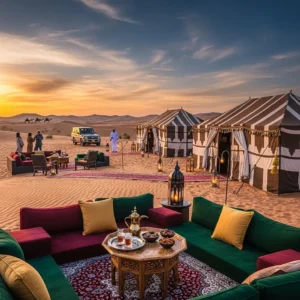
Some are rustic. Some are luxury.
Luxury camps are better for a Special Needs Desert Safari.
They have better flooring.
They have actual toilets, not just holes in the ground.
They have dedicated staff.
Ask specifically about the bathroom.
Is there a disabled toilet?
Does it have grab bars? Is the door wide enough?
If not, how will you manage?
You might need to bring a portable commode chair.
Or you might need to limit fluid intake (carefully).
Check the dining seating.
Low cushions are impossible for many.
You need a table and chair.
Ensure this is reserved for you.
You do not want to fight for a chair upon arrival.
Visit https://dubaidesertsafarie.com/ to find accessible camps.
Food Allergies and Feeding Tubes
Dietary needs are common with medical conditions.
Gluten-free, casein-free, or nut-free diets.
The buffet is a mix of foods. Cross-contamination happens.
For a Special Needs Desert Safari, bring your own food.
It is the only way to be 100% sure.
Pack a cooler bag.
If the guest uses a feeding tube (PEG), you need hygiene.
The desert is dusty.
You need a clean place to administer the feed.
A private tent or the air-conditioned car is best.
Bring plenty of water for flushing the tube.
Bring hand sanitizer and wipes.
Explain to the staff that you are bringing medical food.
They will understand.
Do not rely on the camp kitchen for medical diets.
Medical Safety and Heat Management
Thermoregulation can be an issue.
Some people do not sweat properly.
Others overheat very quickly.
The desert heat is intense, even in the afternoon.
Bring cooling towels. Bring battery fans.
Keep the AC running in the car.
Limit time outside to 10-minute intervals.
Hydration is life support.
Bring electrolyte drinks, not just water.
Know the signs of heatstroke.
Confusion, hot skin, rapid pulse.
If this happens, cool them down instantly.
Leave the desert.
For a Special Needs Desert Safari, carry a medical kit.
Include all daily meds plus emergency meds.
Epipens, seizure rescue meds, inhalers.
Have a list of current medications on paper.
In English and Arabic if possible.
The Role of a Private Carer
If the family wants to relax, hire help.
You can bring a private nurse or carer.
They can manage the wheelchair transfers.
They can handle the toileting.
They can watch the person while you ride a camel.
It allows you to be a family member, not just a caregiver.
Many agencies in Dubai offer travel companions.
Or you can bring your own helper.
Just ensure you book a seat for them.
In a Special Needs Desert Safari, an extra set of hands is valuable.
They can run to the buffet. They can hold the umbrella.
It reduces the physical strain on the parents.
Bathroom Accessibility in the Dunes
This is the most unglamorous part.
But it is the most asked question.
“Where do we go to the bathroom?”
On the drive, there are no toilets.
You must go before you leave the city.
There is usually a stop at a gas station before the desert.
Use the disabled toilet there. It is usually clean.
Once in the dunes, you are in nature.
If an emergency happens, you need privacy.
Bring a “she-wee” or portable urinal bottle.
Bring a large towel for a screen.
At the camp, accessibility varies.
We mentioned grab bars earlier.
But also check the floor wetness.
Camp toilets can get wet and slippery.
Wear non-slip shoes.
Bring your own toilet paper and wipes.
Be prepared for less than perfect conditions.
Booking Tips for Special Needs
Communication is everything.
Do not book online without talking to a human.
Call the operator. Send a detailed email.
List the disability. List the equipment.
“We have a 14-year-old with cerebral palsy in a manual wheelchair.”
“We need a car with a low step.”
“We need a table near the bathroom.”
Ask for photos of the camp.
Ask for photos of the toilet.
A reputable Special Needs Desert Safari provider will be transparent.
If they hesitate, do not book.
If they say “No problem” too quickly, be suspicious.
Make them explain how they will handle it.
Get everything in writing.
Why Royal Desert Adventures is Inclusive
We recommend Royal Desert Adventures because they listen.
They have experience with diverse families.
They have drivers who are patient and kind.
They offer private vehicles which are essential.
They can arrange special seating at the camp.
They do not rush you.
They understand that loading a wheelchair takes time.
They respect the dignity of every guest.
You can discuss your specific needs at https://royaldesertadventures.ae/.
They customize the tour to fit the ability.
They make the impossible possible.
Insurance and Liability
Check your travel insurance.
Does it cover pre-existing conditions?
Does it cover off-road travel?
You need a policy that is comprehensive.
The tour operator has liability insurance.
But it might have exclusions for certain medical conditions.
Read the fine print.
Carry your insurance card with you.
In a Special Needs Desert Safari, paperwork matters.
If you need an ambulance, insurance speeds things up.
It ensures you get the best hospital care.
Preparing the Guest
Involve the person in the planning.
Ask them what they are afraid of.
Ask them what they are excited about.
Give them agency.
Let them choose the playlist for the car.
Let them choose the snacks.
Pack a “comfort bag” for them.
Fidget spinners, favorite blanket, iPad.
A Special Needs Desert Safari should be fun, not an ordeal.
If they are happy, the trip is a success.
Manage energy levels.
Rest the day before. Rest the morning of the trip.
Start the safari well-rested.
Service Animals in Dubai
A note on guide dogs.
Dogs are generally considered unclean in Islamic culture.
They are rarely allowed in public spaces or vehicles.
Service dogs are an exception legally.
But practically, it is difficult.
The sand is hot for their paws.
Camels might react aggressively to dogs.
It is often better to leave the service animal at the hotel.
Use a human guide instead for the day.
If you must bring the dog, clear it with the operator weeks in advance.
You need paperwork for the dog too.
For a Special Needs Desert Safari, human assistance is usually smoother.
Respect and Dignity
You might worry about staring.
Dubai is a multicultural city.
People are generally polite.
However, curiosity exists.
If people stare, it is usually not malicious.
Smile back.
The staff at the camps are hospitable.
They want to help.
Let them help.
Allow them to pour the coffee.
Allow them to assist with the chair.
It is their way of showing respect.
A Special Needs Desert Safari is a cultural exchange.
It breaks down barriers.
Conclusion
The desert is vast and open.
It represents freedom.
No disability should prevent you from feeling that freedom.
With a private car, a good plan, and the right attitude, it is easy.
You can watch the sunset. You can feel the sand.
You can make memories that last a lifetime.
Do not let fear stop you.
Use the resources available.
Book with trusted partners.
Take the leap.
The desert is waiting for you.
20 FAQs About Special Needs Desert Safari (Detailed Answers)
1. Is the desert safari suitable for wheelchair users?
Yes, a Special Needs Desert Safari is suitable for wheelchair users, provided you book the right package. You must book a private vehicle, as shared buses are not accessible. While standard wheelchairs cannot move on soft sand, you can enjoy the drive and the views from the car. At the camp, accessibility depends on the facility. Some camps have paved paths, while others place heavy carpets over the sand to aid movement. For the best experience, inquire about renting a specialized “beach wheelchair” with balloon tires from a third-party mobility shop in Dubai before your trip.
2. Can we bring a folding wheelchair in the car?
Yes, almost all 4×4 SUVs (Land Cruisers, Patrols) have ample trunk space to store a folding manual wheelchair. If you have a large powered wheelchair, you need to inform the operator in advance. A standard SUV might not fit a heavy power chair. In that case, you might need to book a specialized accessible van for the transfer to the desert, though these vans cannot go dune bashing. Communicating the dimensions of your equipment is crucial for a smooth pickup.
3. Are there accessible toilets at the desert camp?
This varies greatly by camp. Basic camps often have small toilet cubicles that are not wheelchair accessible. However, premium and luxury camps often have a designated disabled toilet with a wider door and sometimes grab bars. It is vital to ask for photos of the bathroom facilities before you book. Even with accessible toilets, the path to reach them might be sandy. Always bring your own hygiene supplies and be prepared for facilities that are functional but not hospital-grade.
4. Can children with autism enjoy the safari?
Absolutely. Many children with autism love the sensory experience of the sand and the rhythmic motion of the car. However, the loud music and fire show at the camp can be overwhelming. To ensure a successful Special Needs Desert Safari, bring noise-canceling headphones and sunglasses. Request a private car so you can control the environment (music, temperature) during the drive. If the camp becomes too much, you can retreat to the quiet car or a private tent. A “Nature Drive” is often better than aggressive dune bashing for sensitive children.
5. Is dune bashing safe for people with Down Syndrome?
Dune bashing involves high-speed maneuvers and G-forces. For individuals with Down Syndrome, there is a higher risk of Atlantoaxial Instability (instability of the neck vertebrae). Violent jerks could cause serious injury. Therefore, it is strongly recommended to skip the dune bashing and opt for a flat/nature drive. Always consult a doctor before the trip. A gentle drive allows them to see the dunes without the risk of neck injury. Safety must always come first.
6. Do the drivers have training for special needs guests?
Standard safari drivers are trained in first aid and driving skills, but they are not specifically trained as disability carers. However, drivers from reputable companies like https://royaldesertadventures.ae/ are experienced in hospitality and are generally very patient and helpful. They can assist with loading wheelchairs and offer a steady arm for support. If you require medical assistance or lifting, you should bring your own carer or family member who is trained to handle the specific needs of the guest.
7. Can we skip the dune bashing and go straight to camp?
Yes, this is the most common request for a Special Needs Desert Safari. You can book a “Dinner Only” or “Direct to Camp” package. A private car will pick you up from your hotel and drive you directly to the campsite entrance using flat tracks or roads. This avoids all the rough terrain. You arrive fresh and relaxed, ready to enjoy the sunset, food, and entertainment. This is the safest option for anyone with mobility or medical concerns.
8. How do we manage dietary restrictions for guests?
The camp buffet serves a variety of foods, but cross-contamination is possible. If a guest has severe allergies (e.g., nuts, gluten) or requires a specific texture (pureed food), it is safer to bring your own food. Operators allow this for medical reasons. Pack a cooler bag with safe meals. If the guest uses a feeding tube, the private car or a VIP tent provides a clean, private space to administer the feed away from the blowing sand and public view.
9. Is the fire show safe for people with epilepsy?
The fire show involves spinning flames, and sometimes strobe lights are used on the stage. For photosensitive epilepsy, this could potentially trigger a seizure. It is best to sit further back from the stage to reduce the intensity of the visual stimulation. You can also alert the staff; sometimes they can advise you when the flashing lights will start so you can look away or cover your eyes. Wearing dark sunglasses can also help mitigate the risk during the performance.
10. Can we get a discount for a companion/carer?
Some operators might offer a discount for a necessary carer, but this is not standard practice in Dubai’s tourism industry. Generally, every seat in the car must be paid for. However, if you are booking a private vehicle (which pays for the car, not the person), you can fill the seats however you like. This is often more cost-effective for a group including a carer than buying individual tickets. Check https://htdesertsafari.com/ for private car rates.
11. What happens in a medical emergency?
In a Special Needs Desert Safari, preparedness is key. Drivers have direct communication with their base and emergency services. Ambulances can reach the desert meeting points. However, response times are longer than in the city. If a guest has a high-risk condition, you must carry all rescue medications (e.g., seizure meds, oxygen if portable/allowed). It is advisable to stay closer to the desert entrance rather than driving deep into the remote dunes to ensure a quicker exit if needed.
12. Can visually impaired guests ride camels?
Yes, visually impaired guests can enjoy camel rides. It is a tactile experience. The camel handler should be informed so they can guide the guest’s hands to the saddle handle. Assistance is needed for mounting and dismounting, as the motion is jerky. A companion should stand by to describe the surroundings. It is often safer for a visually impaired person to ride with a sighted companion on the same camel (if weight limits allow) or just sit on a kneeling camel for a photo.
13. Is the desert sand hot?
Yes, in the afternoon, the sand can be scorching hot. For a guest with neuropathy (loss of sensation in feet, common in diabetes or spinal injuries), this is dangerous. They might burn their feet without feeling it. Always ensure guests wear closed shoes. Do not let them walk barefoot. If a wheelchair user is transferred to a carpet, check the temperature of the carpet first. Burns can happen quickly and ruin the holiday.
14. Are there private areas for privacy?
Yes, you can upgrade to a VIP package or a private tent. This is highly recommended for Special Needs Desert Safari groups. A private tent gives you a secluded space to rest, administer medication, or change clothes away from the public eye. It also provides a noise break for those with sensory processing issues. The extra cost provides dignity and comfort, which is invaluable.
15. How do we handle the heat for MS patients?
Multiple Sclerosis (MS) symptoms often worsen with heat. To manage this, book a winter safari (November to March). If traveling in warmer months, book a late afternoon trip to minimize sun exposure. Keep the car air conditioning running and let the guest stay inside until sunset. Bring cooling vests or ice packs. Hydrate aggressively with cold water. If the guest starts to feel weak or dizzy, move them to the cool car immediately.
16. Is there a priority queue for special needs?
There is no official “Fast Pass” line at desert camps, but staff are usually very accommodating. If you arrive in a private car, you can be dropped closer to the entrance. You can ask the staff to help you bypass the buffet line or bring food to your table (this is standard in VIP service). Booking a VIP table ensures you don’t have to wait in line, which is essential for those who cannot stand for long periods.
17. Can we bring an oxygen concentrator?
Portable oxygen concentrators (POCs) are generally allowed if they are battery-operated. You must inform the operator in advance. The sand is dusty, so keep the device in a protective bag when outside the car. Ensure you have enough battery life for the duration of the trip (6 hours), as there are no charging points in the desert sand. Carrying a backup battery is mandatory for safety.
18. Why is a private vehicle better than a shared one?
A private vehicle gives you control. You control the pickup time. You control the AC temperature. You control the volume of the music. You can stop whenever the guest needs a break. In a shared car, you are at the mercy of other tourists’ schedules and preferences. For a Special Needs Desert Safari, the flexibility of a private car prevents stress and allows you to adapt the itinerary to the guest’s energy levels in real-time.
19. What should we pack for the trip?
Pack a “Go-Bag” specifically for the special needs guest. Include: emergency medical information card, extra medication, water bottle, cooling towel, noise-canceling headphones, sunglasses, wet wipes, hand sanitizer, and a change of clothes. If mobility is an issue, bring a transfer belt. Having these items handy ensures you can handle minor issues without panic.
20. Why choose Royal Desert Adventures for special needs?
We recommend https://royaldesertadventures.ae/ because they have a proven track record of empathy and flexibility. They own their fleet, meaning they can guarantee the type of car you get. Their booking agents take the time to understand your specific requirements. They don’t offer a “cookie-cutter” solution; they adapt the tour for you. Their commitment to safety and customer service makes them the most reliable choice for families needing extra care.